Review
. 2020 Sep;57(3):678-696.
doi: 10.3892/ijo.2020.5099. Epub 2020 Jul 10.

Anticancer peptide: Physicochemical property, functional aspect and trend in clinical application (Review)

Affiliations
Review

Anticancer peptide: Physicochemical property, functional aspect and trend in clinical application (Review)

Wararat Chiangjong et al. Int J Oncol. 2020 Sep.

Abstract

Cancer is currently ineffectively treated using therapeutic drugs, and is also able to resist drug action, resulting in increased side effects following drug treatment. A novel therapeutic strategy against cancer cells is the use of anticancer peptides (ACPs). The physicochemical properties, amino acid composition and the addition of chemical groups on the ACP sequence influences their conformation, net charge and orientation of the secondary structure, leading to an effect on targeting specificity and ACP‑cell interaction, as well as peptide penetrating capability, stability and efficacy. ACPs have been developed from both naturally occurring and modified peptides by substituting neutral or anionic amino acid residues with cationic amino acid residues, or by adding a chemical group. The modified peptides lead to an increase in the effectiveness of cancer therapy. Due to this effectiveness, ACPs have recently been improved to form drugs and vaccines, which have sequentially been evaluated in various phases of clinical trials. The development of the ACPs remains focused on generating newly modified ACPs for clinical application in order to decrease the incidence of new cancer cases and decrease the mortality rate. The present review could further facilitate the design of ACPs and increase efficacious ACP therapy in the near future.

Keywords: therapeutic peptide; anticancer peptide; modified peptide; targeting peptide; clinical application; clinical trial.


Figures
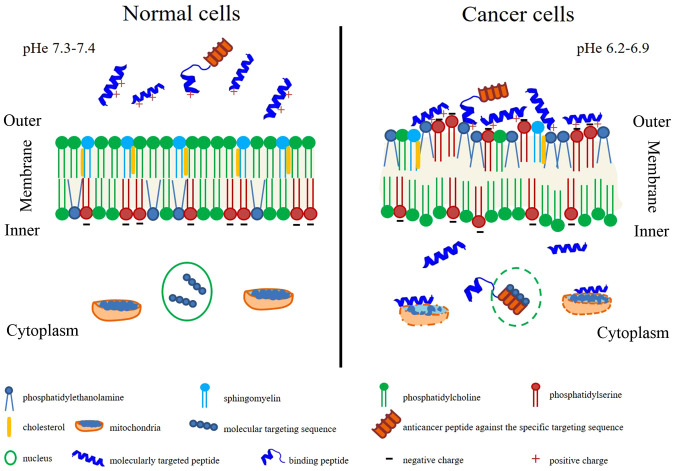
Figure 1
Figure 1
Comparisons of membrane characteristics and anticancer peptides action on healthy cells (left) and cancer cells (right). The outer leaflet of the healthy cell membrane presents a neutral net charge leading to non-interaction of anticancer peptides on the healthy cell surface (left), whereas negative net charge on the outer leaflet of the cancer cell membrane could interact with the cationic anticancer peptides (right). In cancer cells, anticancer peptides, particularly in the α-helical form, act as molecularly targeted peptides that can penetrate and directly bind to the specific cancer cell or organelle membranes promoting cancer cell apoptosis. While, binding peptides linking to the anticancer drugs that have no anticancer property, can recognize and penetrate the cancer cell membrane. pHe, extracellular pH.
Figure 2
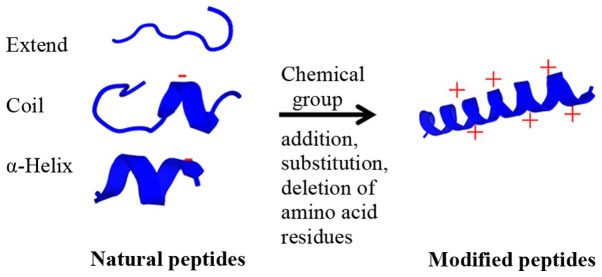
Figure 2
Modification of natural peptides. The natural peptide conformations included the extended, the coiled and/or the α-helical forms with neutral, anionic or cationic properties. These natural peptides are modified by adding the chemical groups (such as acyl and methyl groups) or the positive amino acid residues (such as lysine and arginine) to increase positive net charge and specificity for cancer cell targets. Moreover, the addition, deletion or substitution of the amino acid residues changes the conformation from the extended or coiled peptides to the α-helix form for higher cancer cell penetration. After modification, the cationic α-helix modified peptide exhibits higher efficacy and specificity to the cancer cells.
Figure 3
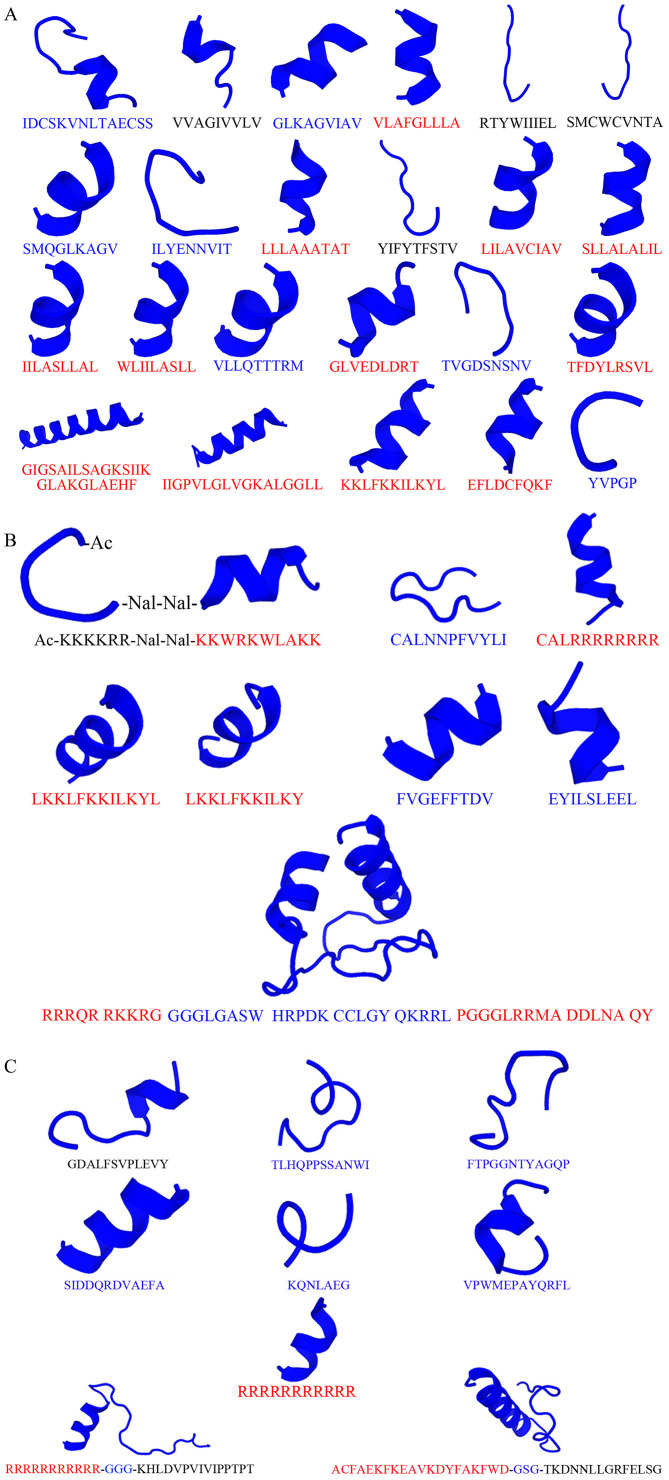
Figure 3
Conformation of anticancer peptides predicted using PEP-FOLD 3.5 (https://mobyle.rpbs.univ-paris-diderot.fr/cgi-bin/portal.py#forms::PEP-FOLD3). (A) Natural, (B) modified and (C) targeting peptides corresponding to Tables II-IV, respectively, performed in three conformations including extend (black alphabet amino acid sequences), coiled (blue alphabet amino acid sequences) and α-helix (red alphabet amino acid sequences).
Figure 4
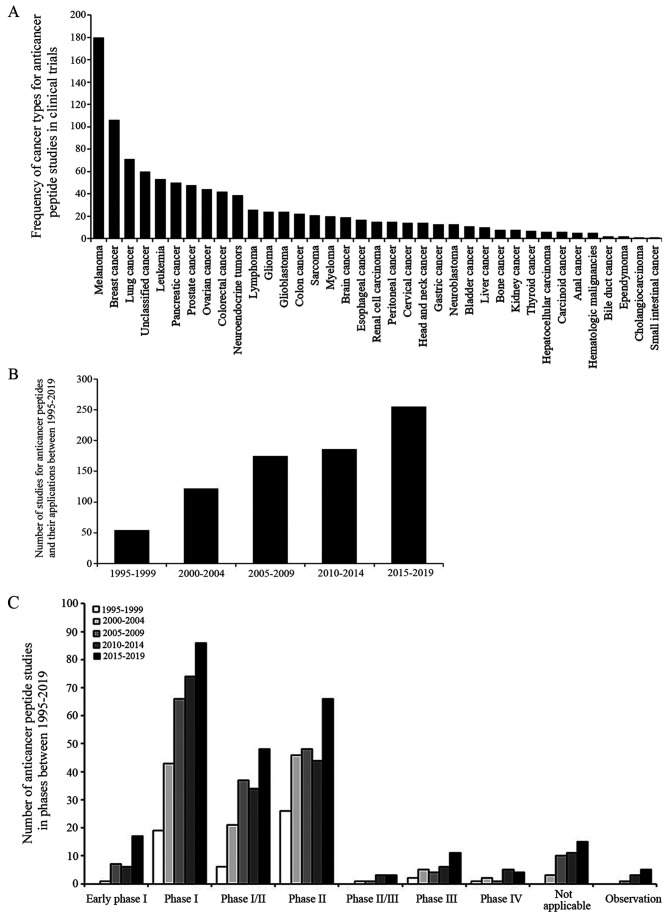
Figure 4
Number of ACP studies for the drug and biological intervention. (A) Frequency of cancer types from 792 ACP studies, which were submitted on the ClinicalTrials.gov website, including 36 cancer types and unclassified cancer types. The unclassified cancer types were reported as solid tumors, cancer or neoplasms. (B) Number of ACP studies in every 5-year period between 1995-2019 was continuously increased. (C) Furthermore, from 1995-2019, >98% of these ACP studies were an intervention study type, including clinical trial in early phase I, phase I, I/II, II, II/III, III, IV and not applicable, while <2% of them were an observation study type, which cannot assign a specific intervention or treatment. Source:www.clinicaltrials.gov search on Feb 4, 2020 with drug, biological and peptide key words in cancer. ACP, anticancer peptide.

References

    1. Wang SH, Yu J. Structure-based design for binding peptides in anti-cancer therapy. Biomaterials. 2018;156:1–15. doi: 10.1016/j.biomaterials.2017.11.024. - DOI - PubMed
    1. Wang X, Zhang L, Ding N, Yang X, Zhang J, He J, Li Z, Sun LQ. Identification and characterization of DNAzymes targeting DNA methyltransferase I for suppressing bladder cancer proliferation. Biochem Biophys Res Commun. 2015;461:329–333. doi: 10.1016/j.bbrc.2015.04.033. - DOI - PubMed
    1. Ingram JR, Blomberg OS, Rashidian M, Ali L, Garforth S, Fedorov E, Fedorov AA, Bonanno JB, Le Gall C, Crowley S, et al. Anti-CTLA-4 therapy requires an Fc domain for efficacy. Proc Natl Acad Sci USA. 2018;115:3912–3917. doi: 10.1073/pnas.1801524115. - DOI - PMC - PubMed
    1. Di JX, Zhang HY. C188-9 a small-molecule STAT3 inhibitor, exerts an antitumor effect on head and neck squamous cell carcinoma. Anticancer Drugs. 2019;30:846–853. doi: 10.1097/CAD.0000000000000783. - DOI - PubMed
    1. Brun S, Bassissi F, Serdjebi C, Novello M, Tracz J, Autelitano F, Guillemot M, Fabre P, Courcambeck J, Ansaldi C, et al. GNS561, a new lysosomotropic small molecule, for the treatment of intrahe-patic cholangiocarcinoma. Invest New Drugs. 2019;37:1135–1145. doi: 10.1007/s10637-019-00741-3. - DOI - PubMed

MeSH terms