. 2020 Aug;6(8):mgen000405.
doi: 10.1099/mgen.0.000405. Epub 2020 Jul 24.

Whole-genome analyses reveal gene content differences between nontypeable Haemophilus influenzae isolates from chronic obstructive pulmonary disease compared to other clinical phenotypes

Affiliations

Whole-genome analyses reveal gene content differences between nontypeable Haemophilus influenzae isolates from chronic obstructive pulmonary disease compared to other clinical phenotypes

Rajendra Kc et al. Microb Genom. 2020 Aug.

Erratum in

Abstract

Nontypeable Haemophilus influenzae (NTHi) colonizes human upper respiratory airways and plays a key role in the course and pathogenesis of acute exacerbations of chronic obstructive pulmonary disease (COPD). Currently, it is not possible to distinguish COPD isolates of NTHi from other clinical isolates of NTHi using conventional genotyping methods. Here, we analysed the core and accessory genome of 568 NTHi isolates, including 40 newly sequenced isolates, to look for genetic distinctions between NTHi isolates from COPD with respect to other illnesses, including otitis media, meningitis and pneumonia. Phylogenies based on polymorphic sites in the core-genome did not show discrimination between NTHi strains collected from different clinical phenotypes. However, pan-genome-wide association studies identified 79 unique NTHi accessory genes that were significantly associated with COPD. Furthermore, many of the COPD-related NTHi genes have known or predicted roles in virulence, transmembrane transport of metal ions and nutrients, cellular respiration and maintenance of redox homeostasis. This indicates that specific genes may be required by NTHi for its survival or virulence in the COPD lung. These results advance our understanding of the pathogenesis of NTHi infection in COPD lungs.

Keywords: chronic obstructive pulmonary disease; nontypeable Haemophilus influenzae; pan-genome-wide association studies; whole-genome sequencing.


Conflict of interest statement

The authors declare that there are no conflicts of interest.

Figures
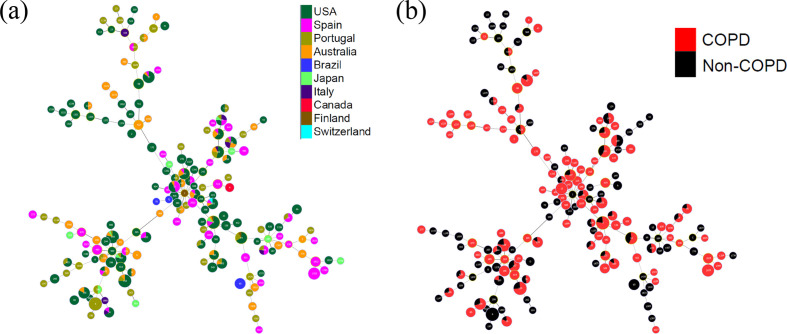
Fig. 1.
Fig. 1.
MST overview of 568 NTHi isolates based on MLST, i.e. allelic profiles of seven housekeeping genes present in the PubMLST database. This was generated using the goeBurst full MST algorithm and was visualized with Phyloviz 2. Each node is a ST, and it is coloured according to the (a) geographical and (b) clinical sources of the isolates. The size of each node is proportional to the number of isolates. The larger STs containing more than 10 NTHi isolates are labelled in-text. There was no absolute separation of the strains according to geography. (a) Based on the MLST profiling, strains from the same STs were common to a wide range of geographical locations. (b) COPD-associated isolates were scattered over the MST indicating a weak or no association between MLST genotype and COPD. Of 174 unique STs in our collection, COPD isolates were found in 70 STs.
Fig. 2.
Fig. 2.
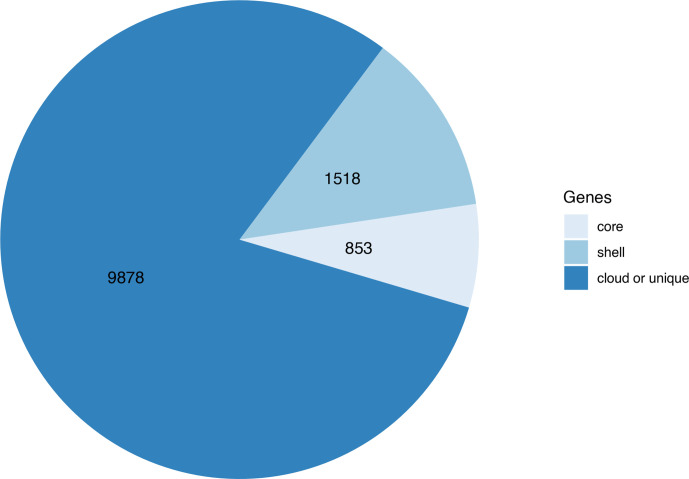
Distribution of genes present in the pan-genome of the NTHi collection (n=568), which was constructed using Roary version 3.12. Of 12 249 pan genes, the NTHi core-genome comprised 853 genes (present in at least 539 NTHi isolates). The remaining 11 396 genes of the accessory genome were further classified into the shell (n=1518 genes, present in less than 539 and at least 85 NTHi isolates) and cloud or unique (n=9878 genes, present in less than 85 NTHi isolates). On average, 47 % of each NTHi strain’s gene set belonged to the core pan-genome. The remaining 53 % of the strain’s gene set belonged to the larger accessory pan-genome. This accessory pan-genome encompassing a large repertoire of genes confers diversity and high levels of plasticity to the NTHi genome.
Fig. 3.
Fig. 3.
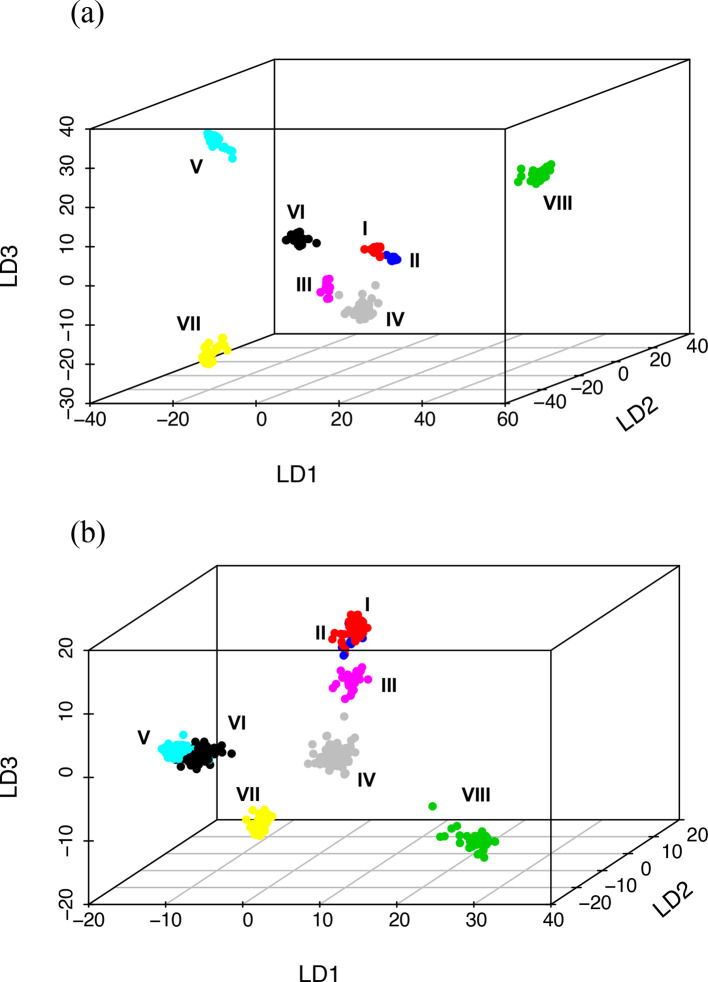
(a) 3D scatterplot of the cgSNP-based DAPC of NTHi isolates (n=568). DAPC resolved the NTHi isolates into eight clusters (clades). Clades I and II were closely related to each other, whereas all other clusters were distinctly separated. (b) The accessory-genes-based DAPC correlated with the cgSNP-based DAPC with a distinct separation of clades III, IV, VIII and VIII, and a close relationship between clades I and II. The only discrepancy was with the isolates of clades V and VI, which were clearly separated on cgSNPs DAPC, whereas they overlapped on the accessory-gene-content DAPC. Each dot is an isolate, coloured according to the classification into one of the eight clusters/clades as assigned by the cgSNP-based DAPC.
Fig. 4.
Fig. 4.
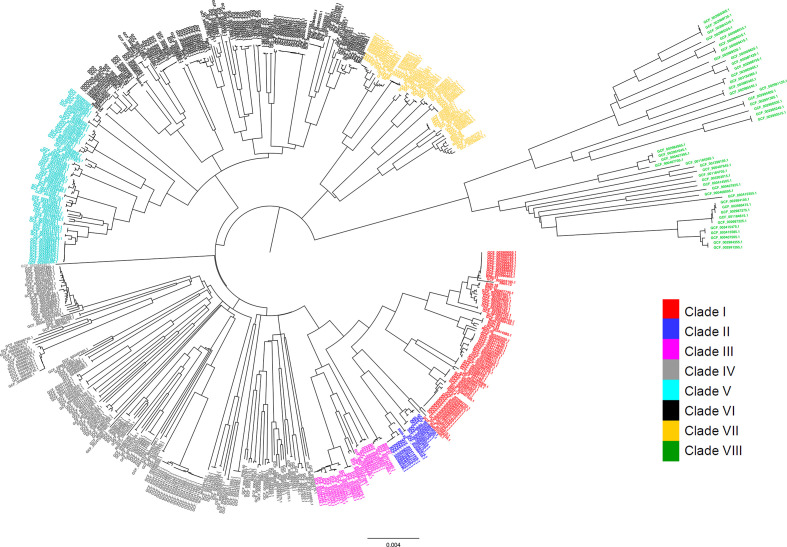
Neighbour-joining phylogenetic tree of 568 NTHi isolates, based on the cgSNPs. The evolutionary distances were computed using the maximum composite likelihood method. There was a total of 664 470 positions in the final dataset. Distinct sub-structuring of the NTHi population was evident with the cgSNP-based phylogeny. The phylogenetic analysis perfectly correlated with the DAPC-based classification that identified eight monophyletic clades. The close association between clades I and II, and between clades V and VI, as observed in accessory-genome-based DAPC, is consistent with the evolutionary relationship between them observed in the core-gene-sequence-based phylogeny obtained using the neighbour-joining maximum composite likelihood method. The tip labels are coloured according to the clades assigned by the cgSNP-based DAPC. Bar, number of base substitutions per site.
Fig. 5.
Fig. 5.
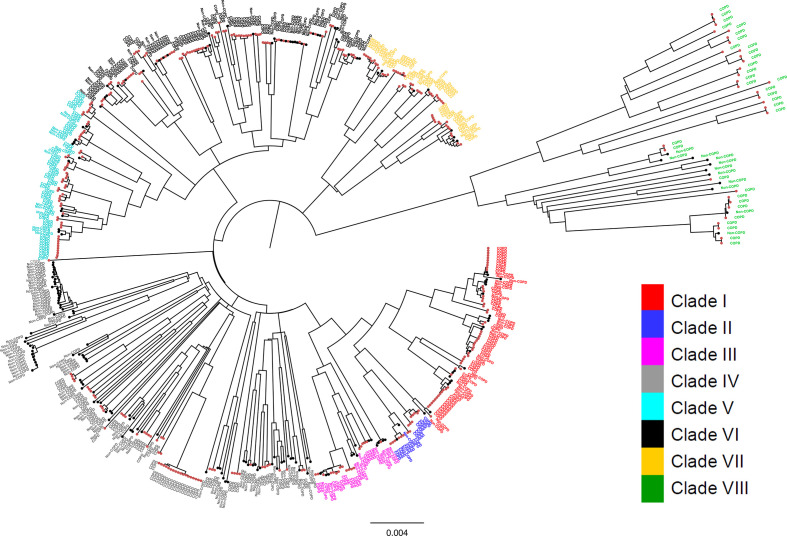
Distribution of 568 NTHi isolates over the cgSNP-based neighbour-joining phylogenetic tree, which is annotated with the clinical source of isolation of the samples as COPD or non-COPD. Each evolutionary clade includes both COPD and non-COPD strains. Branch tips representing COPD strains are highlighted in red, whilst those representing non-COPD strains are shown in black. The tip labels are coloured according to the clades (I to VIII) as assigned by the cgSNP-based DAPC. Bar, number of base substitutions per site.
Fig. 6.
Fig. 6.
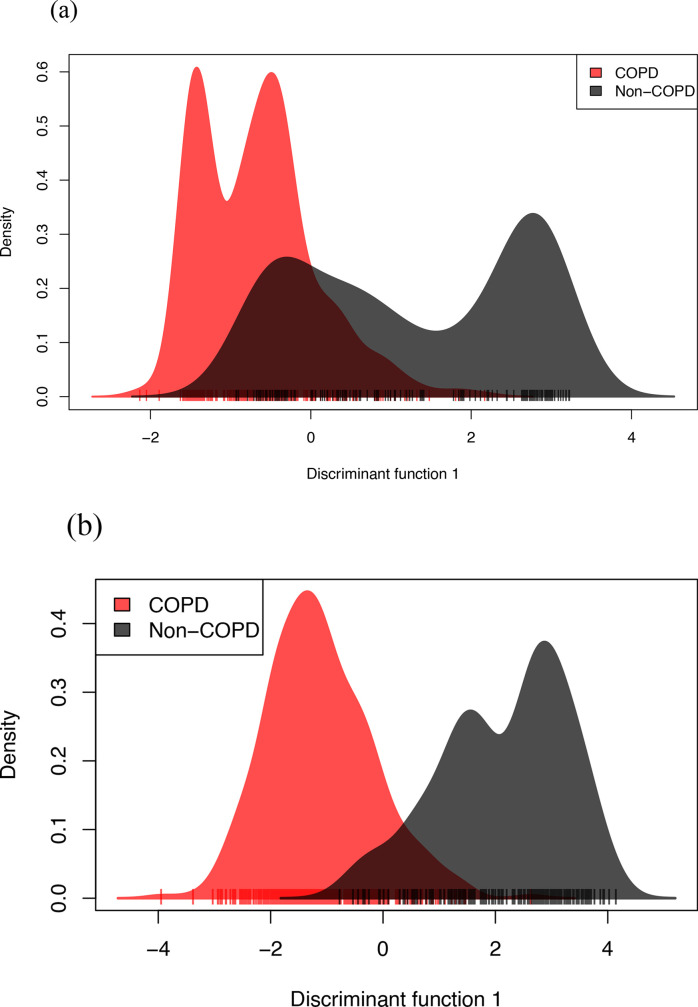
DAPC of 568 NTHi genomes from COPD and other disease isolates. (a) The first discriminant function of the retained PCs based on cgSNPs leaves substantial overlap between COPD and non-COPD strains, 356 NTHi isolates (231 COPD and 125 non-COPD strains) were in the overlapping region. (b) DAPC on the presence/absence profile of accessory genes clearly provides a higher level of separation of COPD from non-COPD strains with 226 NTHi isolates (119 COPD and 107 non-COPD strains) in the overlapping region. Composition of accessory genes, but not the distribution of polymorphic sites in the core-genome, discriminates COPD strains from other clinical phenotype strains of NTHi. Each line is an isolate. COPD and non-COPD isolates are coloured in red and black, respectively.

References

    1. Agrawal A, Murphy TF. Haemophilus influenzae infections in the H. influenzae type B conjugate vaccine era. J Clin Microbiol. 2011;49:3728–3732. doi: 10.1128/JCM.05476-11. - DOI - PMC - PubMed
    1. Moghaddam SJ, Ochoa CE, Sethi S, Dickey BF. Nontypeable Haemophilus influenzae in chronic obstructive pulmonary disease and lung cancer. Int J Chron Obstruct Pulmon Dis. 2011;6:113–123. doi: 10.2147/COPD.S15417. - DOI - PMC - PubMed
    1. Murphy TF, Brauer AL, Schiffmacher AT, Sethi S. Persistent colonization by Haemophilus influenzae in chronic obstructive pulmonary disease. Am J Respir Crit Care Med. 2004;170:266–272. doi: 10.1164/rccm.200403-354OC. - DOI - PubMed
    1. Sriram KB, Cox AJ, Clancy RL, Slack MPE, Cripps AW. Nontypeable Haemophilus influenzae and chronic obstructive pulmonary disease: a review for clinicians. Crit Rev Microbiol. 2018;44:125–142. doi: 10.1080/1040841X.2017.1329274. - DOI - PubMed
    1. Wong SMS, Akerley BJ. Genome-scale approaches to identify genes essential for Haemophilus influenzae pathogenesis. Front Cell Infect Microbiol. 2012;2:23. doi: 10.3389/fcimb.2012.00023. - DOI - PMC - PubMed

Publication types

MeSH terms