


An Integrative Model for the Effectiveness of Biofeedback Interventions for Anxiety Regulation: Viewpoint
- PMID: 32706654
- PMCID: PMC7413290
- DOI: 10.2196/14958
An Integrative Model for the Effectiveness of Biofeedback Interventions for Anxiety Regulation: Viewpoint
Abstract
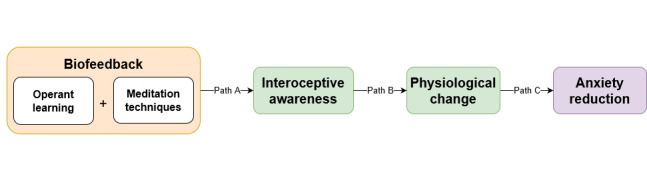
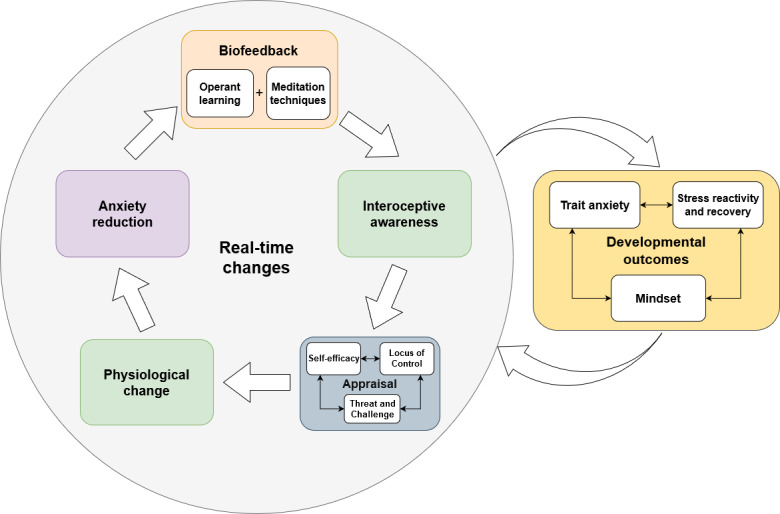
Biofeedback has shown to be a promising tool for the treatment of anxiety; however, several theoretical as well as practical limitations have prevented widespread adaptation until now. With current technological advances and the increasing interest in the use of self-monitoring technology to improve mental health, we argue that this is an ideal time to launch a new wave of biofeedback training. In this viewpoint paper, we reflect on the current state of biofeedback training, including the more traditional techniques and mechanisms that have been thought to explain the effectiveness of biofeedback such as the integration of operant learning and meditation techniques, and the changes in interoceptive awareness and physiology. Subsequently, we propose an integrative model that includes a set of cognitive appraisals as potential determinants of adaptive trajectories within biofeedback training such as growth mindset, self-efficacy, locus of control, and threat-challenge appraisals. Finally, we present a set of detailed guidelines based on the integration of our model with the mechanics and mechanisms offered by emerging interactive technology to encourage a new phase of research and implementation using biofeedback. There is a great deal of promise for future biofeedback interventions that harness the power of wearables and video games, and that adopt a user-centered approach to help people regulate their anxiety in a way that feels engaging, personal, and meaningful.
Keywords: anxiety; appraisal; biofeedback; eHealth; mechanisms; mental health; mobile phone; neurofeedback; review; video games; wearable technology.
©Joanneke Weerdmeester, Marieke MJW van Rooij, Rutger CME Engels, Isabela Granic. Originally published in the Journal of Medical Internet Research (http://www.jmir.org), 23.07.2020.
Conflict of interest statement
Conflicts of Interest: None declared.
Figures

References
-
- Lupton D. The Quantified Self: A Sociology of Self-Tracking. Malden, Massachusets: Polity Press; 2016.
-
- Barick U, Gowda A, Mohanty R, Dutt A, Somanath M, Mittal S, Patil A. Harnessing real world data from wearables and self-monitoring devices: feasibility, confounders. MEFANET J. 2016;4(1):44–9. https://mj.mefanet.cz/mj-20160330
-
- Evenson KR, Goto MM, Furberg RD. Systematic review of the validity and reliability of consumer-wearable activity trackers. Int J Behav Nutr Phys Act. 2015 Dec 18;12:159. doi: 10.1186/s12966-015-0314-1. https://ijbnpa.biomedcentral.com/articles/10.1186/s12966-015-0314-1 10.1186/s12966-015-0314-1 - DOI - DOI - PMC - PubMed
-
- Free C, Phillips G, Watson L, Galli L, Felix L, Edwards P, Patel V, Haines A. The effectiveness of mobile-health technologies to improve health care service delivery processes: a systematic review and meta-analysis. PLoS Med. 2013;10(1):e1001363. doi: 10.1371/journal.pmed.1001363. http://dx.plos.org/10.1371/journal.pmed.1001363 PMEDICINE-D-12-00641 - DOI - DOI - PMC - PubMed
-
- Kim KJ, Shin D. An acceptance model for smart watches. Internet Res. 2015 Aug 3;25(4):527–41. doi: 10.1108/IntR-05-2014-0126. https://www.emerald.com/insight/content/doi/10.1108/IntR-05-2014-0126/fu... - DOI - DOI
