


Making waves: Wastewater surveillance of SARS-CoV-2 for population-based health management
- PMID: 32707307
- PMCID: PMC7357518
- DOI: 10.1016/j.watres.2020.116181
Making waves: Wastewater surveillance of SARS-CoV-2 for population-based health management
Abstract
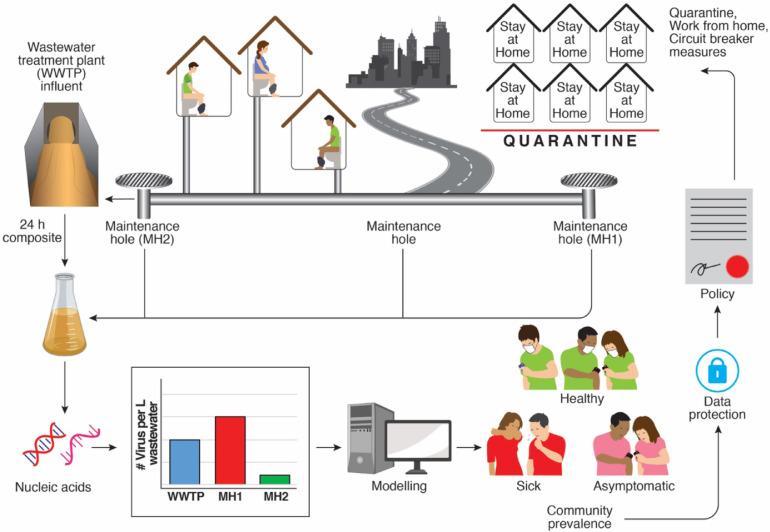
Worldwide, clinical data remain the gold standard for disease surveillance and tracking. However, such data are limited due to factors such as reporting bias and inability to track asymptomatic disease carriers. Disease agents are excreted in the urine and feces of infected individuals regardless of disease symptom severity. Wastewater surveillance - that is, monitoring disease via human effluent - represents a valuable complement to clinical approaches. Because wastewater is relatively inexpensive and easy to collect and can be monitored at different levels of population aggregation as needed, wastewater surveillance can offer a real-time, cost-effective view of a community's health that is independent of biases associated with case-reporting. For SARS-CoV-2 and other disease-causing agents we envision an aggregate wastewater-monitoring system at the level of a wastewater treatment plant and exploratory or confirmatory monitoring of the sewerage system at the neighborhood scale to identify or confirm clusters of infection or assess impact of control measures where transmission has been established. Implementation will require constructing a framework with collaborating government agencies, public or private utilities, and civil society organizations for appropriate use of data collected from wastewater, identification of an appropriate scale of sample collection and aggregation to balance privacy concerns and risk of stigmatization with public health preservation, and consideration of the social implications of wastewater surveillance.
Keywords: Data privacy; Fecal-oral transmission; Health management; SARS-CoV-2; Wastewater surveillance.
Copyright © 2020. Published by Elsevier Ltd.
Conflict of interest statement
Declaration of Competing Interest Eric Alm is scientific advisor and shareholder of BioBot Analytics. The other authors declare no conflict of interest.
Figures
References
-
- Ahmed W., Angel N., Edson J., Bibby K., Bivins A., O'Brien J.W., Choi P.M., Kitajima M., Simpson S.L., Li J. First confirmed detection of SARS-CoV-2 in untreated wastewater in Australia: a proof of concept for the wastewater surveillance of COVID-19 in the community. Sci. Total Environ. 2020 doi: 10.1016/j.scitotenv.2020.138764. - DOI - PMC - PubMed
-
- Ahmed W., Bertsch P.M., Bivins A., Bibby K., Farkas K., Gathercole A., Haramoto E., Gyawali P., Korajkic A., McMinn B.R., Mueller J.F., Simpson S.L., Smith W.J.M., Symonds E.M., Thomas K.V., Verhagen R., Kitajima M. Comparison of virus concentration methods for the RT-qPCR-based recovery of murine hepatitis virus, a surrogate for SARS-CoV-2 from untreated wastewater. Sci. Total Environ. 2020;739 doi: 10.1016/j.scitotenv.2020.139960. - DOI - PMC - PubMed
-
- Bivins A., North D., Ahmad A., Ahmed W., Alm E., Been F., Bhattacharya P., Bijlsma L., Boehm A.B., Brown J., Buttiglieri G., Calabro V., Carducci A., Castiglioni S., Cetecioglu Gurol Z., Chakraborty S., Costa F., Curcio S., de los Reyes F.L., Delgado Vela J., Farkas K., Fernandez-Casi X., Gerba C., Gerrity D., Girones R., Gonzalez R., Haramoto E., Harris A., Holden P.A., Islam M.T., Jones D.L., Kasprzyk-Hordern B., Kitajima M., Kotlarz N., Kumar M., Kuroda K., La Rosa G., Malpei F., Mautus M., McLellan S.L., Medema G., Meschke J.S., Mueller J., Newton R.J., Nilsson D., Noble R.T., van Nuijs A., Peccia J., Perkins T.A., Pickering A.J., Rose J., Sanchez G., Smith A., Stadler L., Stauber C., Thomas K., van der Voorn T., Wigginton K., Zhu K., Bibby K. Wastewater-based epidemiology: global collaborative to maximize contributions in the fight against COVID-19. Environ. Sci. Technol. 2020 doi: 10.1021/acs.est.0c02388. - DOI - PubMed
MeSH terms
Substances
LinkOut - more resources
Full Text Sources
Miscellaneous
