Review
. 2020 Jul 19;9(7):589.
doi: 10.3390/pathogens9070589.

West Nile Virus: An Update on Pathobiology, Epidemiology, Diagnostics, Control and "One Health" Implications

Affiliations
Review

West Nile Virus: An Update on Pathobiology, Epidemiology, Diagnostics, Control and "One Health" Implications

Gervais Habarugira et al. Pathogens. .

Abstract

West Nile virus (WNV) is an important zoonotic flavivirus responsible for mild fever to severe, lethal neuroinvasive disease in humans, horses, birds, and other wildlife species. Since its discovery, WNV has caused multiple human and animal disease outbreaks in all continents, except Antarctica. Infections are associated with economic losses, mainly due to the cost of treatment of infected patients, control programmes, and loss of animals and animal products. The pathogenesis of WNV has been extensively investigated in natural hosts as well as in several animal models, including rodents, lagomorphs, birds, and reptiles. However, most of the proposed pathogenesis hypotheses remain contentious, and much remains to be elucidated. At the same time, the unavailability of specific antiviral treatment or effective and safe vaccines contribute to the perpetuation of the disease and regular occurrence of outbreaks in both endemic and non-endemic areas. Moreover, globalisation and climate change are also important drivers of the emergence and re-emergence of the virus and disease. Here, we give an update of the pathobiology, epidemiology, diagnostics, control, and "One Health" implications of WNV infection and disease.

Keywords: West Nile virus; control; one health; pathogenesis.


Conflict of interest statement

All authors declare no conflict of interest. The funders had no role in the design of the study; in the collection, analyses, or interpretation of data; in the writing of the manuscript, or in the decision to publish this review article.

Figures

Figure 1
Figure 1
The structure of WNV virion (A) and 11 kb long viral genome represented with one ORF encoding 3 structural and 7 non-structural proteins (B) Source: adapted from De Filette et al. [74].
Figure 2
Figure 2
WNV lifecycle and transmission. (a) WNV maintenance between birds (reservoir) and competent mosquito vector, (b) WNV transmission via direct between birds in commercial farm setting, (c) WNV transmission to various hosts (human, horse and crocodile) via mosquito bite, (d) WNV transmission via blood transfusion and organ transplant in human, (e) WNV infection in crocodile through WNV contaminated water.
Figure 3
Figure 3
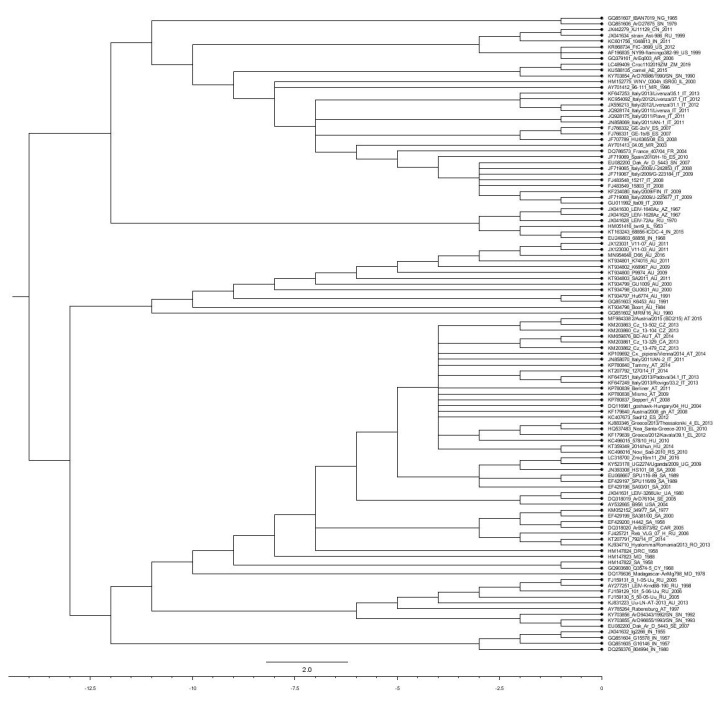
Maximum-likelihood phylogenetic tree of estimating the relationships of selected West Nile virus isolates. The tree was constructed with MEGA-X software version 10.1.8. The optimal tree was obtained using Maximum likelihood method, Nearest Neighbour Interchange (NNI) inference method. The phylogeny was tested with bootstrap replicates method (N = 1000). The evolutionally distances were calculated with the general time reversible (GTR) model, uniform rates. The tree was edited with FigTree v1.4.3 software (http://tree.bio.ed.ac.uk/software/figtree/). The scale represents at the bottom represent divergence time in millions of years ago (MYA). Each sequence used was labelled by GenBank accession number_isolate/strain name_country of isolation_year of isolation.
Figure 4
Figure 4
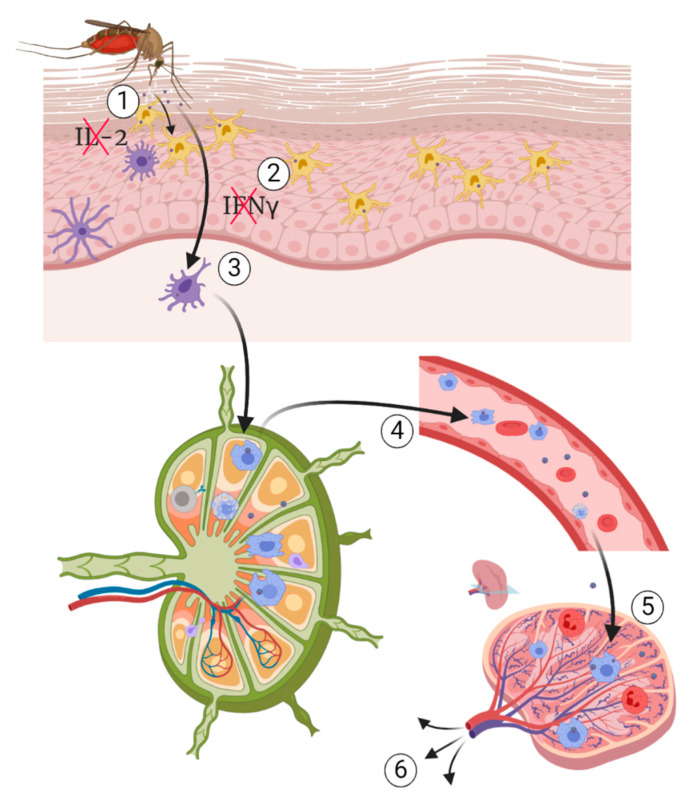
Pathogenesis of WNV infection. (1) Culex quinquefasciatus transmitting WNV during a blood meal on susceptible host and releasing its infectious saliva, (2) immunomodulation by mosquito’s saliva followed by infection of keratinocytes and Langerhans cells, (3) migration of infected cells to nearby draining lymph nodes, (4) viremia followed by migration of infected macrophage from the lymph nodes, and (5) spleen from which the virus spread to other organs of tropism. Source: Adapted from Petersen et al. [1].
Figure 5
Figure 5
WNV neuroinvasive mechanisms. (a) Passive migration of free virus particles across the disrupted blood-brain barrier (BBB) through a “transudative” mechanism following increased vascular permeability, (b) “Trojan horse” mechanism through migration of infected macrophages into brain parenchyma, (c) direct infection of endothelial cell. (d) retrograde axonal transport of WNV, (e) WNV migration into spinal cord, (f) WNV migration from spinal cord to brain and vice versa, (g) neuroinvasive mechanism by transneural mechanism via olfactory nerve, (1) astrocyte, (2) microglia, (3) WNV particles, (4) transmigrating macrophage, (5) motor neuron, (6) blood-brain barrier (BBB) tight junction. Source: Adapted from Petersen et al. [1].

References

    1. Petersen L.R., Brault A.C., Nasci R.S. West Nile virus: Review of the literature. JAMA. 2013;310:308–315. doi: 10.1001/jama.2013.8042. - DOI - PMC - PubMed
    1. Popović N., Milošević B., Urošević A., Poluga J., Lavadinović L., Nedelijković J., Jevtović D., Dulović O. Outbreak of West Nile virus infection among humans in Serbia, August to October 2012. Euro. Surveill. 2013;18:20613. doi: 10.2807/1560-7917.ES2013.18.43.20613. - DOI - PubMed
    1. Brandler S., Tangy F. Vaccines in development against West Nile virus. Viruses. 2013;5:2384–2409. doi: 10.3390/v5102384. - DOI - PMC - PubMed
    1. Petersen L.R., Marfin A.A., Gubler D.J. West nile virus. JAMA. 2003;290:524–528. doi: 10.1001/jama.290.4.524. - DOI - PubMed
    1. Phalen D.N., Dahlhausen B. West Nile virus. Semin. Avian Exot. Pet. Med. 2004;13:67–78. doi: 10.1053/j.saep.2004.01.002. - DOI

LinkOut - more resources