


Sensors and Systems for Physical Rehabilitation and Health Monitoring-A Review
- PMID: 32707749
- PMCID: PMC7436073
- DOI: 10.3390/s20154063
Sensors and Systems for Physical Rehabilitation and Health Monitoring-A Review
Abstract
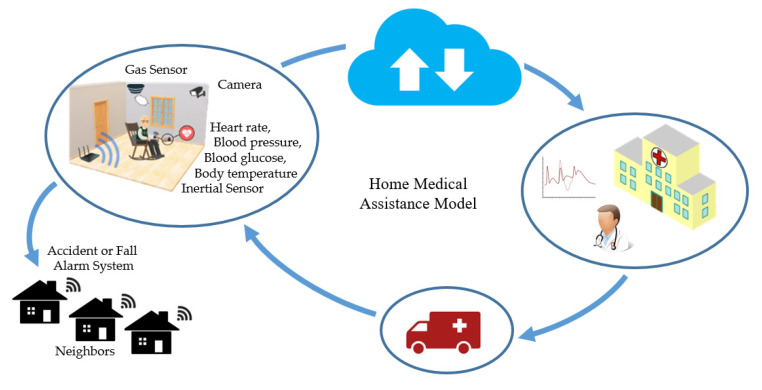
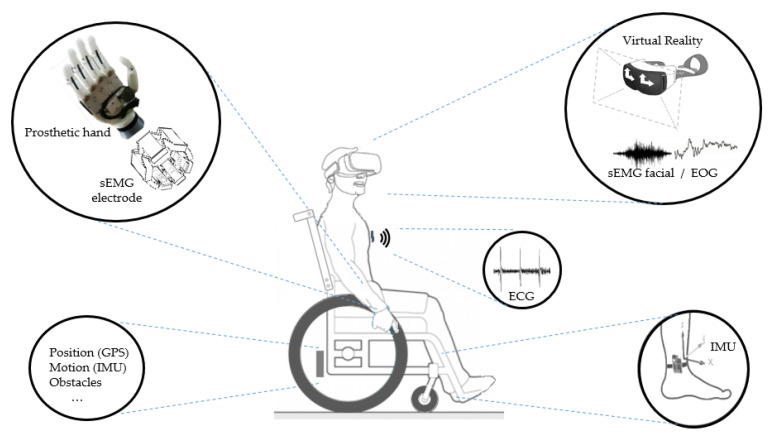
The use of wearable equipment and sensing devices to monitor physical activities, whether for well-being, sports monitoring, or medical rehabilitation, has expanded rapidly due to the evolution of sensing techniques, cheaper integrated circuits, and the development of connectivity technologies. In this scenario, this paper presents a state-of-the-art review of sensors and systems for rehabilitation and health monitoring. Although we know the increasing importance of data processing techniques, our focus was on analyzing the implementation of sensors and biomedical applications. Although many themes overlap, we organized this review based on three groups: Sensors in Healthcare, Home Medical Assistance, and Continuous Health Monitoring; Systems and Sensors in Physical Rehabilitation; and Assistive Systems.
Keywords: e-health systems; physical rehabilitation; sensors; systems.
Conflict of interest statement
The authors declare no conflict of interest.
Figures
References
-
- Tormene P., Bartolo M., De Nunzio A.M., Fecchio F., Quaglini S., Tassorelli C., Sandrini G. Estimation of human trunk movements by wearable strain sensors and improvement of sensor’s placement on intelligent biomedical clothes. Biomed. Eng. Online. 2012;11:95. doi: 10.1186/1475-925X-11-95. - DOI - PMC - PubMed
-
- Zhang L., Zhang Y., Tang S., Luo H. Privacy Protection for E-Health Systems by Means of Dynamic Authentication and Three-Factor Key Agreement. IEEE Trans. Ind. Electron. 2018;65:2795–2805. doi: 10.1109/TIE.2017.2739683. - DOI
-
- Seshadri D.R., Drummond C., Craker J., Rowbottom J.R., Voos J.E. Wearable Devices for Sports: New Integrated Technologies Allow Coaches, Physicians, and Trainers to Better Understand the Physical Demands of Athletes in Real time. IEEE Pulse. 2017;8:38–43. doi: 10.1109/MPUL.2016.2627240. - DOI - PubMed
-
- Municio E., Daneels G., De Brouwer M., Ongenae F., De Turck F., Braem B., Famaey J., Latre S. Continuous Athlete Monitoring in Challenging Cycling Environments Using IoT Technologies. IEEE Internet Things J. 2019;6:10875–10887. doi: 10.1109/JIOT.2019.2942761. - DOI
Publication types
MeSH terms
Grants and funding
LinkOut - more resources
Full Text Sources
Other Literature Sources
