


Biological Properties, Bioactive Constituents, and Pharmacokinetics of Some Capsicum spp. and Capsaicinoids
- PMID: 32707790
- PMCID: PMC7432674
- DOI: 10.3390/ijms21155179
Biological Properties, Bioactive Constituents, and Pharmacokinetics of Some Capsicum spp. and Capsaicinoids
Abstract
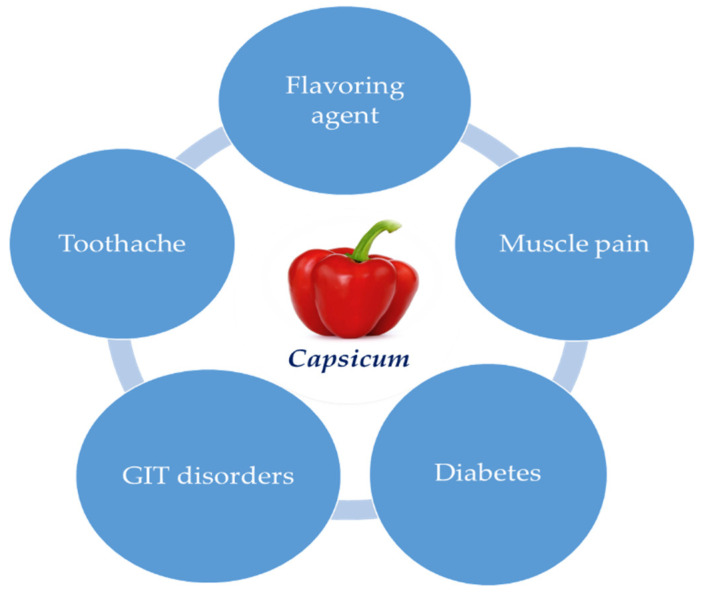
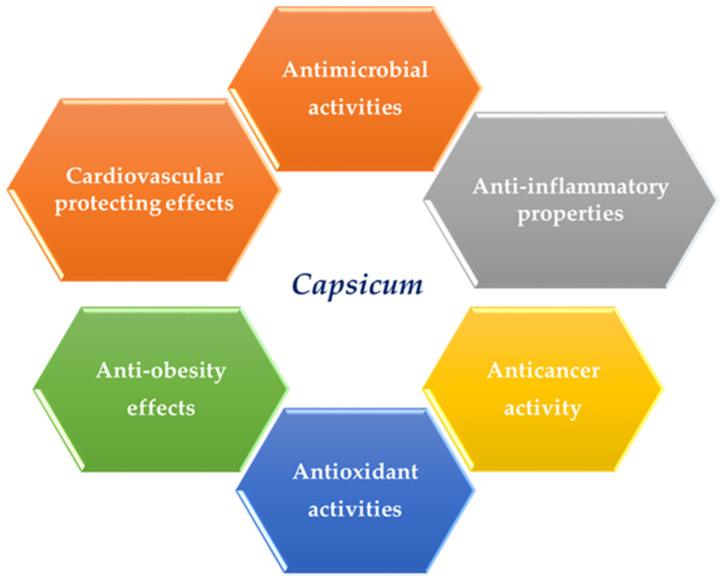
Pepper originated from the Capsicum genus, which is recognized as one of the most predominant and globally distributed genera of the Solanaceae family. It is a diverse genus, consisting of more than 31 different species including five domesticated species, Capsicum baccatum, C. annuum, C. pubescen, C. frutescens, and C. chinense. Pepper is the most widely used spice in the world and is highly valued due to its pungency and unique flavor. Pepper is a good source of provitamin A; vitamins E and C; carotenoids; and phenolic compounds such as capsaicinoids, luteolin, and quercetin. All of these compounds are associated with their antioxidant as well as other biological activities. Interestingly, Capsicum fruits have been used as food additives in the treatment of toothache, parasitic infections, coughs, wound healing, sore throat, and rheumatism. Moreover, it possesses antimicrobial, antiseptic, anticancer, counterirritant, appetite stimulator, antioxidant, and immunomodulator activities. Capsaicin and Capsicum creams are accessible in numerous ways and have been utilized in HIV-linked neuropathy and intractable pain.
Keywords: Capsicum spp.; bioactive constituents; pharmacokinetics.
Conflict of interest statement
The authors declare no conflict of interest.
Figures
References
-
- Kraft K.H., Brown C.H., Nabhan G.P., Luedeling E., Ruiz J.d.J.L., D’Eeckenbrugge G.C., Hijmans R.J., Gepts P. Multiple lines of evidence for the origin of domesticated chili pepper, Capsicum annuum, in Mexico. Proc. Natl. Acad. Sci. USA. 2014;111:6165–6170. doi: 10.1073/pnas.1308933111. - DOI - PMC - PubMed
-
- Andrews J. The Pepper Trail: History and Recipes from Around the World. The University of North Texas Press; Denton, TX, USA: 1999.
-
- Bosland P.W. Progress in New Crops. ASHS Press; Arlington, VA, USA: 1996. Capsicums: Innovative Uses of An Ancient Crop; pp. 479–487.
-
- Menichini F., Tundis R., Bonesi M., Loizzo M.R., Conforti F., Statti G., De Cindio B., Houghton P.J., Menichini F. The influence of fruit ripening on the phytochemical content and biological activity of Capsicum chinense Jacq. cv Habanero. Food Chem. 2009;114:553–560. doi: 10.1016/j.foodchem.2008.09.086. - DOI
Publication types
MeSH terms
Substances
LinkOut - more resources
Full Text Sources
Medical
Miscellaneous
