Review
. 2020 Jul 22;10(8):1090.
doi: 10.3390/biom10081090.

The UPR in Neurodegenerative Disease: Not Just an Inside Job

Affiliations
Review

The UPR in Neurodegenerative Disease: Not Just an Inside Job

Anna Maria van Ziel et al. Biomolecules. .

Abstract

Neurons are highly specialized cells that continuously and extensively communicate with other neurons, as well as glia cells. During their long lifetime, the post-mitotic neurons encounter many stressful situations that can disrupt protein homeostasis (proteostasis). The importance of tight protein quality control is illustrated by neurodegenerative disorders where disturbed neuronal proteostasis causes neuronal dysfunction and loss. For their unique function, neurons require regulated and long-distance transport of membrane-bound cargo and organelles. This highlights the importance of protein quality control in the neuronal endomembrane system, to which the unfolded protein response (UPR) is instrumental. The UPR is a highly conserved stress response that is present in all eukaryotes. However, recent studies demonstrate the existence of cell-type-specific aspects of the UPR, as well as cell non-autonomous UPR signaling. Here we discuss these novel insights in view of the complex cellular architecture of the brain and the implications for neurodegenerative diseases.

Keywords: cell non-autonomous; neurodegenerative disease; proteostasis; unconventional secretion; unfolded protein response.


Conflict of interest statement

The authors declare no conflict of interest.

Figures

Figure 1
Figure 1
Signaling and gene regulation of the canonical cell autonomous unfolded protein response (UPR). The accumulation of unfolded proteins in the endoplasmic reticulum (ER) induces the three signaling cascades initiated by the transmembrane proteins: IRE1, ATF6 and PERK. This results in the inhibition of protein translation through PERK and the production of active transcription factors: XBP1s, ATF6 and ATF4 via IRE1, ATF6 and PERK, respectively. Upon translocation to the nucleus, XBP1s and ATF6 bind in different compositions to specific promoter sequences, including ERSE, ERSE-II and UPRE, and initiate transcription of multiple UPR genes, including ER chaperones and ERAD genes. Nuclear ATF4 binds the CARE promoter motif and induces CHOP transcription, which in turn increases GADD34 levels, thereby providing negative feedback in the PERK pathway. For details see main text.
Figure 2
Figure 2
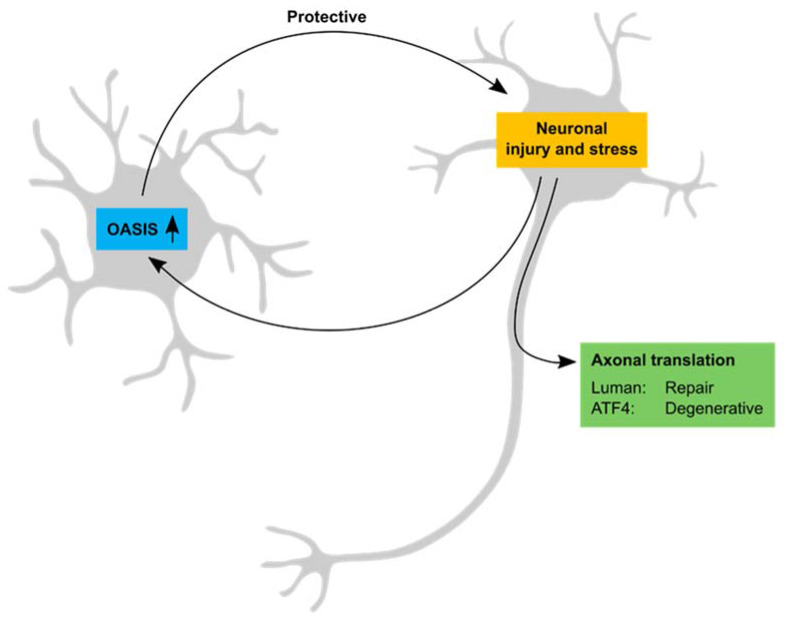
Potential interaction of cell-type-specific UPR responses in neuronal stress and injury. Neuronal stress (i.e., kainate or Aβ toxicity) or injury (i.e., axotomy) induces the UPR in glia cells and neurons. In addition to the canonical UPR present in every cell, cell-type-specific and cell non-autonomous signaling are activated. The astrocyte-specific UPR transducer OASIS elicits both a cell autonomous and cell non-autonomous protective response. In the neuronal axon, the transcription factor ATF4 is selectively upregulated and mediates a degenerative response, although the involvement of the UPR is not conclusively demonstrated. The neuron-specific UPR transducer Luman/CREB3 is specifically translated in the stressed axon and elicits a cell autonomous protective response. The combination of protective and degenerative cell autonomous and cell non-autonomous UPR responses will ultimately determine the fate of the neuron: degeneration or survival. Separate pathways have been shown to exist; the interactions between cells and pathways are hypothetical. See text for further detail.
Figure 3
Figure 3
Putative proteostatic functions of cell non-autonomous UPR signaling. Schematic depiction of three hypotheses showing possible functions of cell non-autonomous UPR signaling. (1) Upon protein stress, accumulating or misfolded proteins from ER or cytosol are secreted to maintain intracellular proteostasis. For example, impairment of proteasomal or autolysosomal degradation (a) or defects in the conventional secretory pathway (b) have been observed to cause protein stress and induce protein secretion. (2) ER chaperones are secreted alone or together with misfolded proteins, to maintain or restore proteostasis in the extracellular space. (3) Cells that experience proteotoxic stress can secrete “danger signals” or DAMPs to alert recipient cells for upcoming proteotoxic insults. In addition, chaperones can be secreted to compensate chaperone levels between cells. Both forms of transcellular communication can contribute to proteostasis at the tissue or organismal level. For details, see main text.

References

    1. Hetz C., Papa F.R. The Unfolded Protein Response and Cell Fate Control. Mol. Cell. 2018;69:169–181. doi: 10.1016/j.molcel.2017.06.017. - DOI - PubMed
    1. Walter P., Ron D. The Unfolded Protein Response: From Stress Pathway to Homeostatic Regulation. Science. 2011;334:1081–1086. doi: 10.1126/science.1209038. - DOI - PubMed
    1. Viotti C. ER to Golgi-Dependent Protein Secretion: The Conventional Pathway. Methods Mol. Biol. 2016;1459:3–29. - PubMed
    1. Mori K. Signalling pathways in the unfolded protein response: Development from yeast to mammals. J. Biochem. 2009;146:743–750. doi: 10.1093/jb/mvp166. - DOI - PubMed
    1. Carrara M., Prischi F., Ali M.M.U. UPR Signal Activation by Luminal Sensor Domains. Int. J. Mol. Sci. 2013;14:6454–6466. doi: 10.3390/ijms14036454. - DOI - PMC - PubMed

Publication types

MeSH terms