Review
. 2020 Jul 22;11(8):836.
doi: 10.3390/genes11080836.

Genomic Islands in Mycoplasmas

Affiliations
Review

Genomic Islands in Mycoplasmas

Christine Citti et al. Genes (Basel). .

Abstract

Bacteria of the Mycoplasma genus are characterized by the lack of a cell-wall, the use of UGA as tryptophan codon instead of a universal stop, and their simplified metabolic pathways. Most of these features are due to the small-size and limited-content of their genomes (580-1840 Kbp; 482-2050 CDS). Yet, the Mycoplasma genus encompasses over 200 species living in close contact with a wide range of animal hosts and man. These include pathogens, pathobionts, or commensals that have retained the full capacity to synthesize DNA, RNA, and all proteins required to sustain a parasitic life-style, with most being able to grow under laboratory conditions without host cells. Over the last 10 years, comparative genome analyses of multiple species and strains unveiled some of the dynamics of mycoplasma genomes. This review summarizes our current knowledge of genomic islands (GIs) found in mycoplasmas, with a focus on pathogenicity islands, integrative and conjugative elements (ICEs), and prophages. Here, we discuss how GIs contribute to the dynamics of mycoplasma genomes and how they participate in the evolution of these minimal organisms.

Keywords: Mollicutes; evolution; genome; genomic island; horizontal gene transfer; mobile elements; mycoplasmas; phages.


Conflict of interest statement

The authors declare no conflict of interest.

Figures
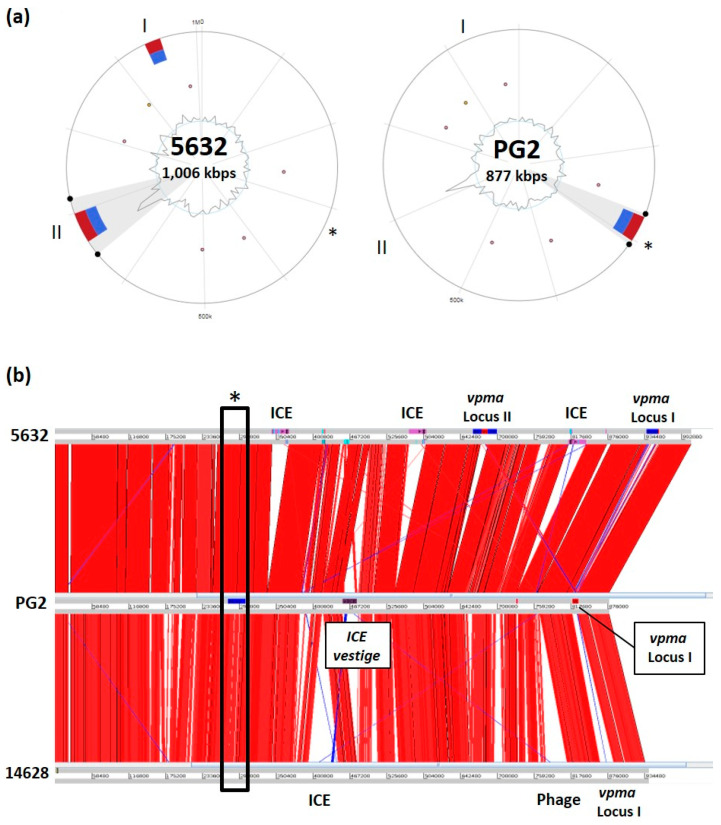
Figure 1
Figure 1
Genomic island (GIs) predictions and locations in three sequenced M. agalactiae strains. (a) GI predictions using Island Viewer 4 and the two circular genomes of M. agalactiae strain 5632 (left) and type strain PG2T (right). The circle represents a single chromosome, with the outermost red bars indicating locations of all predicted GIs by integrating the four detection methods included in IslandViewer 4. Within the circle, GIs predictions by the software IslandPath-DIMOB are shown as blue. SIGI-HMM, IslandPick, and Islander did not give any result. Homologs to microbial resistance genes and pathogen-associated genes are indicated as circular glyphs inside the circles. (b) Genome comparison using the Artemis Comparison Tool and the M. agalactiae genome from 3 strains, 5632 (NCBI RefSeq NC_013948.1), PG2 (NCBI RefSeq NC_009497.1), and 14628 (WGS SPQY01000001: SPQY01000015). The vpma loci are labeled I and II and are detailed in Figure 2; the asterisk designates the locus detected in PG2T by Island Viewer 4. M. agalactiae ICEs present in 5632 and 14628 are indicated as well as the position of an ICE vestige in PG2. A prophage identified only in 14628 is shown, which was not detected by Island Viewer 4 or other dedicated prediction tools. Of note, panel (a) was generated using genomes annotated with the NCBI Prokaryotic Genome Annotation Pipeline (PGAP) (NC_009497.1 for PG2 and NC_013948.1 for 5632), when expert annotation was used, one ICE was detected in strain 5632, in addition to the vpma loci and a single locus in PG2, which was not detected before (CU179680.1 for PG2; FP671138.1 for 5632).
Figure 2
Figure 2
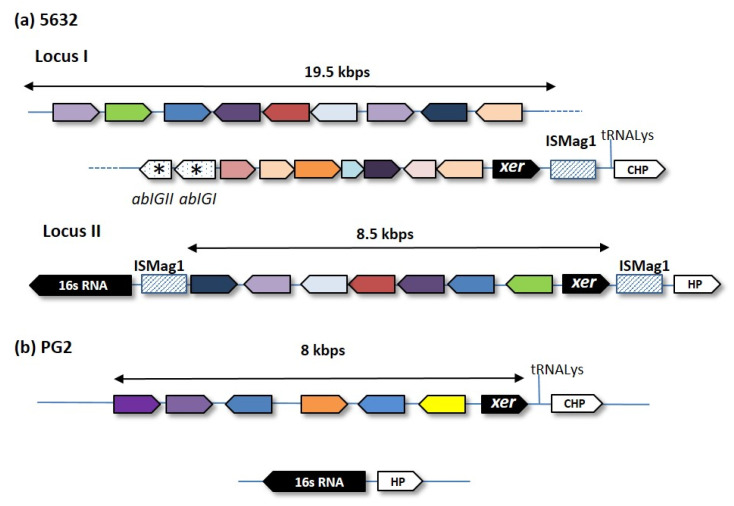
Comparison of M. agalactiae vpma loci of strain 5632 (a) with that of the PG2T type strain (b). In PG2T, the counterpart of 5632 locus-II is deprived of vpma genes. Large filled arrows represent Vpma CDSs, with each color representing individual Vpmas whose genes might occur in the two loci. The two non-Vpma-related CDSs (abiGI and abiGI) only found in 5632 are indicated by an asterisk. ISMag1 elements are indicated by hatched boxes. Schematics were approximately drawn to scale. HP—hypothetical protein; CHP—conserved hypothetical protein. Locus I of 5632 was split in two parts to fit into a portrait format but were indeed collinear, as indicated by the dotted lines. xer: genes encoding the tyrosine recombinase [20].
Figure 3
Figure 3
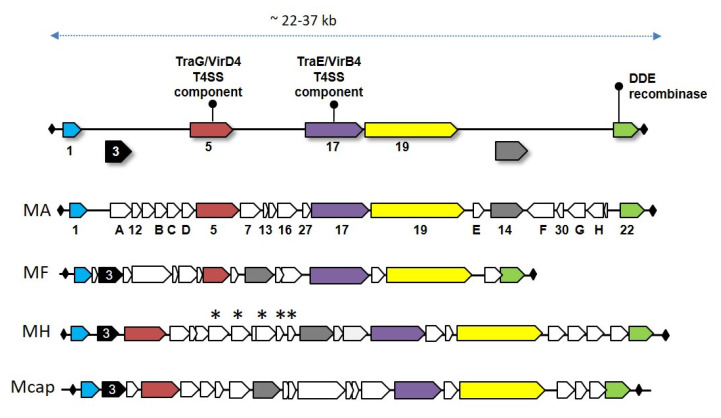
Overall gene organization of Mycoplasma Integrative and Conjugative Element (MICE). MICEs are large GIs whose sizes range from 22–37 kbp and display a set of highly conserved genes across MICEs. These are represented as colored filled arrows with some, less conserved, being represented below the line. Inverted repeats that flank the MICE and are juxtaposed in the circular form are represented by diamonds. Direct repeats (not shown here) are generated upon MICE random integration in the host chromosome. For illustration, representative MICEs of the M. agalactiae strain 5632 (MA), M. fermentans strain M64 (MF), M. hominis strain 4788 (MH), and M. mycoides subsp. capri strain GM12T (Mcap) are shown. Asterisks represent MICE genes which are specific to M. hominis ICEs.
Figure 4
Figure 4
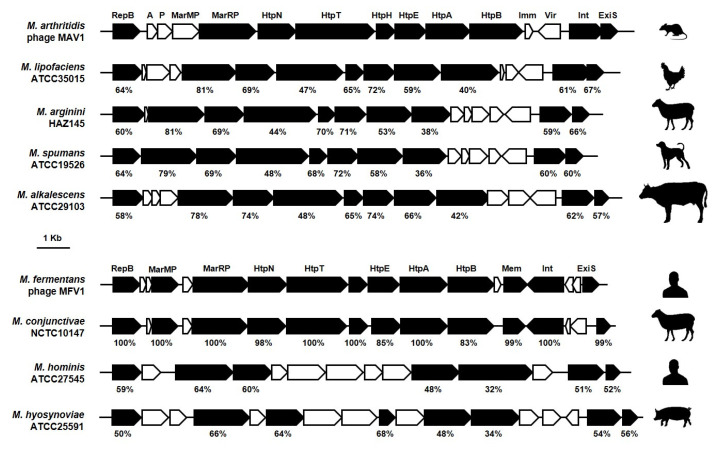
Comparison of φMAV1 and φMFV1 genomic regions with prophage sequences identified in mycoplasma species of the Hominis phylogenetic group. φMAV1-like and φMFV1-like sequences were identified by BLASTP analyses using CDSs highlighted in black and a sequence database consisting of non-redundant protein sequences restricted to Mollicutes (taxid:31969). No similarity was identified outside of the Hominis phylogenetic group. CDS products in φMAV1 and φMFV1 are indicated. For each CDS, the percentage of global similarity with φMAV1 or φMFV1 is indicated. This value was determined by using the EMBOSS Needle alignment tool. Animal icons are used to illustrate the host tropism of each strain. These illustrations are limited to a single prophage sequence per chromosome, and a single strain per species. The overall organization φMAV1 is highly conserved among φMAV1-like sequences, which mainly differ at putative repressor (imm) and virulence (vir) genes and CDSs located at close proximity. A remarkable feature of φMFV1 genomic region is its proximity with the animal Mycoplasma species M. conjunctivae.
Figure 5
Figure 5
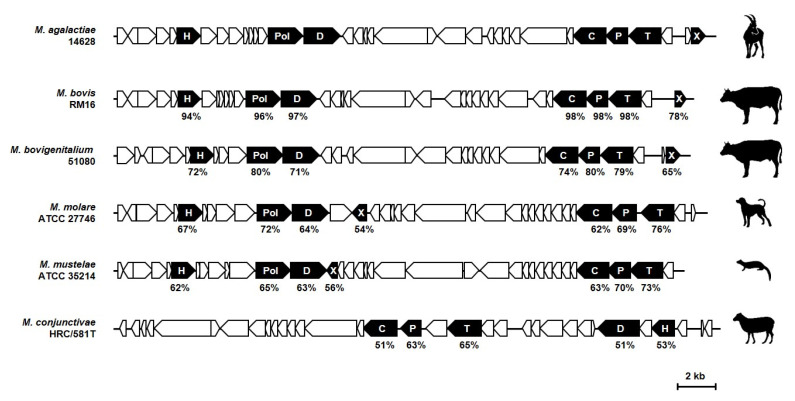
Genome map of M. agalactiae φMAgV1 from strain 14628 and comparison with MAgV1-like sequences identified in Mycoplasma species of the Hominis phylogenetic group. The locations, sizes, and orientations of the CDSs are indicated by arrows. MAgV1-like sequences were identified by BLASTP analyses using φMAgV1 CDSs highlighted in black and a sequence database consisting of non-redundant protein sequences restricted to Mollicutes (taxid:31969). No similarity was identified outside of the Hominis phylogenetic group. The letter code in black arrows refers to CDS products: H, helicase; Pol, DNA polymerase; D, DNA primase; C, prohead protein; P, portal; T, terminase; X, Xer. For each CDS, the percentage of the global similarity with φMAgV1 is indicated. This value was determined by using the EMBOSS Needle alignment tool. Animal icons are used to illustrate the host tropism of each strain. The overall organization of φMAgV1 is conserved in M. bovis RM16 and M. bovigenitalium 51080. A particular feature of MAgV1-like sequences in M. molare ATCC 27746 and M. mustelae ATCC 35214 is the central position of the recombinase gene (xer). The genome of M. conjunctivae HRC/581T is characterized by an important reorganization of the MAgV1-like sequence and the absence of DNA polymerase and recombinase genes.
Figure 6
Figure 6
Genomic organization of M. pulmonis phage P1 and putative fingerprint of a P1-like phage attack in M. bovis 3308MB. Black arrows indicate CDSs in phage P1 displaying some similarity with sequences of the 3308MB draft genome. The percentage of global similarity was determined by using the EMBOSS Needle alignment tool. The letter code in black arrows refers to the CDS products. Pol, DNA polymerase GP16, DNA encapsidation protein. Animal icons are used to illustrate the host tropism of M. pulmonis and M. bovis.

References

    1. Citti C., Blanchard A. Mycoplasmas and their host: Emerging and re-emerging minimal pathogens. Trends Microbiol. 2013;21:196–203. doi: 10.1016/j.tim.2013.01.003. - DOI - PubMed
    1. Woese C.R., Maniloff J., Zablen L.B. Phylogenetic analysis of the mycoplasmas. Proc. Natl. Acad. Sci. USA. 1980;77:494–498. doi: 10.1073/pnas.77.1.494. - DOI - PMC - PubMed
    1. Ciccarelli F.D., Doerks T., von Mering C., Creevey C.J., Snel B., Bork P. Toward automatic reconstruction of a highly resolved tree of life. Science. 2006;311:1283–1287. doi: 10.1126/science.1123061. - DOI - PubMed
    1. Sirand-Pugnet P., Citti C., Barré A., Blanchard A. Evolution of mollicutes: Down a bumpy road with twists and turns. Res. Microbiol. 2007;158:754–766. doi: 10.1016/j.resmic.2007.09.007. - DOI - PubMed
    1. Fraser C.M., Gocayne J.D., White O., Adams M.D., Clayton R.A., Fleischmann R.D., Bult C.J., Kerlavage A.R., Sutton G., Kelley J.M., et al. The minimal gene complement of Mycoplasma genitalium. Science. 1995;270:397–403. doi: 10.1126/science.270.5235.397. - DOI - PubMed

Publication types

LinkOut - more resources