


Sphingolipid Analysis Indicate Lactosylceramide as a Potential Biomarker of Inflammatory Bowel Disease in Children
- PMID: 32708181
- PMCID: PMC7408557
- DOI: 10.3390/biom10071083
Sphingolipid Analysis Indicate Lactosylceramide as a Potential Biomarker of Inflammatory Bowel Disease in Children
Abstract
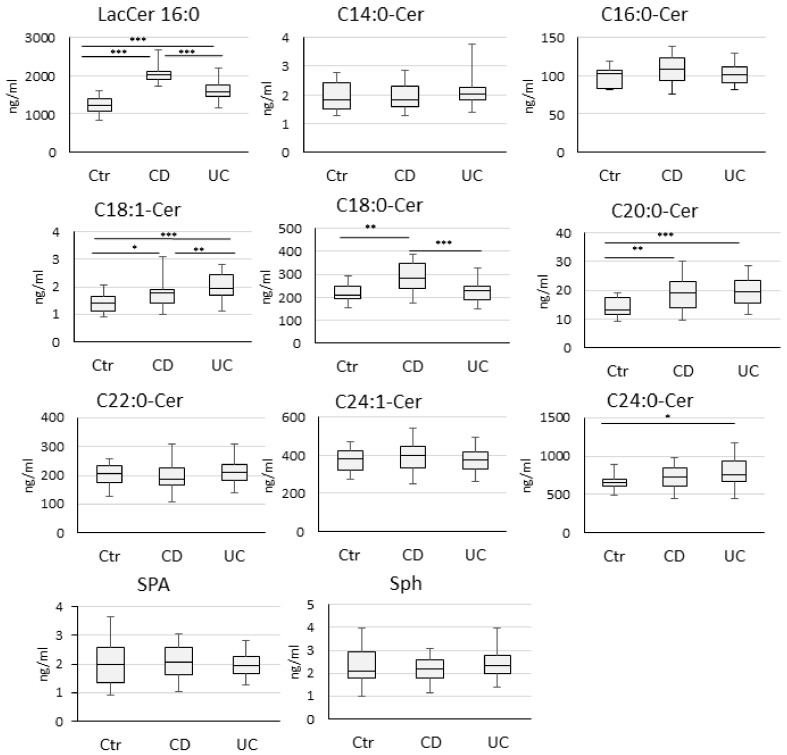
An altered ceramide composition in patients with inflammatory bowel disease (IBD) has been reported recently. The aim of this study was to evaluate the concentrations of sphingolipids in the serum of treatment-naive children with newly diagnosed IBD and to determine the diagnostic value of the tested lipids in pediatric IBD. The concentrations of sphingolipids in serum samples were evaluated using a quantitative method, an ultra-high-performance liquid chromatography-tandem mass spectrometry in children with Crohn's disease (CD) (n=34), ulcerative colitis (UC) (n = 39), and controls (Ctr) (n = 24). Among the study groups, the most significant differences in concentrations were noted for C16:0-LacCer, especially in children with CD compared to Ctr or even to UC. Additionally, the relevant increase in C20:0-Cer and C18:1-Cer concentrations were detected in both IBD groups compared to Ctr. The enhanced C24:0-Cer level was observed only in UC, while C18:0-Cer only in the CD group. The highest area under the curve (AUC), specificity, and sensitivity were determined for C16:0-LacCer in CD diagnosis. Our results suggest that the serum LacC16-Cer may be a potential biomarker that distinguishes children with IBD from healthy controls and differentiates IBD subtypes. In addition, C20:0-Cer and C18:0-Cer levels also seem to be closely connected with IBD.
Keywords: Crohn’s disease; ceramide; children; inflammatory bowel disease; lactosylceramide; sphingolipid; ulcerative colitis.
Conflict of interest statement
The authors declare no conflicts of interest.
Figures
References
-
- Levine A., Koletzko S., Turner D., Escher J.C., Cucchiara S., de Ridder L., Kolho K.L., Veres G., Russell R.K., Paerregaard A., et al. ESPGHAN revised porto criteria for the diagnosis of inflammatory bowel disease in children and adolescents. J. Pediatr. Gastroenterol. Nutr. 2014;58:795–806. doi: 10.1097/MPG.0000000000000239. - DOI - PubMed
-
- Daniluk U., Daniluk J., Kucharski R., Kowalczyk T., Pietrowska K., Samczuk P., Filimoniuk A., Kretowski A., Lebensztejn D., Ciborowski M. Untargeted Metabolomics and Inflammatory Markers Profiling in Children With Crohn’s Disease and Ulcerative Colitis-A Preliminary Study. Inflamm. Bowel. Dis. 2019;25:1120–1128. doi: 10.1093/ibd/izy402. - DOI - PubMed
-
- Bazarganipour S., Hausmann J., Oertel S., El-Hindi K., Brachtendorf S., Blumenstein I., Kubesch A., Sprinzl K., Birod K., Hahnefeld L., et al. The Lipid Status in Patients with Ulcerative Colitis: Sphingolipids are Disease-Dependent.Regulated. J. Clin. Med. 2019;8:971. doi: 10.3390/jcm8070971. - DOI - PMC - PubMed
Publication types
MeSH terms
Substances
Grants and funding
LinkOut - more resources
Full Text Sources
