Review
. 2020 Jul 21;11(7):827.
doi: 10.3390/genes11070827.

Consequence of Paradigm Shift with Repeat Landscapes in Reptiles: Powerful Facilitators of Chromosomal Rearrangements for Diversity and Evolution

Affiliations
Review

Consequence of Paradigm Shift with Repeat Landscapes in Reptiles: Powerful Facilitators of Chromosomal Rearrangements for Diversity and Evolution

Syed Farhan Ahmad et al. Genes (Basel). .

Abstract

Reptiles are notable for the extensive genomic diversity and species richness among amniote classes, but there is nevertheless a need for detailed genome-scale studies. Although the monophyletic amniotes have recently been a focus of attention through an increasing number of genome sequencing projects, the abundant repetitive portion of the genome, termed the "repeatome", remains poorly understood across different lineages. Consisting predominantly of transposable elements or mobile and satellite sequences, these repeat elements are considered crucial in causing chromosomal rearrangements that lead to genomic diversity and evolution. Here, we propose major repeat landscapes in representative reptilian species, highlighting their evolutionary dynamics and role in mediating chromosomal rearrangements. Distinct karyotype variability, which is typically a conspicuous feature of reptile genomes, is discussed, with a particular focus on rearrangements correlated with evolutionary reorganization of micro- and macrochromosomes and sex chromosomes. The exceptional karyotype variation and extreme genomic diversity of reptiles are used to test several hypotheses concerning genomic structure, function, and evolution.

Keywords: amniote; chromosome; genome; karyotype; sex chromosome.


Conflict of interest statement

The authors declare no conflict of interest.

Figures

Figure 1
Figure 1
Percentage of transposable elements (TEs) in the genome representative amniotes. The bird genome contains the lowest percentage of TEs and genome size compared with the genomes of mammals and reptiles. (a) Bar chart shows the TE percentage of different birds (blue), reptiles (green) and mammals (red) and the red line indicates the genome size. (b) Distribution of total TE percentage in the genome of different species across reptiles, mammals and birds. Each dot represents a species. The species list is given as Supplementary Dataset S1.
Figure 2
Figure 2
Percentage of total genomic repeats in diverse lineages of squamate reptiles. Violin plots highlighting the family-wise distribution of total repeat proportion (a) and microsatellite density (b) in genomes. Each dot represents a single species. The species list is given as Supplementary Dataset S1.
Figure 3
Figure 3
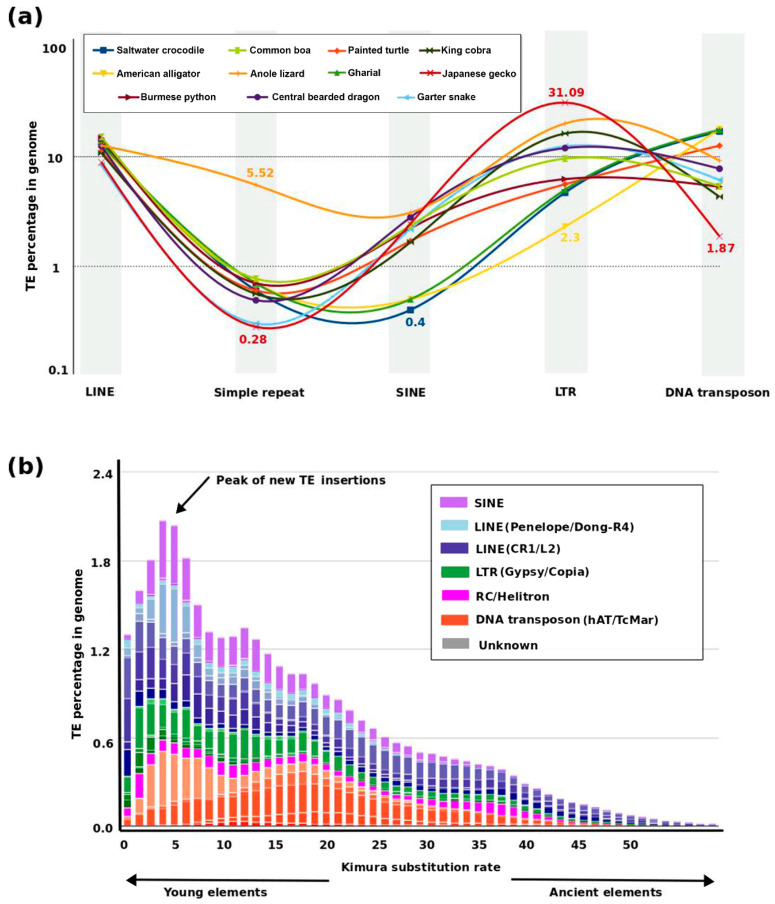
Genomic proportion of repeats in reptiles. (a) Comparative line plot of major repeat elements in 11 representative species. The proportion of LINEs is similar for each species, whereas Anolis shows the highest abundance of simple repeats. LTRs are most abundant in gecko and least abundant in alligator. Crocodile, gharial, and alligator show similarly low abundance of SINEs. The X-axis has no intrinsic meaning for variable values and is given to represent the types of repeats only. A bar graph of the same data is provided as Supplementary Figure S1. (b) Transposable element (TE) evolutionary landscape of the Anolis genome. The y-axis and x-axis represent genomic proportion (%) and Kimura divergence, respectively. A recent wave of transposition in the Anolis genome has occurred, as indicated by the black arrow and very low proportions of old elements. K values from 1 to 50 denote evolutionary divergence from younger to older repeats. Data for the percentage of repeat elements was sourced from the literature and the RepeatMasker database (http://www.repeatmasker.org/genomicDatasets/RMGenomicDatasets.html, last accessed, June 2020). The Anole TE landscape was retrieved from RepeatMasker and manually annotated and edited using Inkscape V 0.92 (https://inkscape.org/release/inkscape-0.92/).
Figure 4
Figure 4
Phylogenetic relationships of 84 reptile species highlighting all families. Chromosome number and genome size were plotted as heatmaps in R using customized script for each corresponding species. The tree topology was retrieved from the TimeTree online database (http://www.timetree.org/). Chromosome number and genome size data were sourced from the animal genome database (https://www.animalgenome.org). Genome size and actual number of chromosomes for each species is listed as Supplementary Dataset S2.
Figure 5
Figure 5
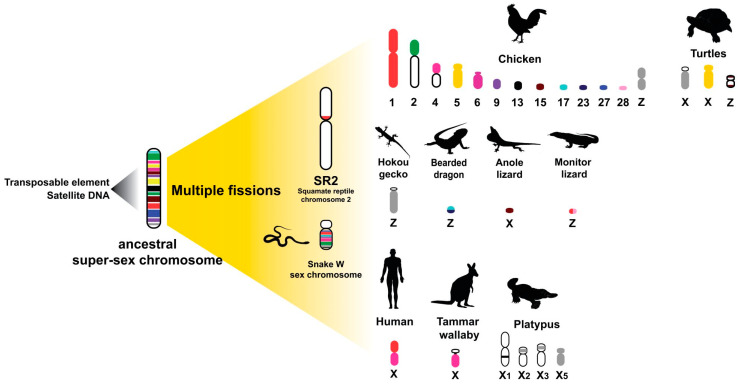
Schematic representation of amniotes sex chromosome evolution. Transposable elements (TEs) mobilization and copy number amplification affected genome reorganization via non-homologous recombination and multiple fission events, resulting in the evolution of heteromorphic X and Y or Z and W chromosomes in different amniote lineages. Chromosomal locations of genes in the amniotes were obtained from comparative gene mapping (chromosome mapping via a cytogenetic technique) and whole genome sequencing as the following sources: chicken (Gallus gallus) [24], humans (Homo sapiens) and tammar wallaby (Macropus eugenii) [195], duck-billed platypus (Ornithorhynchus anatinus) [196], green anole (Anolis carolinensis) [52], bearded dragon lizard (Pogona vitticeps) [191], Hokou gecko (Gekko hokouensis) [197], komodo dragon (Varanus komodoensis) [198], snakes [20,38], marsh turtle (Siebenrockiella crassicollis), wood turtle (Glyptemys insculpta), Mexican musk turtle (Staurotypus triporcatus), giant musk turtle (Staurotypus salvinii), spiny softshell turtle (Apalone spinifera), and Chinese softshell turtle (Pelodiscus sinensis) [25,26,118,152,199].

References

    1. Darwin C., Wallace A. On the Tendency of Species to form Varieties; and on the Perpetuation of Varieties and Species by Natural Means of Selection. J. Proc. Linn. Soc. Lond. Zool. 1858;3:45–62. doi: 10.1111/j.1096-3642.1858.tb02500.x. - DOI
    1. Darwin C. The Origin of Species, by Means of Natural Selection, or the Preservation of Favored Races in the Struggle for Life. 2nd ed. John Murray; London, UK: 1860. pp. 149–150. - DOI
    1. Dobzhansky T. Genetics of Natural Populations. XXVI. Chromosomal Variability in Island and Continental Populations of Drosophila willistoni from Central America and the West Indies. Evolution. 1957;11:280. doi: 10.1111/j.1558-5646.1957.tb02896.x. - DOI
    1. Crombach A., Hogeweg P. Chromosome rearrangements and the evolution of genome structuring and adaptability. Mol. Biol. Evol. 2007;24:1130–1139. doi: 10.1093/molbev/msm033. - DOI - PubMed
    1. Stebbins G.L. The Inviability, Weakness, and Sterility of Interspecific Hybrids. Adv. Genet. 1958;9:147–215. doi: 10.1016/S0065-2660(08)60162-5. - DOI - PubMed

Publication types

LinkOut - more resources