


Pulmonary Artery Thrombosis: A Diagnosis That Strives for Its Independence
- PMID: 32708482
- PMCID: PMC7404175
- DOI: 10.3390/ijms21145086
Pulmonary Artery Thrombosis: A Diagnosis That Strives for Its Independence
Abstract
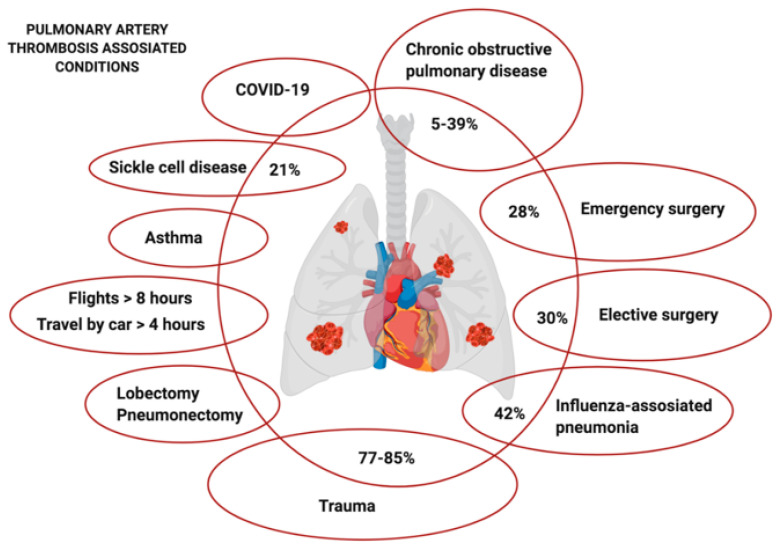
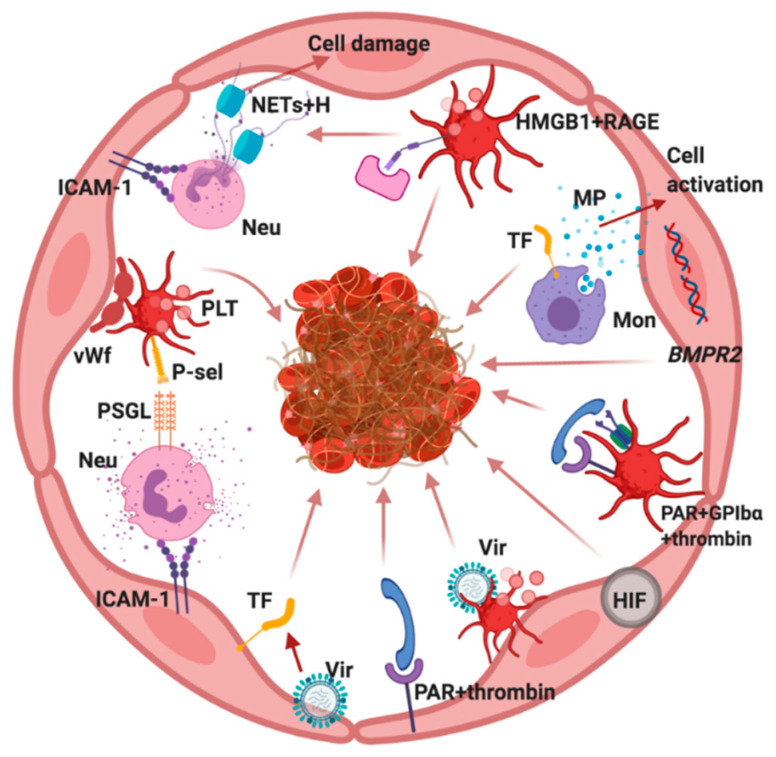
According to a widespread theory, thrombotic masses are not formed in the pulmonary artery (PA) but result from migration of blood clots from the venous system. This concept has prevailed in clinical practice for more than a century. However, a new technologic era has brought forth more diagnostic possibilities, and it has been shown that thrombotic masses in the PA could, in many cases, be found without any obvious source of emboli. Chronic obstructive pulmonary disease, asthma, sickle cell anemia, emergency and elective surgery, viral pneumonia, and other conditions could be complicated by PA thrombosis development without concomitant deep vein thrombosis (DVT). Different pathologies have different causes for local PA thrombotic process. As evidenced by experimental results and clinical observations, endothelial and platelet activation are the crucial mechanisms of this process. Endothelial dysfunction can impair antithrombotic function of the arterial wall through downregulation of endothelial nitric oxide synthase (eNOS) or via stimulation of adhesion receptor expression. Hypoxia, proinflammatory cytokines, or genetic mutations may underlie the procoagulant phenotype of the PA endothelium. Both endotheliocytes and platelets could be activated by protease mediated receptor (PAR)- and receptors for advanced glycation end (RAGE)-dependent mechanisms. Hypoxia, in particular induced by high altitudes, could play a role in thrombotic complications as a trigger of platelet activity. In this review, we discuss potential mechanisms of PA thrombosis in situ.
Keywords: platelet activation; prothrombotic phenotype; pulmonary artery thrombosis; pulmonary embolism.
Conflict of interest statement
The authors declare no conflict of interest.
Figures
References
-
- Tadlock M.D., Chouliaras K., Kennedy M., Talving P., Okoye O., Aksoy H., Karamanos E., Zheng L., Grabo D.J., Rogers C., et al. The origin of fatal pulmonary emboli: A postmortem analysis of 500 deaths from pulmonary embolism in trauma, surgical, and medical patients. Am. J. Surg. 2015;209:959–968. doi: 10.1016/j.amjsurg.2014.09.027. - DOI - PubMed
Publication types
MeSH terms
Substances
Grants and funding
LinkOut - more resources
Full Text Sources
Medical
Research Materials
