Review
. 2020 Jul 18;9(7):1725.
doi: 10.3390/cells9071725.

The Tumor Suppressor PTEN as Molecular Switch Node Regulating Cell Metabolism and Autophagy: Implications in Immune System and Tumor Microenvironment

Affiliations
Review

The Tumor Suppressor PTEN as Molecular Switch Node Regulating Cell Metabolism and Autophagy: Implications in Immune System and Tumor Microenvironment

Saveria Aquila et al. Cells. .

Abstract

Recent studies conducted over the past 10 years evidence the intriguing role of the tumor suppressor gene Phosphatase and Tensin Homolog deleted on Chromosome 10 PTEN in the regulation of cellular energy expenditure, together with its capability to modulate proliferation and survival, thus expanding our knowledge of its physiological functions. Transgenic PTEN mice models are resistant to oncogenic transformation, present decreased adiposity and reduced cellular glucose and glutamine uptake, together with increased mitochondrial oxidative phosphorylation. These acquisitions led to a novel understanding regarding the role of PTEN to counteract cancer cell metabolic reprogramming. Particularly, PTEN drives an "anti-Warburg state" in which less glucose is taken up, but it is more efficiently directed to the mitochondrial Krebs cycle. The maintenance of cellular homeostasis together with reduction of metabolic stress are controlled by specific pathways among which autophagy, a catabolic process strictly governed by mTOR and PTEN. Besides, a role of PTEN in metabolic reprogramming and tumor/stroma interactions in cancer models, has recently been established. The genetic inactivation of PTEN in stromal fibroblasts of mouse mammary glands, accelerates breast cancer initiation and progression. This review will discuss our novel understanding in the molecular connection between cell metabolism and autophagy by PTEN, highlighting novel implications regarding tumor/stroma/immune system interplay. The newly discovered action of PTEN opens innovative avenues for investigations relevant to counteract cancer development and progression.

Keywords: Warburg state; cancer metabolism; immune system; stroma.


Conflict of interest statement

The authors declare no conflict of interest.

Figures
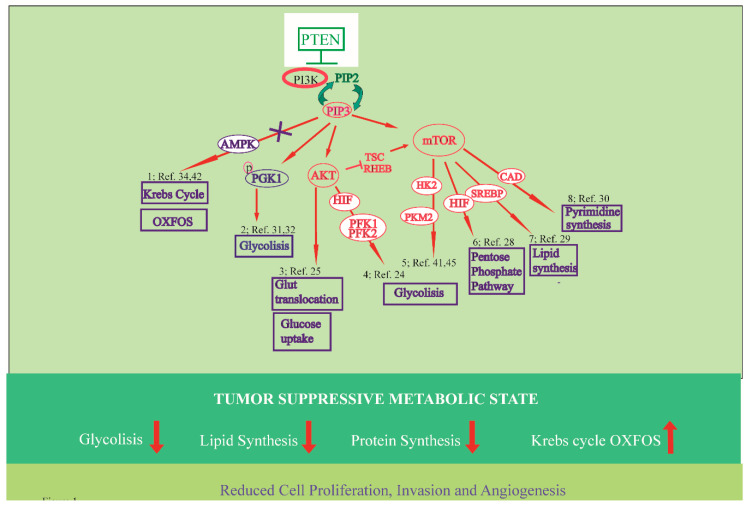
Figure 1
Figure 1
A schematic summary of metabolic pathways (upper panel) determining the tumor suppressive activities (lower panel) for PTEN. See the text for details. (1) PTEN through AMPK induces Krebs cycle and OXFOS. (2) PTEN suppresses glycolysis through PGK1 inhibition. (3) PTEN blocks AKT induced Glut1 translocation and glucose uptake. (4) PTEN blocks mTOR-induced HIF1, PFK1, and glycolysis. (5) PTEN blocks mTOR-induced PKM2 transcription. (6) PTEN decreases PPP flux. (7) PTEN blocks mTOR-induced SREBP transcription factor and lipid synthesis. (8) PTEN reduces pyrimidine synthesis.
Figure 2
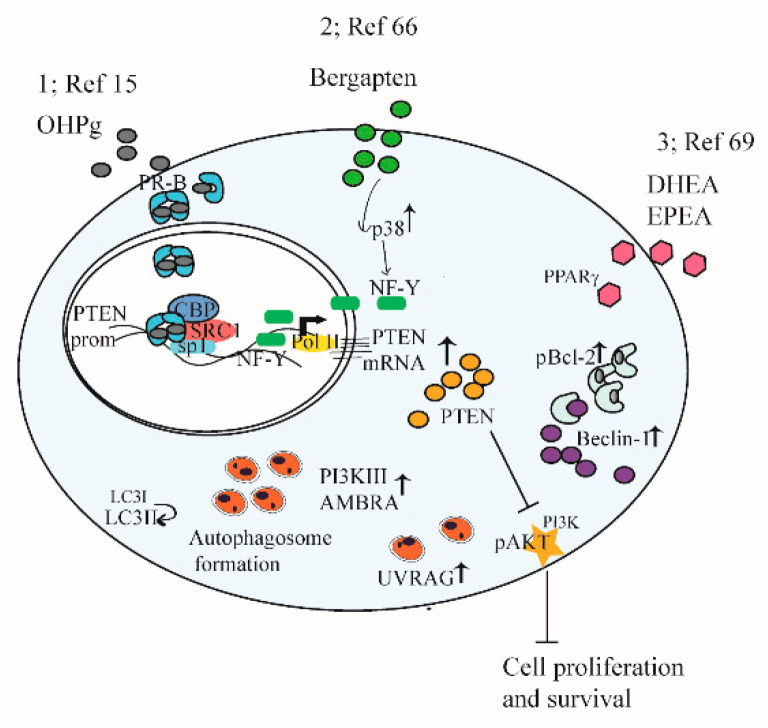
Figure 2
A schematic summary illustrating mechanisms targeting PTEN and autophagy in cancer cells. See the text for details. (1) The functional interplay between progesterone receptor-B and PTEN, via AKT, modulates autophagy in breast cancer cells. (2) PTEN as a key target of BergaPTEN action in breast cancer cells for the induction of autophagy. (3) DHEA and EPEA through PPARγ-increased expression PTEN, resulting in the inhibition of AKT–mTOR pathways, induction of Bcl-2 phosphorylation, its dissociation from Beclin-1, and autophagy induction.
Figure 3
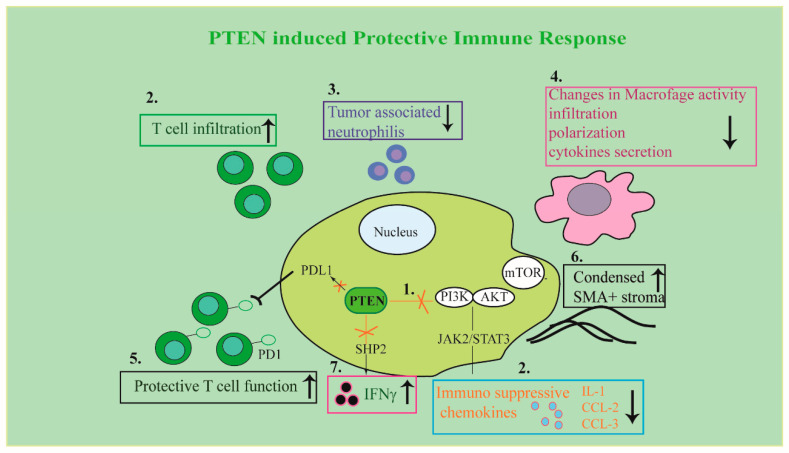
Figure 3
A schematic summary illustrating PTEN role in tumor/stroma interplay. See the text for details. (1) PTEN blocks oncogenic drivers of tumors including PI3K/AKT/mTOR and JAK2/STAT3. (2) PTEN reduces immunosuppressive cytokines, determining induction of T cells’ infiltration into tumor tissue. (3) PTEN reduces tumor-associated neutrophils (4) PTEN in macrophages reduces cytokines and M2 macrophage polarization in TME. (5) In tumor cells PTEN decreases PD-L1 expression which is responsible for T cell inactivation in the tumor microenvironment. (6) PTEN induces a condensed layer of SMA-positive stroma. (7) PTEN blocks PI3K-dependent activation of SHP 2 which acts as a negative regulator to inhibit IFN-γ.

References

    1. Li J., Yen C., Liaw D., Podsypanina K., Bose S., Wang S.I., Puc J., Miliaresis C., Rodgers L., McCombie R., et al. PTEN, a putative protein tyrosine phosphatase gene mutated in human brain, breast, and prostate cancer. Science. 1997;275:1943–1947. doi: 10.1126/science.275.5308.1943. - DOI - PubMed
    1. Pulido R. PTEN Inhibition in Human Disease Therapy. Molecules. 2018;23:285. doi: 10.3390/molecules23020285. - DOI - PMC - PubMed
    1. Gong Z.-H., Zhou F., Shi C., Xiang T., Zhou C.-K., Wang Q.-Q., Jiang Y.-S., Gao S.-F. miRNA-221 promotes cutaneous squamous cell carcinoma progression by targeting PTEN. Cell. Mol. Biol. Lett. 2019;24:9. doi: 10.1186/s11658-018-0131-z. - DOI - PMC - PubMed
    1. Mighell T.L., Evans-Dutson S., O’Roak B.J. A Saturation Mutagenesis Approach to Understanding PTEN Lipid Phosphatase Activity and Genotype-Phenotype Relationships. Am. J. Hum. Genet. 2018;102:943–955. doi: 10.1016/j.ajhg.2018.03.018. - DOI - PMC - PubMed
    1. Milella M., Falcone I., Conciatori F., Incani U.C., Del Curatolo A., Inzerilli N., Nuzzo C.M., Vaccaro V., Vari S., Cognetti F., et al. PTEN: Multiple Functions in Human Malignant Tumors. Front. Oncol. 2015;5:24. doi: 10.3389/fonc.2015.00024. - DOI - PMC - PubMed

Publication types

Substances