


Review of Non-Destructive Civil Infrastructure Evaluation for Bridges: State-of-the-Art Robotic Platforms, Sensors and Algorithms
- PMID: 32708656
- PMCID: PMC7412414
- DOI: 10.3390/s20143954
Review of Non-Destructive Civil Infrastructure Evaluation for Bridges: State-of-the-Art Robotic Platforms, Sensors and Algorithms
Abstract
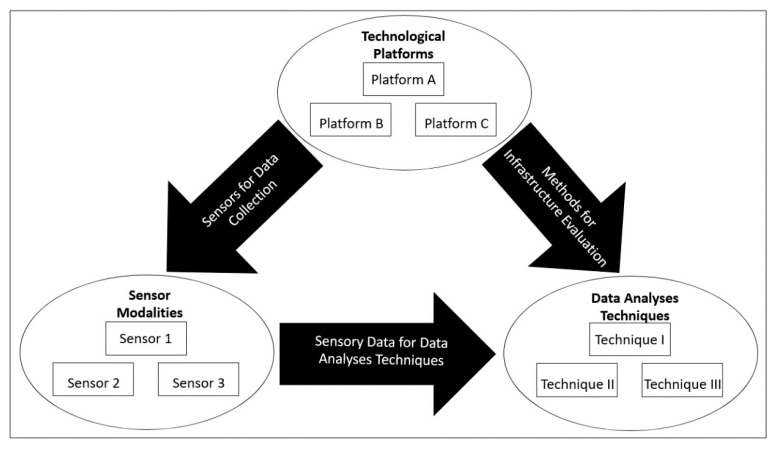
The non-destructive evaluation (NDE) of civil infrastructure has been an active area of research in recent decades. The traditional inspection of civil infrastructure mostly relies on visual inspection using human inspectors. To facilitate this process, different sensors for data collection and techniques for data analyses have been used to effectively carry out this task in an automated fashion. This review-based study will examine some of the recent developments in the field of autonomous robotic platforms for NDE and the structural health monitoring (SHM) of bridges. Some of the salient features of this review-based study will be discussed in the light of the existing surveys and reviews that have been published in the recent past, which will enable the clarification regarding the novelty of the present review-based study. The review methodology will be discussed in sufficient depth, which will provide insights regarding some of the primary aspects of the review methodology followed by this review-based study. In order to provide an in-depth examination of the state-of-the-art, the current research will examine the three major research streams. The first stream relates to technological robotic platforms developed for NDE of bridges. The second stream of literature examines myriad sensors used for the development of robotic platforms for the NDE of bridges. The third stream of literature highlights different algorithms for the surface- and sub-surface-level analysis of bridges that have been developed by studies in the past. A number of challenges towards the development of robotic platforms have also been discussed.
Keywords: NDE sensor fusion; concrete crack detection; convolutional neural network (CNNs); electric resistivity (ER) sensors; ground-penetrating radar (GPR); impact echo (IE); infrared (IR) thermography; non-destructive evaluation (NDE); rebar detection and localization; structural health monitoring (SHM).
Conflict of interest statement
The authors declare no conflict of interest.
Figures
References
-
- Penn A. The Deadliest Bridge Collapses in the US in the Last 50 Years. [(accessed on 20 June 2020)]; Available online: https://www.cnn.com/2018/03/15/us/bridge-collapse-history-trnd/index.html.
-
- Kirk S.R., Mallett J.W. Highway Bridge Conditions: Issues for Congress. Congressional Research Service; Washington, DC, USA: Dec 19, 2013.
-
- Wright L., Chinowsky P., Strzepek K., Jones R., Streeter R., Smith J.B., Mayotte J.-M., Powell A., Jantarasami L., Perkins W. Estimated effects of climate change on flood vulnerability of U.S. bridges. Mitig. Adapt. Strat. Glob. Chang. 2012;17:939–955. doi: 10.1007/s11027-011-9354-2. - DOI
-
- Briaud J.-L., Brandimarte L., Wang J., D’Odorico P. Probability of scour depth exceedance owing to hydrologic uncertainty. Georisk Assess. Manag. Risk Eng. Syst. Geohazards. 2007;1:77–88. doi: 10.1080/17499510701398844. - DOI
-
- US Department of Transportation Report. Department of Transportation; Washington, DC, USA: 2015. 2015 Status of the Nation’s Highways, Bridges, and Transit: Conditions and Performance.
Publication types
Grants and funding
LinkOut - more resources
Full Text Sources
Miscellaneous
