


Neutralizing Antibody Production in Asymptomatic and Mild COVID-19 Patients, in Comparison with Pneumonic COVID-19 Patients
- PMID: 32708872
- PMCID: PMC7408950
- DOI: 10.3390/jcm9072268
Neutralizing Antibody Production in Asymptomatic and Mild COVID-19 Patients, in Comparison with Pneumonic COVID-19 Patients
Abstract
Objectives: To investigate antibody production in asymptomatic and mild COVID-19 patients.
Methods: Sera from asymptomatic to severe COVID-19 patients were collected. Microneutralization (MN), fluorescence immunoassay (FIA), and enzyme-linked immunosorbent assay (ELISA) were performed.
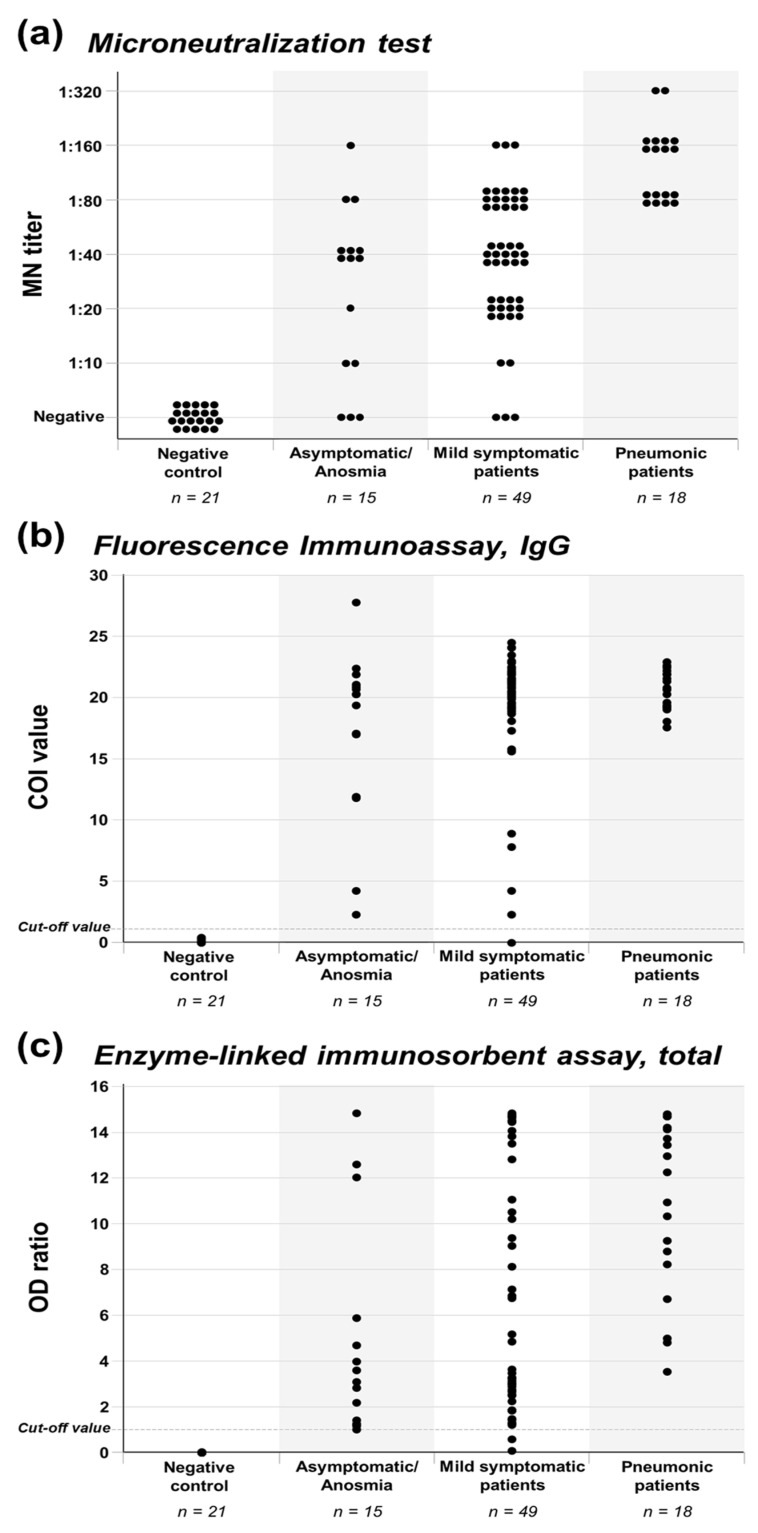
Results: A total of 70 laboratory-confirmed COVID-19 patients were evaluated, including 15 asymptomatic/anosmia, 49 mild symptomatic, and 6 pneumonia patients. The production of the neutralizing antibody was observed in 100% of pneumonia, 93.9% of mild symptomatic, and 80.0% of asymptomatic/anosmia groups. All the patients in the pneumonia group showed high MN titer (≥1:80), while 36.7% of mild symptomatic and 20.0% of asymptomatic/anosmia groups showed high titer (p < 0.001). Anti-SARS-CoV-2 antibodies could be more sensitively detected by FIA IgG (98.8%) and ELISA (97.6%) in overall. For the FIA IgG test, all patients in the pneumonia group exhibited a high COI value (≥15.0), while 89.8% of mild symptomatic and 73.3% of asymptomatic/anosmia groups showed a high value (p = 0.049). For the ELISA test, all patients in the pneumonia group showed a high optical density (OD) ratio (≥3.0), while 65.3% of mild symptomatic and 53.3% of asymptomatic/anosmia groups showed a high ratio (p = 0.006).
Conclusions: Most asymptomatic and mild COVID-19 patients produced the neutralizing antibody, although the titers were lower than pneumonia patients. ELISA and FIA sensitively detected anti-SARS-CoV-2 antibodies.
Keywords: COVID-19; asymptomatic; mild; neutralizing antibody; serology.
Conflict of interest statement
There are no potential conflicts of interest relevant to this article to report.
Figures
References
-
- WHO Coronavirus Disease (COVID-19) Outbreak Situation. [(accessed on 12 July 2020)]; Available online: https://www.who.int/emergencies/diseases/novel-coronavirus-2019.
-
- Kim J.Y., Choe P.G., Oh Y., Oh K.J., Kim J., Park S.J., Park J.H., Na H.K., Oh M.-D. The First Case of 2019 Novel Coronavirus Pneumonia Imported into Korea from Wuhan, China: Implication for Infection Prevention and Control Measures. J. Korean Med. Sci. 2020;35:e61. doi: 10.3346/jkms.2020.35.e61. - DOI - PMC - PubMed
LinkOut - more resources
Full Text Sources
Miscellaneous
