Review
. 2020 Jul 17;21(14):5064.
doi: 10.3390/ijms21145064.

Targeting Cannabinoid Receptors: Current Status and Prospects of Natural Products

Affiliations
Review

Targeting Cannabinoid Receptors: Current Status and Prospects of Natural Products

Dongchen An et al. Int J Mol Sci. .

Abstract

Cannabinoid receptors (CB1 and CB2), as part of the endocannabinoid system, play a critical role in numerous human physiological and pathological conditions. Thus, considerable efforts have been made to develop ligands for CB1 and CB2, resulting in hundreds of phyto- and synthetic cannabinoids which have shown varying affinities relevant for the treatment of various diseases. However, only a few of these ligands are clinically used. Recently, more detailed structural information for cannabinoid receptors was revealed thanks to the powerfulness of cryo-electron microscopy, which now can accelerate structure-based drug discovery. At the same time, novel peptide-type cannabinoids from animal sources have arrived at the scene, with their potential in vivo therapeutic effects in relation to cannabinoid receptors. From a natural products perspective, it is expected that more novel cannabinoids will be discovered and forecasted as promising drug leads from diverse natural sources and species, such as animal venoms which constitute a true pharmacopeia of toxins modulating diverse targets, including voltage- and ligand-gated ion channels, G protein-coupled receptors such as CB1 and CB2, with astonishing affinity and selectivity. Therefore, it is believed that discovering novel cannabinoids starting from studying the biodiversity of the species living on planet earth is an uncharted territory.

Keywords: animal venoms; cannabinoid receptor type 1 (CB1) and type 2 (CB2); phytocannabinoids; structural analysis; synthetic cannabinoids.


Conflict of interest statement

The authors declare no conflict of interest.

Figures
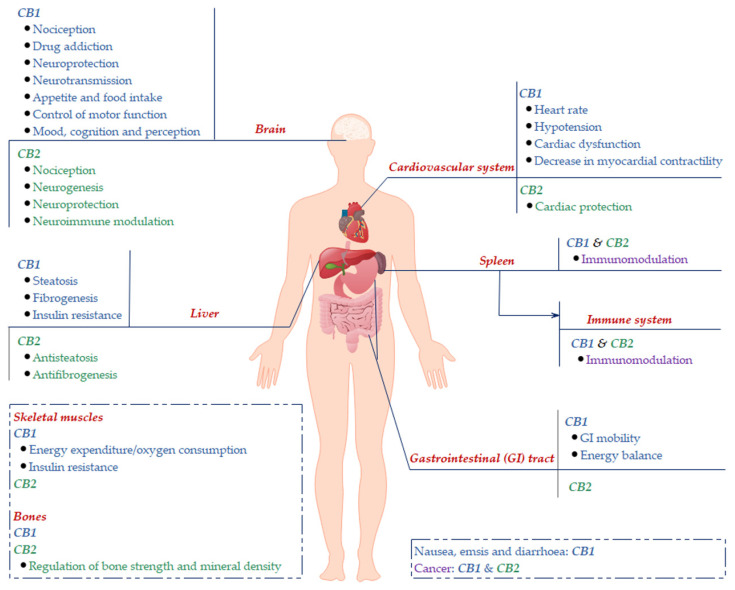
Figure 1
Figure 1
Major localization of CB1 and CB2 and their associated physiology in the human body. CB1: the majority of CB1 was found to be expressed in the brain, where it modulates various neurological activities. CB1 is located in the peripheral tissues, and, although to a lesser extent, also participates in the modulations of local tissue functions. CB2: the predominant expression of CB2 was revealed to be in the immune system (such as the spleen), where it exhibits the effects of immune modulation, and other peripheral tissues.
Figure 2
Figure 2
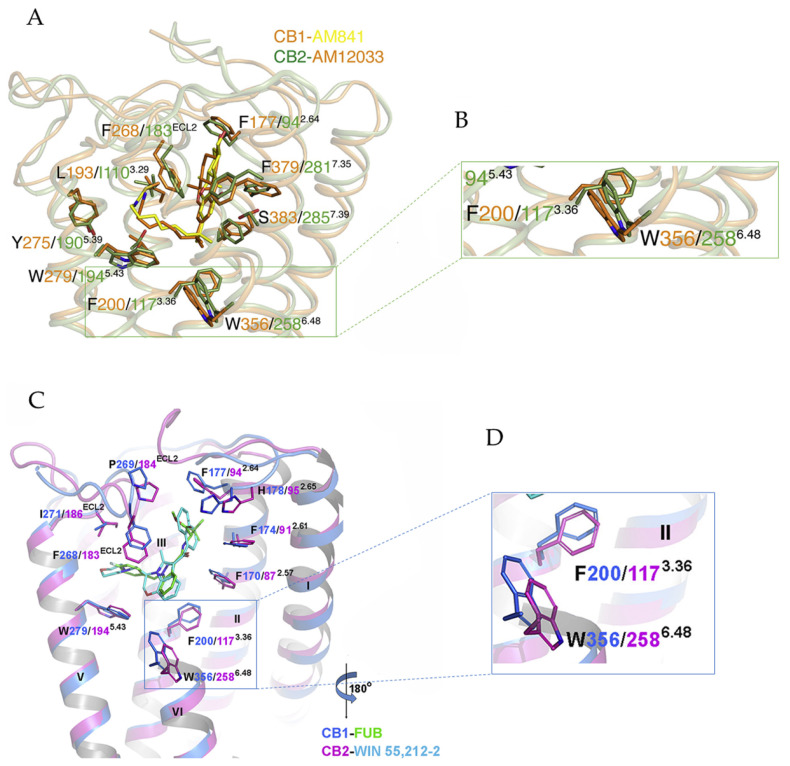
(A) Binding pocket of human CB1-Gi complex bound to agonist AM841 and human CB2-Gi complex bound to agonist AM12033. Orange cartoon, CB1 structure; green cartoon, CB2 structure; yellow sticks, AM841; orange sticks, AM12033. (B) Comparison of the “toggle switch” residue conformation in human CB1, orange cartoon; and in human CB2, green cartoon. (C) Binding pocket of human CB1-Gi complex bound to agonist FUB and human CB2-Gi complex bound to agonist WIN 55,212-2. Marine cartoon, CB1 structure; purple cartoon, CB2 structure; green sticks, FUB; cyan sticks, WIN 55,212-2. (D) Comparison of the “toggle switch” residue conformation in human CB1, marine cartoon; and in human CB2, purple cartoon. (A) and (B) are derived from Hua et al. [29], (C) and (D) are derived from Xing et al. [28].
Figure 3
Figure 3
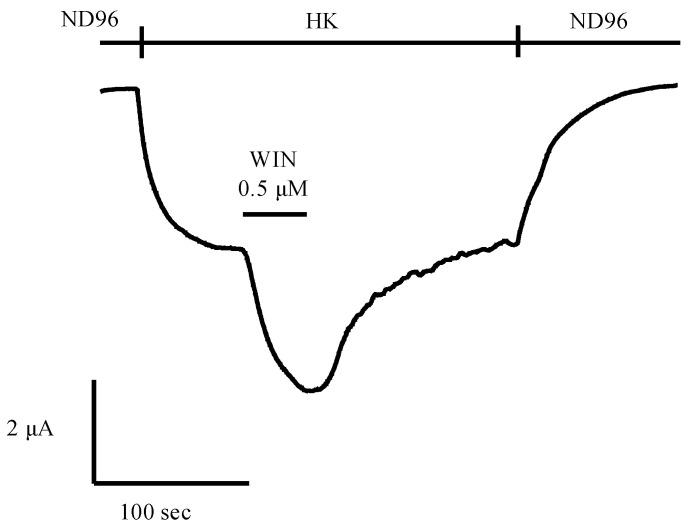
Cannabinoid agonist WIN-55,212-2 (WIN) activated inwardly rectifying potassium currents in oocytes co-expressing GIRK1/2 + RGS4 with CB1. Currents were induced by exchanging ND96 with HK while the oocytes were voltage-clamped at −90 mV. Current enhancement observed on application of 0.5 μM WIN in the presence of HK. In the final, oocytes were perfused with ND96. The experiment was repeated in at least 4 oocytes. In the case of CB2, a similar approach is followed. ND96: physiological salt buffer solution (96 mM NaCl, 2 mM MgCl2, 2 mM KCl, 5 mM HEPES, and 1.8 mM CaCl2, with a final pH of 7.5), HK: high potassium solution for the measurement of K+ currents through GIRK1/2 channels (96 mM KCl, 2 mM NaCl, 1 mM MgCl2, 1.8 mM CaCl2, 5 mM HEPES with a final pH of 7.5).

References

    1. Pertwee R.G. Cannabinoid pharmacology: The first 66 years. Br. J. Pharmacol. 2006;147 doi: 10.1038/sj.bjp.0706406. - DOI - PMC - PubMed
    1. Cristino L., Bisogno T., Di Marzo V. Cannabinoids and the expanded endocannabinoid system in neurological disorders. Nat. Rev. Neurol. 2020;16:9–29. doi: 10.1038/s41582-019-0284-z. - DOI - PubMed
    1. Munro S., Thomas K.L., Abu-Shaar M. Molecular characterization of a peripheral receptor for cannabinoids. Nature. 1993;365:61–65. doi: 10.1038/365061a0. - DOI - PubMed
    1. Matsuda L.A., Lolait S.J., Brownstein M.J., Young A.C., Bonner T.I. Structure of a cannabinoid receptor and functional expression of the cloned cDNA. Nature. 1990;346:561–564. doi: 10.1038/346561a0. - DOI - PubMed
    1. Ye L., Cao Z., Wang W., Zhou N. New insights in cannabinoid receptor structure and signaling. Curr. Mol. Pharmacol. 2019;12:239–248. doi: 10.2174/1874467212666190215112036. - DOI - PMC - PubMed

MeSH terms

LinkOut - more resources