. 2020 Jul 17;25(14):3270.
doi: 10.3390/molecules25143270.

In Vitro Hormetic Effect Investigation of Thymol on Human Fibroblast and Gastric Adenocarcinoma Cells

Affiliations

In Vitro Hormetic Effect Investigation of Thymol on Human Fibroblast and Gastric Adenocarcinoma Cells

Ayse Günes-Bayir et al. Molecules. .

Abstract

The concept of hormesis includes a biphasic cellular dose-response to a xenobiotic stimulus defined by low dose beneficial and high dose inhibitory or toxic effects. In the present study, an attempt has been made to help elucidate the beneficial and detrimental effects of thymol on different cell types by evaluating and comparing the impact of various thymol doses on cancerous (AGS) and healthy (WS-1) cells. Cytotoxic, genotoxic, and apoptotic effects, as well as levels of reactive oxygen species and glutathione were studied in both cell lines exposed to thymol (0-600 µM) for 24 h. The results showed significant differences in cell viability of AGS compared to WS-1 cells exposed to thymol. The differences observed were statistically significant at all doses applied (P ≤ 0.001) and revealed hormetic thymol effects on WS-1 cells, whereas toxic effects on AGS cells were detectable at all thymol concentrations. Thymol at low concentrations provides antioxidative protection to WS-1 cells in vitro while already inducing toxic effects in AGS cells. In that sense, the findings of the present study suggest that thymol exerts a dose-dependent hormetic impact on different cell types, thereby providing crucial information for future in vivo studies investigating the therapeutic potential of thymol.

Keywords: cancerous cells; healthy cells; hormetic effect; thymol.


Conflict of interest statement

The authors declare no conflicts of interest.

Figures

Figure 1
Figure 1
Cytotoxicity effect of thymol (0–600 μM) after 24 h incubation was studied in healthy and cancerous cells. All values are expressed as the mean ± SD. * Differences were considered significant compared to the control group from P ≤ 0.001. SD: Standard deviation.
Figure 2
Figure 2
Reactive oxygen species (ROS) levels in healthy and cancerous cells exposed to thymol (0–100 μM) were investigated by DCFH-DA assay after 24 h incubation. All values are expressed as the mean ± SD. * Differences were considered significant compared to the control group from P ≤ 0.001. SD: Standard deviation.
Figure 3
Figure 3
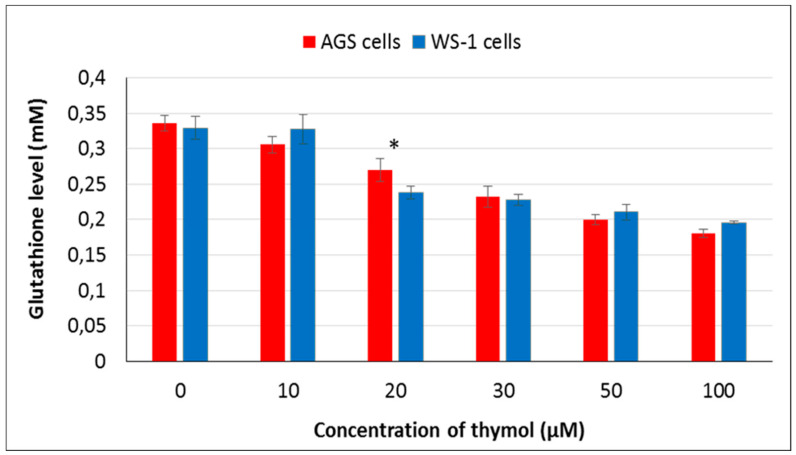
GSH levels in healthy and cancerous cells were shown after 24 h of exposure to thymol (0–100 μM). All values are expressed as the mean ± SD. * Differences were considered significant compared to the control group from P ≤ 0.001. SD: Standard deviation.
Figure 4
Figure 4
Morphological changes in healthy and cancerous cells were demonstrated, which were exposed to thymol (0–100 μM) after 24h incubation. (a) Apoptotic and (b) necrotic effects of thymol on both cell cultures are given in comparison with control cells as percentages. All values are expressed as the mean ± SD. * Differences were considered significant compared to the control group from P ≤ 0.001. SD: Standard deviation.
Figure 4
Figure 4
Morphological changes in healthy and cancerous cells were demonstrated, which were exposed to thymol (0–100 μM) after 24h incubation. (a) Apoptotic and (b) necrotic effects of thymol on both cell cultures are given in comparison with control cells as percentages. All values are expressed as the mean ± SD. * Differences were considered significant compared to the control group from P ≤ 0.001. SD: Standard deviation.
Figure 5
Figure 5
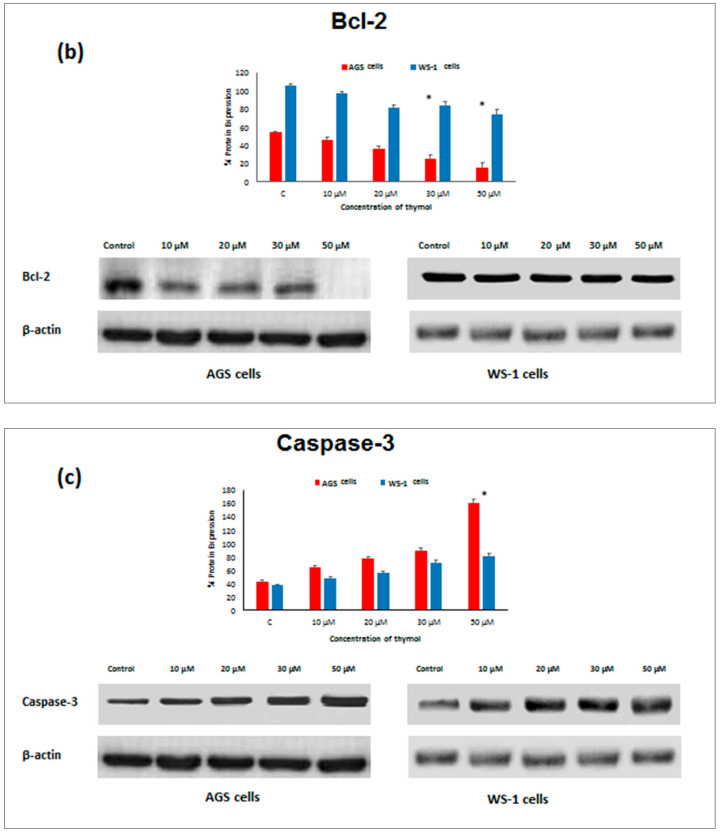
Thymol induced apoptosis was detected by Western blotting. Healthy and cancerous cells were treated with 0–50 μM of thymol. Expressions of Bax (a), Bcl-2 (b), Caspase-3 (c), and Caspase-9 (d) proteins are presented as percentages as well as on gel. All values are expressed as the mean ± SD. * Differences were considered significant compared to the control group from P ≤ 0.001. SD: Standard deviation. C: Control.
Figure 5
Figure 5
Thymol induced apoptosis was detected by Western blotting. Healthy and cancerous cells were treated with 0–50 μM of thymol. Expressions of Bax (a), Bcl-2 (b), Caspase-3 (c), and Caspase-9 (d) proteins are presented as percentages as well as on gel. All values are expressed as the mean ± SD. * Differences were considered significant compared to the control group from P ≤ 0.001. SD: Standard deviation. C: Control.
Figure 5
Figure 5
Thymol induced apoptosis was detected by Western blotting. Healthy and cancerous cells were treated with 0–50 μM of thymol. Expressions of Bax (a), Bcl-2 (b), Caspase-3 (c), and Caspase-9 (d) proteins are presented as percentages as well as on gel. All values are expressed as the mean ± SD. * Differences were considered significant compared to the control group from P ≤ 0.001. SD: Standard deviation. C: Control.
Figure 6
Figure 6
The genotoxic effect of thymol on healthy and cancerous cells was detected by comet assay. Cells exposed to thymol (0–50 μM) were analyzed after 24 h of incubation. All values are expressed as the mean ± SD. * Differences were considered significant compared to the control group from P ≤ 0.001. SD: Standard deviation.

References

    1. Calabrese E.J. Biphasic dose responses in biology, toxicology and medicine: Accounting for their generalizability and quantitative features. Environ. Pollut. 2013;182:452–460. doi: 10.1016/j.envpol.2013.07.046. - DOI - PubMed
    1. Calabrese E.J. Cancer biology and hormesis: Human tumor cell lines commonly display hermetic (biphasic) dose responses. Crit. Rev. Toxicol. 2005;35:463–582. doi: 10.1080/10408440591034502. - DOI - PubMed
    1. Nagini S. Carcinoma of the stomach: A review of epidemiology, pathogenesis, molecular genetics and chemoprevention. World J. Gastrointest. Oncol. 2012;4:156–169. doi: 10.4251/wjgo.v4.i7.156. - DOI - PMC - PubMed
    1. Ferguson L.R. Role of plant polyphenols in genomic stability. Mutat. Res. 2001;475:89–111. doi: 10.1016/S0027-5107(01)00073-2. - DOI - PubMed
    1. Elmore S. Apoptosis: A Review of Programmed Cell Death. Toxicol. Pathol. 2007;35:495–516. doi: 10.1080/01926230701320337. - DOI - PMC - PubMed

MeSH terms