


Microbial involvement in Alzheimer disease development and progression
- PMID: 32709243
- PMCID: PMC7382139
- DOI: 10.1186/s13024-020-00378-4
Microbial involvement in Alzheimer disease development and progression
Abstract
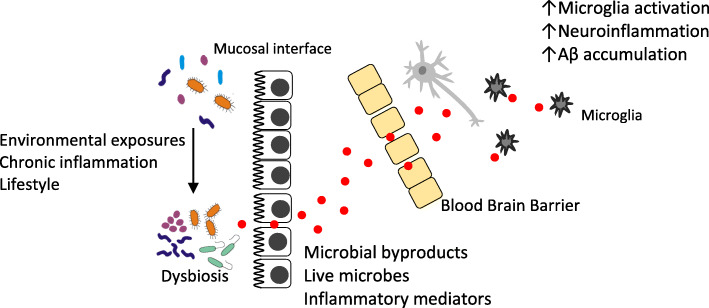
Alzheimer disease (AD) is the most prominent form of dementia and the 5th leading cause of death in individuals over 65. AD is a complex disease stemming from genetic, environmental, and lifestyle factors. It is known that AD patients have increased levels of senile plaques, neurofibrillary tangles, and neuroinflammation; however, the mechanism(s) by which the plaques, tangles, and neuroinflammation manifest remain elusive. A recent hypothesis has emerged that resident bacterial populations contribute to the development and progression of AD by contributing to neuroinflammation, senile plaque formation, and potentially neurofibrillary tangle accumulation (Fig. 1). This review will highlight recent studies involved in elucidating microbial involvement in AD development and progression.
Keywords: Alzheimer disease; Gut microbiota; Oral microbiota.
Conflict of interest statement
The authors declare they have no competing interests.
Figures
References
-
- Dorszewska J, Prendecki M, Oczkowska A, Dezor M, Kozubski W. Molecular basis of familial and sporadic Alzheimer's disease. Curr Alzheimer Res. 2016;13(9):952–963. - PubMed
-
- Martin L, Latypova X, Wilson CM, Magnaudeix A, Perrin ML, Yardin C, et al. Tau protein kinases: involvement in Alzheimer’s disease. Ageing Res Rev. 2013;12(1):289–309. - PubMed
-
- Rabia Sajjad RA, Shah AA, Manzoor I, Mustafa G. Pathogenesis of Alzheimer’s disease: role of amyloid-beta and Hyperphosphorylated tau protein [review] 2018.
Publication types
MeSH terms
Substances
Grants and funding
LinkOut - more resources
Full Text Sources
Medical
