


Multivariate Analysis of Black Race and Environmental Temperature on COVID-19 in the US
- PMID: 32709397
- PMCID: PMC7305735
- DOI: 10.1016/j.amjms.2020.06.015
Multivariate Analysis of Black Race and Environmental Temperature on COVID-19 in the US
Abstract
Background: There has been much interest in environmental temperature and race as modulators of Coronavirus disease-19 (COVID-19) infection and mortality. However, in the United States race and temperature correlate with various other social determinants of health, comorbidities, and environmental influences that could be responsible for noted effects. This study investigates the independent effects of race and environmental temperature on COVID-19 incidence and mortality in United States counties.
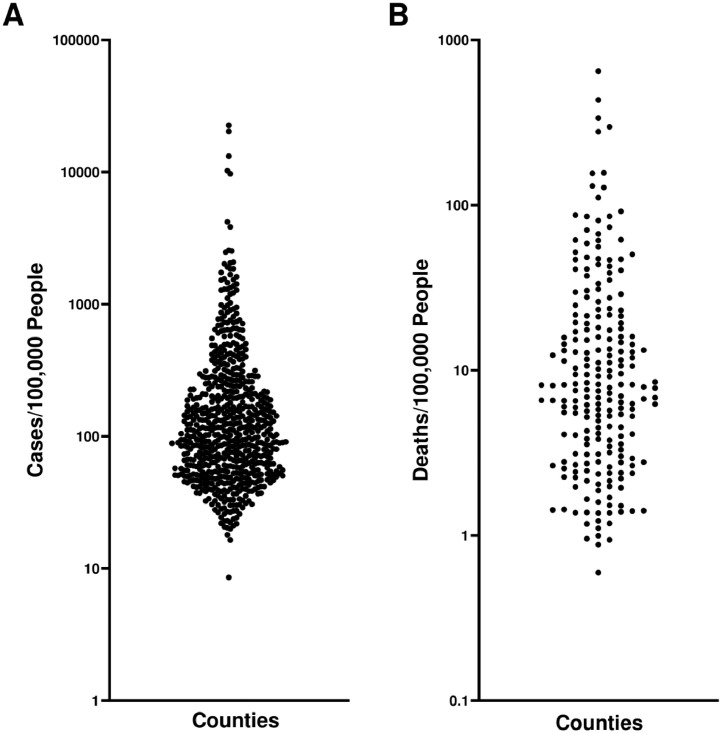
Methods: Data on COVID-19 and risk factors in all United States counties was collected. 661 counties with at least 50 COVID-19 cases and 217 with at least 10 deaths were included in analyses. Upper and lower quartiles for cases/100,000 people and halves for deaths/100,000 people were compared with t-tests. Adjusted linear and logistic regression analyses were performed to evaluate the independent effects of race and environmental temperature.
Results: Multivariate regression analyses demonstrated Black race is a risk factor for increased COVID-19 cases (OR=1.22, 95% CI: 1.09-1.40, P=0.001) and deaths independent of comorbidities, poverty, access to health care, and other risk factors. Higher environmental temperature independently reduced caseload (OR=0.81, 95% CI: 0.71-0.91, P=0.0009), but not deaths.
Conclusions: Higher environmental temperatures correlated with reduced COVID-19 cases, but this benefit does not yet appear in mortality models. Black race was an independent risk factor for increased COVID-19 cases and deaths. Thus, many proposed mechanisms through which Black race might increase risk for COVID-19, such as socioeconomic and healthcare-related predispositions, are inadequate in explaining the full magnitude of this health disparity.
Keywords: Black Race; COVID-19; Coronavirus; Environmental temperature; SARS-CoV-2.
Copyright © 2020 Southern Society for Clinical Investigation. Published by Elsevier Inc. All rights reserved.
Figures
Comment in
-
On Race and the Environment in the COVID-19 Pandemic.Am J Med Sci. 2020 Oct;360(4):327-328. doi: 10.1016/j.amjms.2020.07.014. Epub 2020 Jul 13. Am J Med Sci. 2020. PMID: 32747006 Free PMC article. No abstract available.
References
-
- Al-Rousan N, Al-Najjar H. The correlation between the spread of COVID-19 infections and weather variables in 30 Chinese provinces and the impact of Chinese government mitigation plans. Eur Rev Med Pharmacol Sci. 2020;24(8):4565–4571. - PubMed
MeSH terms
LinkOut - more resources
Full Text Sources
Miscellaneous
