. 2020 Jul 24;10(1):12394.
doi: 10.1038/s41598-020-69389-x.

A high-quality reference genome for cabbage obtained with SMRT reveals novel genomic features and evolutionary characteristics

Affiliations

A high-quality reference genome for cabbage obtained with SMRT reveals novel genomic features and evolutionary characteristics

Honghao Lv et al. Sci Rep. .

Abstract

Cabbage (Brassica oleracea var. capitata) is an important vegetable crop widely grown throughout the world, providing plentiful nutrients and health-promoting substances. To facilitate further genetics and genomic studies and crop improvement, we present here a high-quality reference genome for cabbage. We report a de novo genome assembly of the cabbage double-haploid line D134. A combined strategy of single-molecule real-time (SMRT) sequencing, 10× Genomics and chromosome conformation capture (Hi-C) produced a high quality cabbage draft genome. The chromosome-level D134 assembly is 529.92 Mb in size, 135 Mb longer than the current 02-12 reference genome, with scaffold N50 length being raised as high as 38 times. We annotated 44,701 high-quality protein-coding genes, and provided full-length transcripts for 45.59% of the total predicted gene models. Moreover, we identified novel genomic features like underrated TEs, as well as gene families and gene family expansions and contractions during B. oleracea evolution. The D134 draft genome is a cabbage reference genome assembled by SMRT long-read sequencing combined with the 10× Genomics and Hi-C technologies for scaffolding. This high-quality cabbage reference genome provides a valuable tool for improvement of Brassica crops.


Conflict of interest statement

The authors declare no competing interest.

Figures
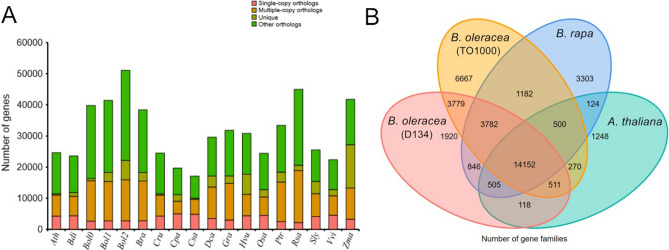
Figure 1
Figure 1
Distribution of genes in cabbage D134 and other representative plant species. (A) Orthologous genes found in different plant species. Ath, A. thaliana; Bdi, B. distachyon; Bol0, B. oleracea (D134); Bol1, B. oleracea (02-12); Bol2, B. oleracea (TO1000); Bra, B. rapa; Cru, C. rubella; Cpa, C. papaya; Csa, C. sativus; Dca, D. carota; Gra, G. raimondii; Hvu, H. vulgare; Osa, O. sativa; Ptr, P. trichocarpa; Rsa, R. sativus; Sly, S. lycopersicum; Vvi, V. vinifera; Zma, Z. mays. (B) Venn diagram showing unique and shared gene families among A. thaliana, B. rapa and B. oleracea (D134 and TO1000).
Figure 2
Figure 2
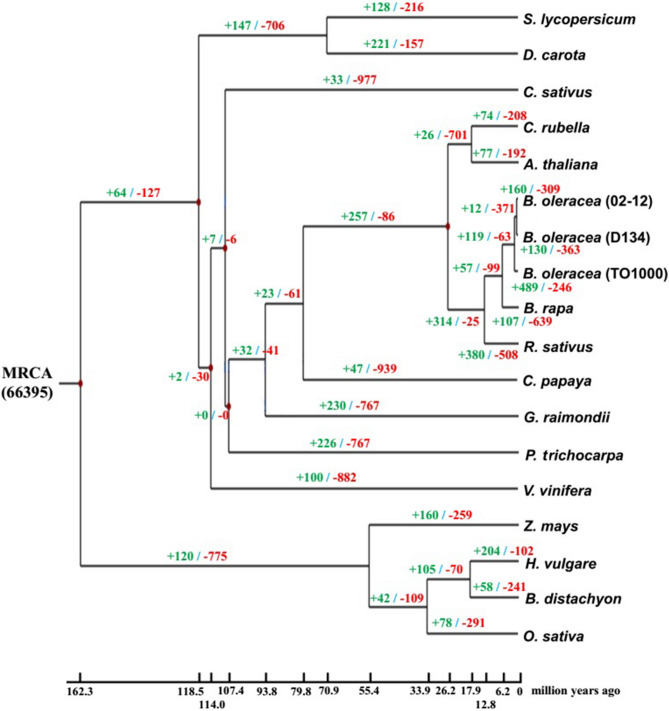
Phylogenetic tree showing divergence times and the evolution of gene family sizes. The phylogenetic tree shows the topology and divergence times for 18 plant species. MRCA, most recent common ancestor. The number in parentheses is the number of gene families in the MRCA as estimated by CAFÉ.
Figure 3
Figure 3
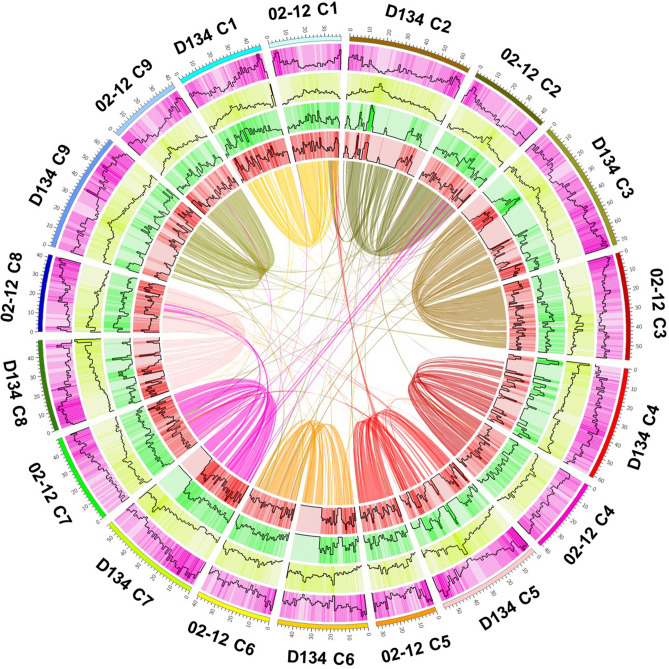
Genomic landscape of D134 and 02-12. Chromosomes, gene density, TE density, SNP density, indel density and best-hit gene pairs are in order from outside to inside in the Circos images.

References

    1. Jaillon O, Aury JM, Noel B, Policriti A, Clepet C, Casagrande A. The grapevine genome sequence suggests ancestral hexaploidization in major angiosperm phyla. Nature. 2007;449:463–467. doi: 10.1038/nature06148. - DOI - PubMed
    1. Bowers JE, Chapman BA, Rong J, Paterson AH. Unravelling angiosperm genome evolution by phylogenetic analysis of chromosomal duplication events. Nature. 2003;422:433–438. doi: 10.1038/nature01521. - DOI - PubMed
    1. Jiao Y, Wickett NJ, Ayyampalayam S, Chanderbali AS, Landherr L, Ralph PE, et al. Ancestral polyploidy in seed plants and angiosperms. Nature. 2011;473:97–100. doi: 10.1038/nature09916. - DOI - PubMed
    1. Wang X, Wang H, Wang J, Sun R, Wu J, Liu S, et al. The genome of the mesopolyploid crop species Brassica rapa. Nat. Genet. 2011;43:1035–1039. doi: 10.1038/ng.919. - DOI - PubMed
    1. Parkin IA, Koh C, Tang H, Robinson SJ, Kagale S, Clarke WE, et al. Transcriptome and methylome profiling reveals relics of genome dominance in the mesopolyploid Brassica oleracea. Genome Biol. 2014;15:R77. doi: 10.1186/gb-2014-15-6-r77. - DOI - PMC - PubMed

Publication types