


Deaths Attributable to Cancer in the US Human Immunodeficiency Virus Population During 2001-2015
- PMID: 32710777
- PMCID: PMC8096269
- DOI: 10.1093/cid/ciaa1016
Deaths Attributable to Cancer in the US Human Immunodeficiency Virus Population During 2001-2015
Erratum in
-
Erratum to: Deaths Attributable to Cancer in the US Human Immunodeficiency Virus Population During 2001-2015.Clin Infect Dis. 2022 Jan 29;74(2):373. doi: 10.1093/cid/ciab805. Clin Infect Dis. 2022. PMID: 34931234 Free PMC article. No abstract available.
Abstract
Background: Antiretroviral therapy (ART) has reduced mortality among people living with human immunodeficiency virus (HIV), but cancer remains an important cause of death. We characterized cancer-attributable mortality in the HIV population during 2001-2015.
Methods: We used data from population-based HIV and cancer registries in the United States (US). Cox proportional hazards regression models were used to estimate adjusted hazard ratios (HRs) associating cancer diagnoses with overall mortality, we could perhaps cut these words to accommodate the word limit. However readers will probably want to know what statistical adjustments were made to the model. Population-attributable fractions (PAFs) were calculated using these HRs and the proportion of deaths preceded by cancer. Cancer-specific PAFs and cancer-attributable mortality rates were calculated for demographic subgroups, AIDS-defining cancers (Kaposi sarcoma [KS], non-Hodgkin lymphoma [NHL], cervical cancer), and non-AIDS-defining cancers.
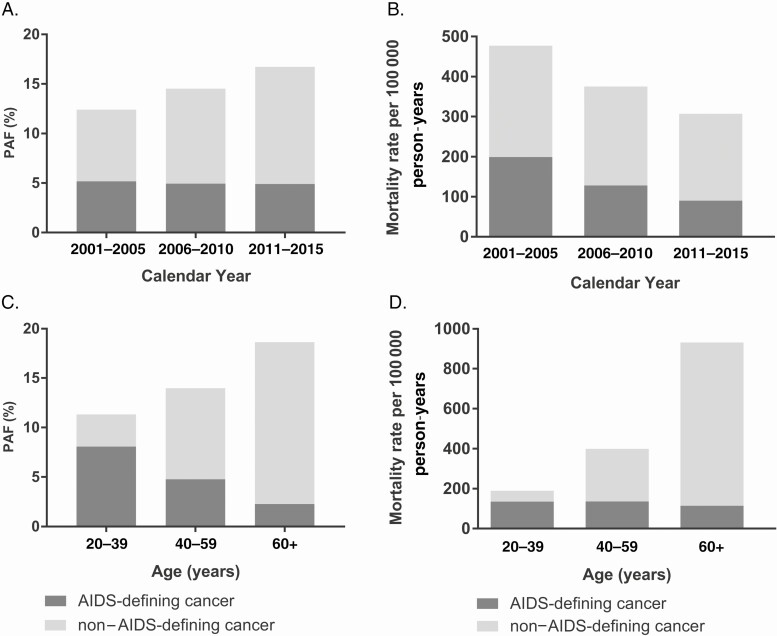
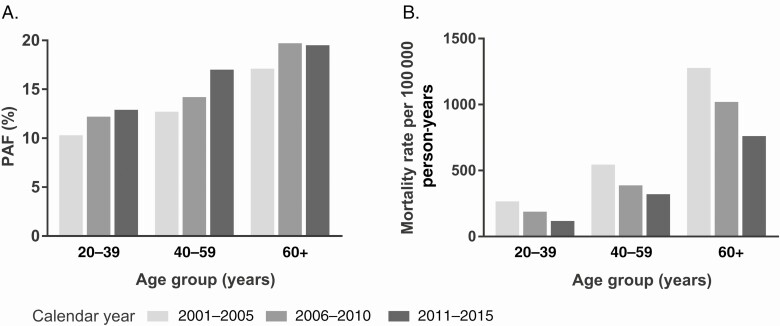
Results: Cancer-attributable mortality was 386.9 per 100 000 person-years, with 9.2% and 5.0% of deaths attributed to non-AIDS-defining and AIDS-defining cancers, respectively. Leading cancer-attributable deaths were from NHL (3.5%), lung cancer (2.4%), KS (1.3%), liver cancer (1.1%), and anal cancer (0.6%). Overall, cancer-attributable mortality declined from 484.0 per 100 000 person-years during 2001-2005 to 313.6 per 100 000 person-years during 2011-2015, while the PAF increased from 12.6% to 17.1%; the PAF for non-AIDS-defining cancers increased from 7.2% to 11.8% during 2011-2015. Cancer-attributable mortality was highest among those aged ≥60 years (952.2 per 100 000 person-years), with 19.0% of deaths attributed to non-AIDS-defining cancers.
Conclusions: Although cancer-attributable mortality has declined over time, it remains high and represents a growing fraction of deaths in the US HIV population. Mortality from non-AIDS-defining cancers may rise as the HIV population ages. ART access, early cancer detection, and improved cancer treatment are priorities for reducing cancer-attributable mortality.
Keywords: AIDS; cancer; human immunodeficiency virus; mortality; population-attributable fraction.
Published by Oxford University Press for the Infectious Diseases Society of America 2020.
Figures
References
-
- Hammer SM, Squires KE, Hughes MD, et al. . A controlled trial of two nucleoside analogues plus indinavir in persons with human immunodeficiency virus infection and CD4 cell counts of 200 per cubic millimeter or less. AIDS Clinical Trials Group 320 Study Team. N Engl J Med 1997; 337:725–33. - PubMed
-
- Engels EA, Biggar RJ, Hall HI, et al. . Cancer risk in people infected with human immunodeficiency virus in the United States. Int J Cancer 2008; 123:187–94. - PubMed
-
- Patel P, Hanson DL, Sullivan PS, et al. . Incidence of types of cancer among HIV-infected persons compared with the general population in the United States, 1992–2003. Ann Intern Med 2008; 148:728–36. - PubMed
