


Factors influencing utilization of skilled birth attendant during childbirth in the Southern highlands, Tanzania: a multilevel analysis
- PMID: 32711490
- PMCID: PMC7382099
- DOI: 10.1186/s12884-020-03110-8
Factors influencing utilization of skilled birth attendant during childbirth in the Southern highlands, Tanzania: a multilevel analysis
Abstract
Background: Use of skilled health provider (SBA) during and after childbirth has been reported to reduce maternal and newborn deaths; and is one of the key indicators monitored in Sustainable Development Goals (SDGs). Progress, levels and factors influencing utilization of SBA differ within and between countries. In Tanzania, SBA coverage stands at 64% while the national target is 80%; with wide variability between regions (42-96%). This study aimed at determining factors associated with utilization of skilled births providers during childbirth in Mbeya Region, Southern highlands, Tanzania.
Methods: This was a cross-sectional analytical study conducted in December 2015 to January 2016, in Mbeya Region. A total of 2844 women of reproductive age were enrolled, but only 1777 women who reported a live birth 5 years prior to the survey were included in this analysis. Multilevel logistic regression analyses were used to determine independent factors influencing utilization of SBA during childbirth. Random effects logistic model was used to assess the variability between clusters on the odds of using skilled birth attendants during delivery.
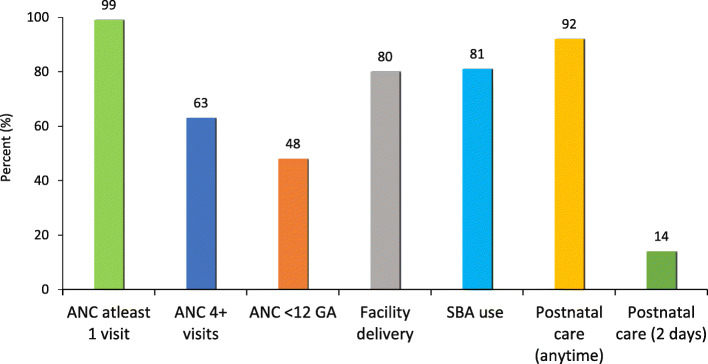
Results: In this setting, 81% of the women reported utilization of skilled births attendants during childbirth. ANC visits four times or more (aOR = 1.63-95% CI = 1.26, 2.10; p < 0.001) and having secondary education or higher (aOR = 2.16; 95% CI = 1.19-3.90; p = 0.011) were associated with increased SBA use during childbirth whereas having two (aOR = 0.51; 95% CI: 0.33-0.79; p = 0.003) or three children (aOR = 0.37; 95% CI: 0.27-0.58; p < 0.001) relative to one child, 30 to 60 min walking distance to the health facility (aOR = 0.66; 95% CI: 0.48-0.92; p = 0.012) and more than 1 h walking distance to the health facility (aOR = 0.43; 95% CI: 0.32-0.57; p < 0.001) compared to < 30 min; were associated with decreased SBA use during childbirth.
Conclusion: The proportion of births attended by skilled births attendants was high, but 19% of the women are still left behind. Concentrated efforts to improve utilization of SBA should be targeted to women with low education, with higher number of children, and with low frequency of ANC attendance. Furthermore, community and facility interventions addressing transport for pregnant women are needed. Qualitative study to explore the barriers of SBA use among the 19% who are not using skilled assistance during childbirth is needed.
Keywords: Factors; Predictors; SBA; Skilled births attendants; Southern highlands; Tanzania; Utilization.
Conflict of interest statement
The authors declare that they have no competing interests.
Figures
References
-
- WHO . Trends in maternal mortality: 2000 to 2017: estimates by WHO, UNICEF, UNFPA, World Bank Group and the United Nations population division. Geneva: World Health Organization; 2019. p. 2019.
-
- WHO . Targets and Strategies for Ending Preventable Maternal Mortality. Consensus Statement. April 2014. Geneva: Department of Reproductive Health and Research World Health Organization; 2014.
-
- WHO . Making pregnancy safer: the critical role of the skilled attendant. A joint statement by WHO, ICM and FIGO. Geneva: WHO; 2004.
-
- WHO . Definition of skilled health personnel providing care during childbirth: the 2018 joint statement by WHO, UNFPA, UNICEF, ICM, ICN, FIGO and IPA. Geneva: WHO; 2018.
-
- UNICEF . Neonatal mortality. UNICEF Data: monitoring the situation of children and women. 2019.
MeSH terms
LinkOut - more resources
Full Text Sources
Medical
