Review
. 2020 Jul 25;5(1):128.
doi: 10.1038/s41392-020-00243-2.

COVID-19: immunopathogenesis and Immunotherapeutics

Affiliations
Review

COVID-19: immunopathogenesis and Immunotherapeutics

Li Yang et al. Signal Transduct Target Ther. .

Abstract

The recent novel coronavirus disease (COVID-19) outbreak, caused by severe acute respiratory syndrome coronavirus 2 (SARS-CoV-2), is seeing a rapid increase in infected patients worldwide. The host immune response to SARS-CoV-2 appears to play a critical role in disease pathogenesis and clinical manifestations. SARS-CoV-2 not only activates antiviral immune responses, but can also cause uncontrolled inflammatory responses characterized by marked pro-inflammatory cytokine release in patients with severe COVID-19, leading to lymphopenia, lymphocyte dysfunction, and granulocyte and monocyte abnormalities. These SARS-CoV-2-induced immune abnormalities may lead to infections by microorganisms, septic shock, and severe multiple organ dysfunction. Therefore, mechanisms underlying immune abnormalities in patients with COVID-19 must be elucidated to guide clinical management of the disease. Moreover, rational management of the immune responses to SARS-CoV-2, which includes enhancing anti-viral immunity while inhibiting systemic inflammation, may be key to successful treatment. In this review, we discuss the immunopathology of COVID-19, its potential mechanisms, and clinical implications to aid the development of new therapeutic strategies against COVID-19.


Conflict of interest statement

The authors declare no competing interests.

Figures
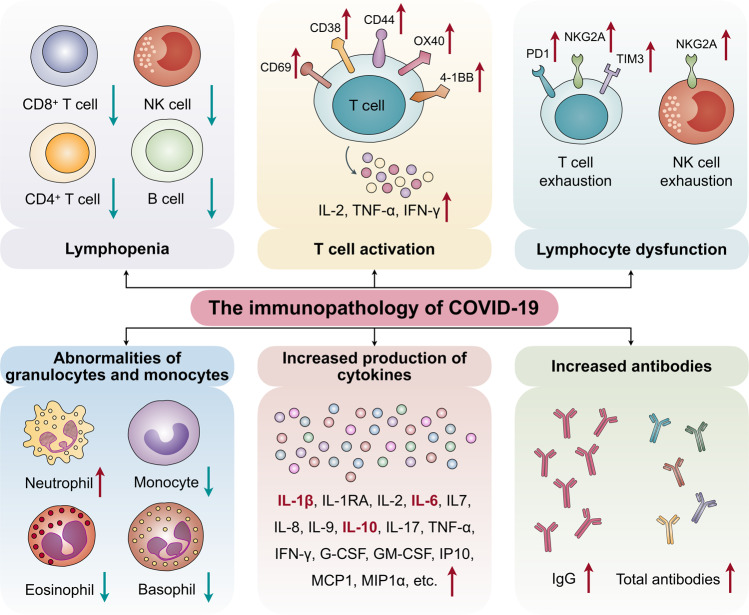
Fig. 1
Fig. 1
The immunopathology of COVID-19. The immune patterns of COVID-19 include lymphopenia, lymphocyte activation and dysfunction, abnormalities of granulocytes and monocytes, increased production of cytokines, and increased antibodies. Lymphopenia is a key feature of patients with COVID-19, especially in severe cases. CD69, CD38, and CD44 are highly expressed on CD4+ and CD8+ T cells of patients, and virus-specific T cells from severe cases exhibit a central memory phenotype with high levels of IFN-γ, TNF-α, and IL-2. However, lymphocytes show an exhaustion phenotype with programmed cell death protein-1 (PD1), T cell immunoglobulin domain and mucin domain-3 (TIM3), and killer cell lectin-like receptor subfamily C member 1 (NKG2A) upregulation. Neutrophil levels are significantly higher in severe patients, while the percentage of eosinophils, basophils, and monocytes are reduced. Increased cytokine production, especially of IL-1β, IL-6, and IL-10, is another key characteristic of severe COVID-19. IgG levels are also increased and there is a higher titer of total antibodies
Fig. 2
Fig. 2
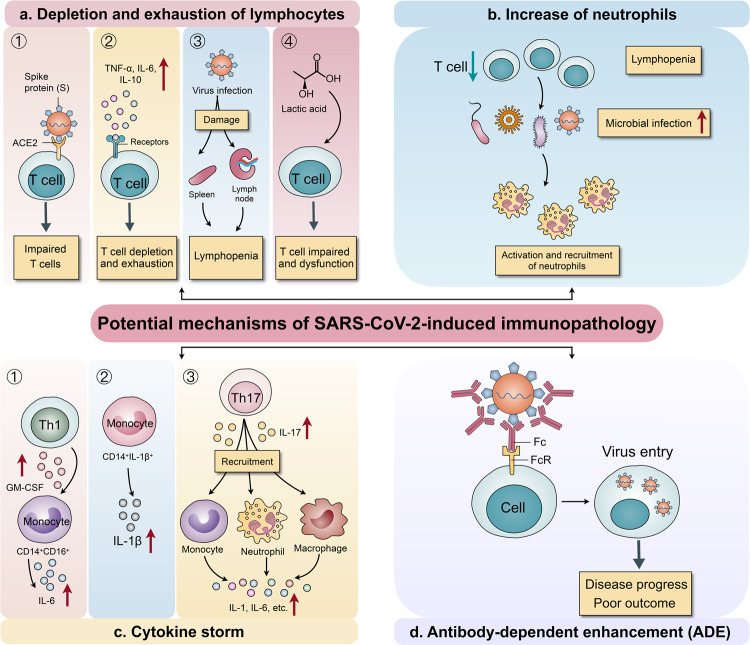
Potential mechanisms of SARS-CoV-2-induced immunopathology. a The potential mechanisms of depletion and exhaustion of lymphocytes. (1) ACE2 receptor expression on lymphocytes, especially on T cells, promotes SARS-CoV-2 entry into lymphocytes. (2) A concomitant increase in inflammatory cytokine levels promotes the depletion and exhaustion of T cells. (3) SARS-CoV-2 directly damages lymphatic organs, including the spleen and lymph nodes, inducing lymphopenia. (4) Increased lactic acid levels inhibit the proliferation and dysfunction of lymphocytes. b Lymphopenia may lead to infection with microbe, further promoting the activation and recruitment of neutrophils in the blood. c The potential mechanisms of cytokine storm induction. (1) CD4+ T cells can be rapidly activated into Th1 cells that secret GM-CSF, further inducing CD14+CD16+ monocytes with high IL-6 levels. (2) An increase in the CD14+IL-1β+ monocyte subpopulation promotes increased IL-1β production. (3) Th17 cells produce IL-17 to further recruit monocytes, macrophages, and neutrophils and stimulate other cytokine cascades, such as IL-1β and IL-6 among others. d A neutralizing monoclonal antibody targeting the virus can enhance virus entry into cells via the Fc region of the antibody bound to the Fc receptor (FcR) on cells; this is correlated with disease progression and poor outcomes of patients with COVID-19
Fig. 3
Fig. 3
Clinical implications of SARS-CoV-2-induced immunopathology. Patients with COVID-19 and presenting with lymphopenia are more prone to infections with the microbe, which leads to disease progression and increased severity. In addition, cytokine storms can initiate inflammatory-induced multiple organ dysfunction, including lung injury that can lead to ARDS, respiratory failure, liver injury with alanine aminotransferase (ALT), aspartate aminotransferase (AST), and γ-glutamine transferase (γ-GT) upregulation, kidney injury with increased urea and creatine levels, and heart injury with increased creatine kinase (CK) and lactate dehydrogenase (LDH) levels

References

    1. Zhu N, et al. A Novel Coronavirus from patients with Pneumonia in China, 2019. N. Engl. J. Med. 2020;382:727–733. - PMC - PubMed
    1. Huang C, et al. Clinical features of patients infected with 2019 novel coronavirus in Wuhan, China. Lancet. 2020;395:497–506. - PMC - PubMed
    1. Chen N, et al. Epidemiological and clinical characteristics of 99 cases of 2019 novel coronavirus pneumonia in Wuhan, China: a descriptive study. Lancet. 2020;395:507–513. - PMC - PubMed
    1. Wang, D. et al. Clinical characteristics of 138 hospitalized patients with 2019 Novel Coronavirus-infected Pneumonia in Wuhan, China. JAMA. 323, 1061–1069 (2020). - PMC - PubMed
    1. Li T, et al. Significant changes of peripheral T lymphocyte subsets in patients with severe acute respiratory syndrome. J. Infect. Dis. 2004;189:648–651. - PMC - PubMed

Publication types