Review
. 2020 Jul 2:11:969.
doi: 10.3389/fphar.2020.00969. eCollection 2020.

Pharmacogenetic Testing for Prevention of Severe Cutaneous Adverse Drug Reactions

Affiliations
Review

Pharmacogenetic Testing for Prevention of Severe Cutaneous Adverse Drug Reactions

Chih-Jung Chang et al. Front Pharmacol. .

Abstract

Severe cutaneous adverse reactions (SCAR), such as Stevens-Johnson syndrome (SJS), toxic epidermal necrolysis (TEN), and drug rash with eosinophilia and systemic symptoms (DRESS), are idiosyncratic and unpredictable drug-hypersensitivity reactions with a high-mortality rate ranging from 10% to over 30%, thus causing a major burden on the healthcare system. Recent pharmacogenomic studies have revealed strong associations between SCAR and the genes encoding human-leukocyte antigens (HLAs) or drug-metabolizing enzymes. Some of pharmacogenetic markers have been successfully applied in clinical practice to protect patients from SCAR, such as HLA-B*15:02 and HLA-A*31:01 for new users of carbamazepine, HLA-B*58:01 for allopurinol, and HLA-B*57:01 for abacavir. This article aims to update the current knowledge in the field of pharmacogenomics of drug hypersensitivities or SCAR, and its implementation in the clinical practice.

Keywords: T cell receptor; drug hypersensitivity; human-leukocyte antigen; pharmacogenetics; severe cutaneous adverse reactions.


Figures

Figure 1
Figure 1
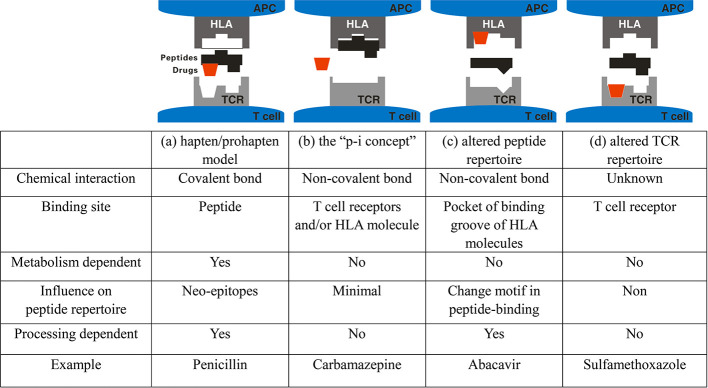
Four models of interaction between small molecule drugs and the HLA-peptide-TCR in drug hypersensitivity. (A) Hapten/pro-hapten concept: Drugs or reactive metabolites serve as haptens and bind to the endogenous peptides to form the haptenated peptides (neo-epitopes) that presented by HLA molecules at the cell surface where the novel peptide is recognized as foreign. The HLA/drug/peptide complex is recognized by TCR, which trigger the drug-specific T cell activation. (B) The “pharmacological interaction with immune receptors (p-i)” concept: T cells are proposed to recognize immunogenic complexes formed through a labile interaction of the causative drug, HLA and TCR at the cell surface or TCR and active drug-specific T cells without the intercellular processing in APC. (C) The altered repertoire model: The drug interacts with the antigen-binding cleft of the HLA molecule altering the space available to anchor residues of peptide ligands and results in selection of ligands with a novel HLA binding motif, which promotes polyclonal T-cell activation. (D) The “altered TCR repertoire” model. Drugs bind to TCR, resulting in conformational change of TCR, which then bind to the HLA/self-peptide complex to elicit immune reaction.

References

    1. Aggarwal R., Sharma M., Modi M., Garg V. K., Manilla S. (2014). HLA-B * 1502 is associated with carbamazepine induced Stevens-Johnson syndrome in North Indian population. Hum. Immunol. 75 (11), 1120–1122. 10.1016/j.humimm.2014.09.022 - DOI - PubMed
    1. Alfirevic A., Jorgensen A. L., Williamson P. R., Chadwick D. W., Park B. K., Pirmohamed M. (2006). HLA-B locus in Caucasian patients with carbamazepine hypersensitivity. Pharmacogenomics 7 (6), 813–818. 10.2217/14622416.7.6.813 - DOI - PubMed
    1. Bharadwaj M., Illing P., Theodossis A., Purcell A. W., Rossjohn J., McCluskey J. (2012). Drug hypersensitivity and human leukocyte antigens of the major histocompatibility complex. Annu. Rev. Pharmacol. Toxicol. 52, 401–431. 10.1146/annurev-pharmtox-010611-134701 - DOI - PubMed
    1. Bossi P., Roujeau J. C., Bricaire F., Caumes E. (2002). Stevens-Johnson syndrome associated with abacavir therapy. Clin. Infect. Dis. 35 (7), 902. 10.1086/342571 - DOI - PubMed
    1. Camous X., Calbo S., Picard D., Musette P. (2012). Drug Reaction with Eosinophilia and Systemic Symptoms: an update on pathogenesis. Curr. Opin. Immunol. 24 (6), 730–735. 10.1016/j.coi.2012.07.010 - DOI - PubMed