Review
. 2020 Jul 23;40(2):02.
doi: 10.35946/arcr.v40.2.02. eCollection 2020.

The Endocrine System and Alcohol Drinking in Females

Affiliations
Review

The Endocrine System and Alcohol Drinking in Females

Deborah A Finn. Alcohol Res. .

Abstract

Sexually dimorphic effects of alcohol exposure throughout life have been documented in clinical and preclinical studies. In the past, rates of alcohol use disorder (AUD) were higher in men than in women, but over the past 10 years, the difference between sexes in prevalence of AUD and binge drinking has narrowed. Recent evidence adds to historical data regarding the influence of sex steroids on alcohol drinking and the interaction with stress-related steroids. This review considers the contribution of the endocrine system to alcohol drinking in females, with a focus on the hypothalamic pituitary gonadal axis and the hypothalamic pituitary adrenal axis and their reciprocal interactions. Emphasis is given to preclinical studies that examined genomic and rapid membrane effects of estrogen, progesterone, glucocorticoids, and GABAergic neurosteroids for their effects on alcohol drinking and models of relapse. Pertinent comparisons to data in males highlight divergent effects of sex and stress steroids on alcohol drinking and emphasize the importance of considering sex in the development of novel pharmacotherapeutic targets for the treatment of AUD. For instance, pharmacological strategies targeting the corticotropin releasing factor and glucocorticoid receptor systems may be differentially effective in males and females, whereas strategies to enhance GABAergic neurosteroids may represent a biomarker of treatment efficacy in both sexes.

Keywords: estrogen; ethanol; glucocorticoid; neurosteroid; progesterone; stress.


Conflict of interest statement

Financial disclosure The author declares no competing financial interests.

Figures
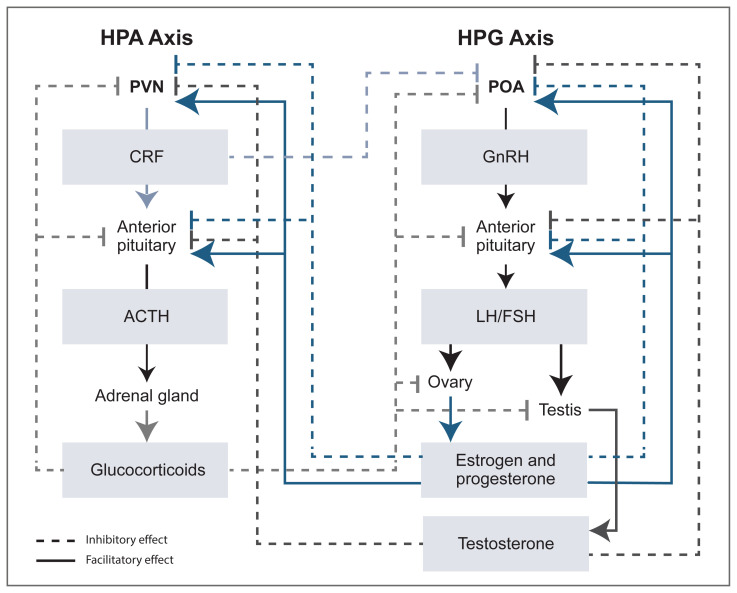
Figure 1
Figure 1. Simplified diagram of the reciprocal interaction between the HPA axis and the HPG axis
Solid lines with arrows depict facilitatory effects. Dashed lines with block symbols depict inhibitory or negative feedback effects. Gonadal steroids are involved in the regulation of the HPA axis at the level of the PVN and the anterior pituitary. Specifically, testosterone has negative feedback effects at the PVN and the anterior pituitary, and estrogen and progesterone can have either a facilitatory or an inhibitory effect at the PVN and the anterior pituitary. Stress steroids can regulate the HPG axis at the level of the hypothalamic POA, anterior pituitary, and gonads (ovaries or testes). Glucocorticoids (corticosterone in rodents, cortisol in humans and monkeys) exert negative feedback at each level of the HPG axis, and CRF exerts negative feedback at the POA. Upstream regulatory centers for each axis are not shown. Also shown is the negative feedback exhibited by glucocorticoids within the HPA axis, the negative feedback exhibited by testosterone within the HPG axis, and the negative and positive feedback exhibited by estrogen and progesterone within the HPG axis. Note: ACTH, adrenocorticotropic hormone; CRF, corticotropin releasing factor; FSH, follicle stimulating hormone; GnRH, gonadotropin releasing hormone; HPA, hypothalamic-pituitary-adrenal; HPG, hypothalamic-pituitary-gonadal; LH, luteinizing hormone; POA, preoptic area; PVN, paraventricular nucleus. Source: Modified from a figure by Oyola and Handa.
Figure 2
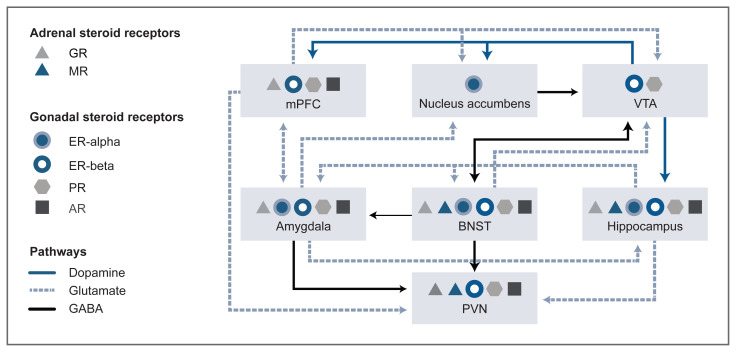
Figure 2. Simplified stress and mesocorticolimbic circuitry, including inputs to the HPA axis and the distribution of gonadal and adrenal steroid receptors
Rapid steroid actions at associated receptors and neurosteroid actions at GABA Subscript A receptors represent additional mechanisms for fine-tuning central nervous system excitability. Gonadal and adrenal steroid receptors have considerable overlap in expression within the hypothalamic (PVN) and extrahypothalamic (e.g., amygdala, BNST) stress circuitry, as well as among components of the mesocorticolimbic (e.g., mPFC, nucleus accumbens, VTA, and hippocampus) circuitry, which ultimately can affect output of the PVN (i.e., the stress response) and alcohol drinking. This simplified circuitry shows GABAergic (red), glutamatergic (green), and dopaminergic (blue) projections within the brain regions that input to the PVN, either directly or indirectly through an inhibitory projection from the peri-PVN (which contains ER-alpha and GR, not shown). The brain regions involved and the overall influence on the output of the PVN (and HPA axis activity) depend on the stressor modality, the level of acute or chronic alcohol consumption, and the various steroid and neurosteroid levels and actions at their associated receptors. Note: AR, androgen receptor; BNST, bed nucleus of the stria terminalis; ER-alpha, estrogen receptor-alpha; ER-beta, estrogen receptor-beta; GABA, gamma-aminobutyric acid; GR, glucocorticoid receptor; HPA, hypothalamic-pituitary-adrenal; mPFC, medial prefrontal cortex; MR, mineralocorticoid receptor; PR, progesterone receptor (both isoforms); PVN, paraventricular nucleus; VTA, ventral tegmental area. Source: Circuitry, and steroid receptor distribution,,,– are modified from other sources.
Figure 3
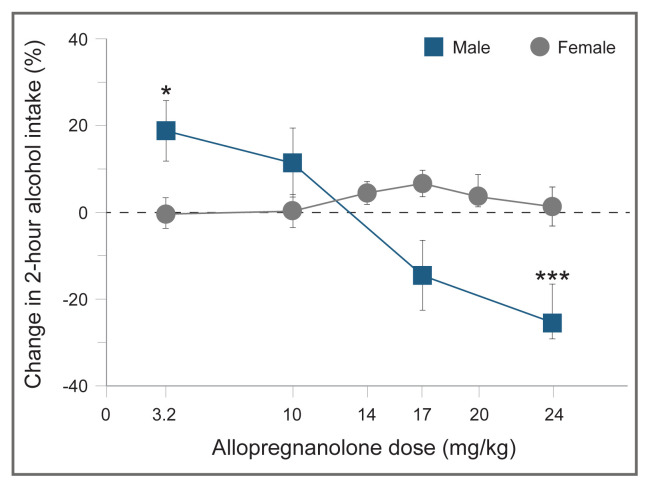
Figure 3. Sex differences in the modulatory effect of allopregnanolone on limited-access alcohol drinking in mice
Dose response is shown as a percentage of change from baseline values (vehicle treatments). The graph depicts the means and standard errors for 18 male and 24 female C57BL/6J mice. The dashed line represents the baseline values. Note: *p ≤ 0.05; ***p ≤ 0.001 versus respective vehicle treatment (20% beta-cyclodextrin). Source: Adapted from Finn DA, Beckley EH, Kaufman KR, et al.
Figure 4
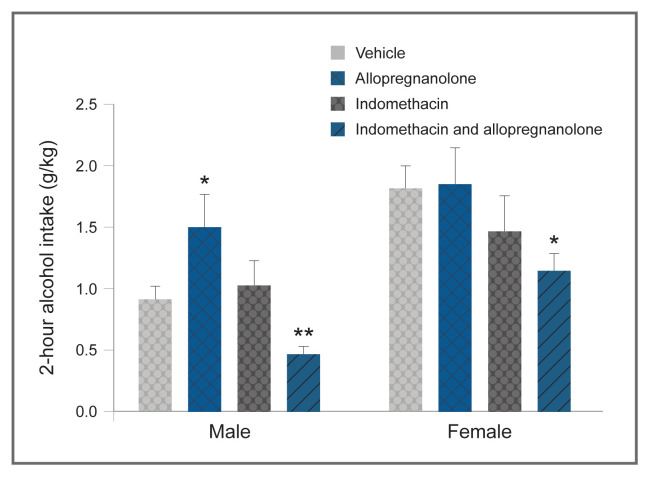
Figure 4. Modulatory effect of a combination of allopregnanolone and indomethacin in male and female mice
Female mouse insensitivity to allopregnanolone’s modulatory effect on limited-access alcohol drinking was overcome by administering 0.1 mg/kg indomethacin along with 10 mg/kg allopregnanolone. Indomethacin blocks the oxidation of allopregnanolone and thereby enhances allopregnanolone’s effect on GABA Subscript A receptor–mediated inhibition. The graph depicts the means and standard errors for 10 male and 10 to 11 female C57BL/6J mice. Note: *p ≤ 0.05; **p ≤ 0.01 versus respective vehicle treatment (20% beta-cyclodextrin). Source: DA Finn and MM Ford, unpublished data, May 2013.
Figure 5
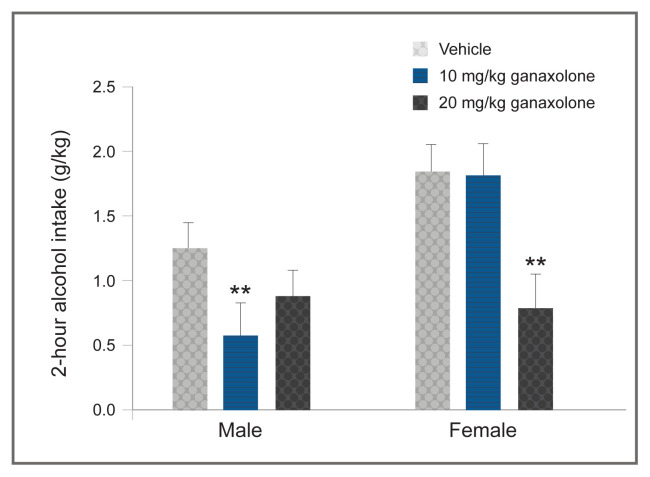
Figure 5. Sex differences in the modulatory effect of the synthetic neurosteroid ganaxolone in mice
Ganaxolone significantly decreased limited-access alcohol drinking in males and females. To significantly suppress alcohol drinking, female mice required a higher dose (20 mg/kg) than male mice (10 mg/kg). The graph depicts the means and standard errors for 10 male and 10 to 11 female C57BL/6J mice. Note: **p ≤ 0.01 versus respective vehicle treatment (20% beta-cyclodextrin). Source: DA Finn and MM Ford, unpublished data, April 2013.

References

    1. National Institute on Alcohol Abuse and Alcoholism. Alcohol Use Disorder: A Comparison Between DSM-IV and DSM-5. 2016. https://www.niaaa.nih.gov/publications/brochures-and-fact-sheets/alcohol....
    1. National Institute on Alcohol Abuse and Alcoholism. Alcohol Facts and Statistics. 2018. [Accessed August 22, 2019]. http://www.niaaa.nih.gov/publications/brochures-and-fact-sheets/alcohol-....
    1. Grucza RA, Sher JK, Kerr WC, et al. Trends in adult alcohol use and binge drinking in the early 21st-century United States: A meta-analysis of 6 national survey series. Alcohol Clin Exp Res. 2018;42(10):1939–1950. doi: 10.1111/acer.13859. - DOI - PMC - PubMed
    1. Becker JB, Koob GF. Sex differences in animal models: Focus on addiction. Pharmacol Rev. 2016;68(2):242–263. doi: 10.1124/pr.115.011163. - DOI - PMC - PubMed
    1. Logrip ML, Milivojevic V, Bertholomey ML, et al. Sexual dimorphism in the neural impact of stress and alcohol. Alcohol. 2018;72:49–59. doi: 10.1016/j.alcohol.2018.02.002. - DOI - PMC - PubMed

Publication types