Review
. 2020 Jun 30:8:745.
doi: 10.3389/fbioe.2020.00745. eCollection 2020.

Advances of Naturally Derived and Synthetic Hydrogels for Intervertebral Disk Regeneration

Affiliations
Review

Advances of Naturally Derived and Synthetic Hydrogels for Intervertebral Disk Regeneration

Guoke Tang et al. Front Bioeng Biotechnol. .

Abstract

Intervertebral disk (IVD) degeneration is associated with most cases of cervical and lumbar spine pathologies, amongst which chronic low back pain has become the primary cause for loss of quality-adjusted life years. Biomaterials science and tissue engineering have made significant progress in the replacement, repair and regeneration of IVD tissue, wherein hydrogel has been recognized as an ideal biomaterial to promote IVD regeneration in recent years. Aspects such as ease of use, mechanical properties, regenerative capacity, and their applicability as carriers for regenerative and anti-degenerative factors determine their suitability for IVD regeneration. This current review provides an overview of naturally derived and synthetic hydrogels that are related to their clinical applications for IVD regeneration. Although each type has its own unique advantages, it rarely becomes a standard product in truly clinical practice, and a more rational design is proposed for future use of biomaterials for IVD regeneration. This review aims to provide a starting point and inspiration for future research work on development of novel biomaterials and biotechnology.

Keywords: intervertebral disk regeneration; low back pain; natural hydrogel; synthetic hydrogel; tissue engineering.


Figures

FIGURE 1
FIGURE 1
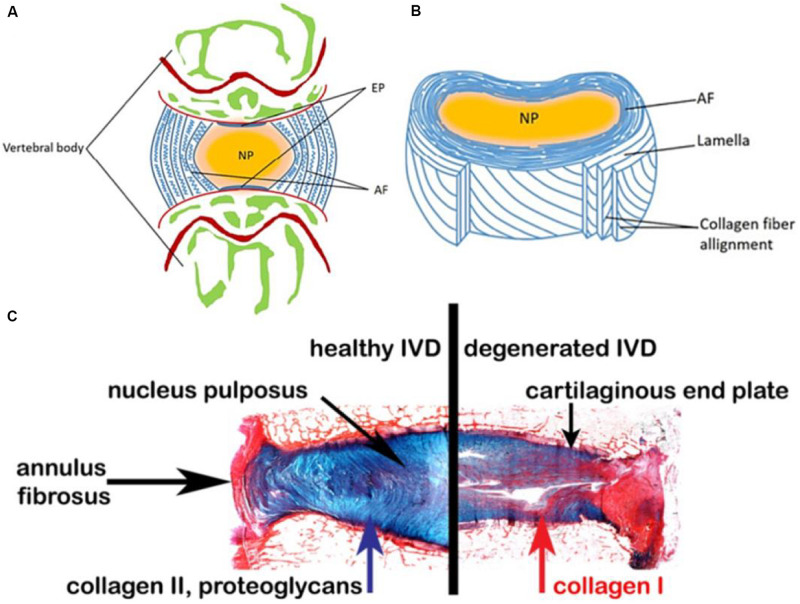
Schematic representations of the adult IVD. (A) Midsagittal cross-section showing anatomical regions. (B) Three-dimensional view of the AF lamellar structure. (C) Comparison of a healthy human disk and a degenerated disk. Reproduced from Sakai and Andersson (2015); Eyre and Muir (1976) with permissions from Copyright 2015 AO Research Institute and 2019 MDPI.
FIGURE 2
FIGURE 2
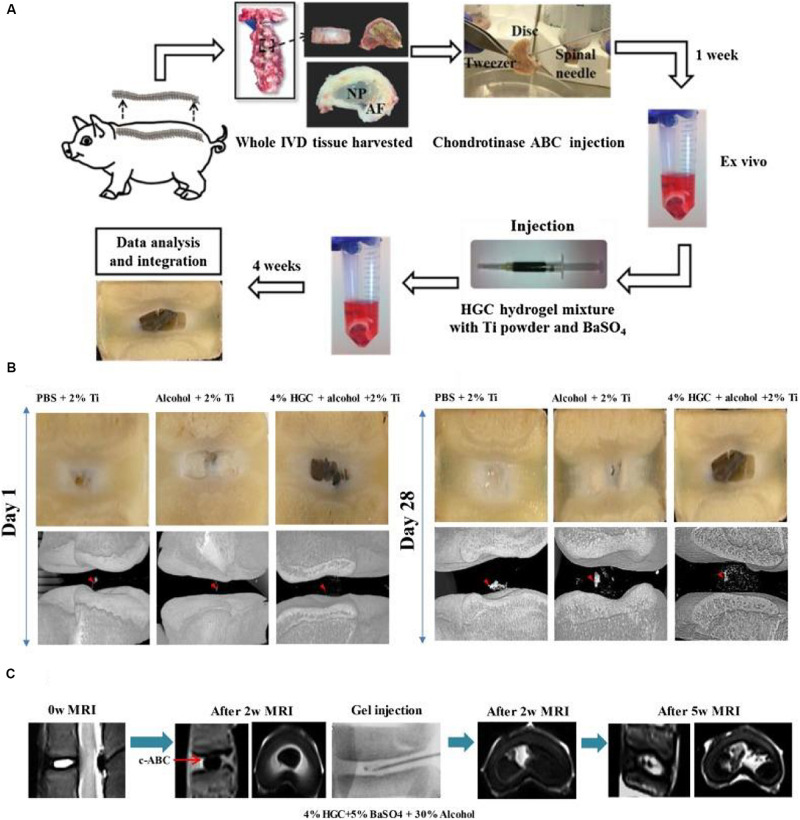
(A) Schematic description of the evaluation of ex vivo degenerative IVD tissue and treatment with HGC hydrogel for CT and MRI imaging. (B) Macroscopic observation and micro-CT images of degenerated IVD tissue at 1 day and 28 days after injection with hydrogels. (C) MRI images of IVD tissue before and 2 weeks after the disk degeneration process and subsequent degenerative IVD tissue at 2 weeks and 5 weeks after injection of HGC hydrogel in 30% alcohol solution. Reproduced from Li et al. (2018) with permission from Copyright 2018 Elsevier.
FIGURE 3
FIGURE 3
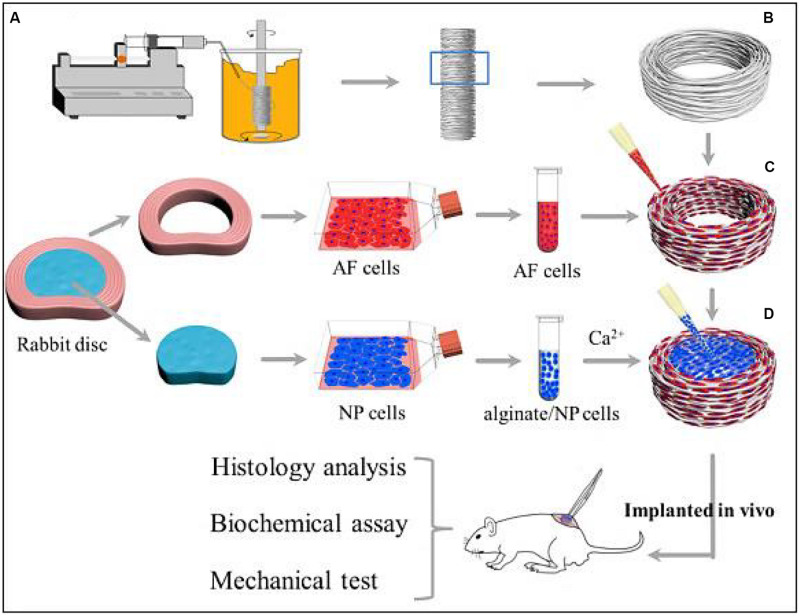
Schematic illustration shows the construction of composite TE-IVD and the design of in vitro study and in vivo implantation into nude mice. (A) Wet spinning process. (B) Circumferentially oriented PCL AF scaffold. (C) Seeding cells to the AF phase. (D) Injecting alginate containing cells into the NP phase. Reproduced from Du et al. (2019) with permission from Copyright 2019 Elsevier.
FIGURE 4
FIGURE 4
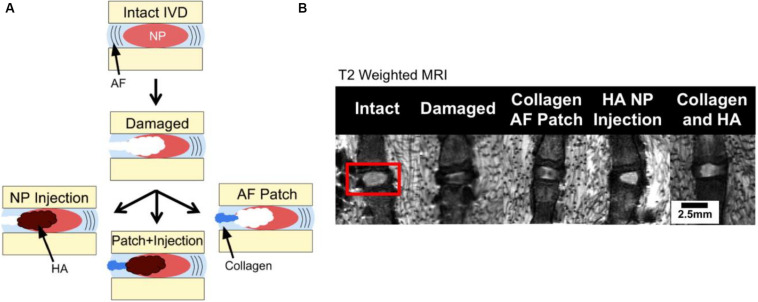
(A) Segments test via annulotomy/nucleotomy and (B) MRI images of NP hydration and morphology where hyperintense regions correspond with greater relaxation time and hydration. Reproduced from Sloan et al. (2017) with permission from Copyright 2017 Elsevier.
FIGURE 5
FIGURE 5
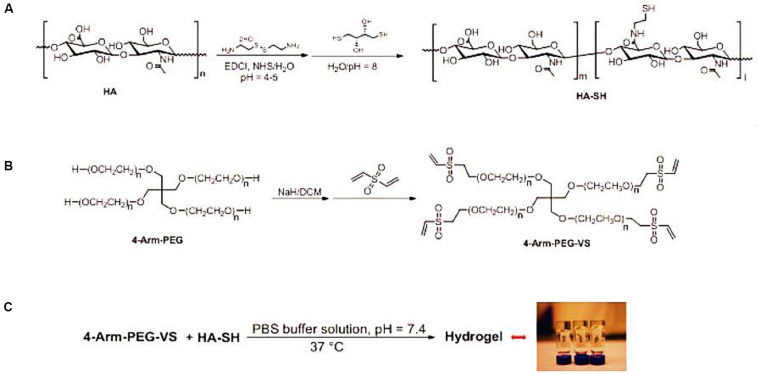
(A) Schematics for synthesis of HA-SH from HA, (B) 4-arm-PEG-VS based on 4-arm-PEG, and (C) formation of the HA-PEG composite hydrogel via the Michael addition reaction between HA-SH and 4-arm-PEG-VS. Reproduced from Jeong et al. (2014) with permission from Copyright 2014 Elsevier.
FIGURE 6
FIGURE 6
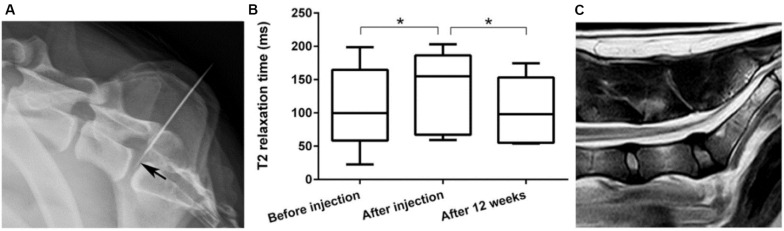
(A) Laterolateral radiographic images of fluoroscopy-guided intradiscal injection. Note that the 20-G needle advanced into the epidural space and the 27-G needle (arrow) positioned in the center of the NP. (B) T2 mapping values of the NP were significantly higher after injection compared with those at preinjection and 3 months’ follow-up. (C) Representative T2 magnetic resonance image 3 months after intradiscal injection with the celecoxib-loaded hydrogel. Reproduced from Tellegen et al. (2018) with permission from Copyright 2018 Wiley. *p < 0.05.
FIGURE 7
FIGURE 7
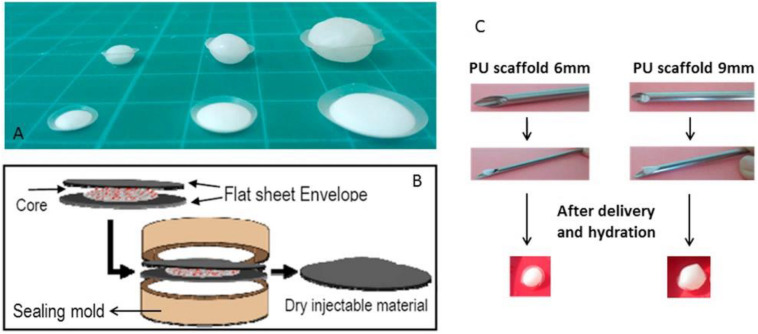
(A) Flat discoid shaped PU scaffold before (front) and after (back) swelling at various sizes. (B) Scheme of PU scaffold assembly process: core disk is wrapped by two envelope disks, and heat sealed within a custom made sealing mold. (C) Non-invasive delivery system for PU scaffold: a demonstration of the scaffold insertion and swelling function after delivery and hydration. Reproduced from Li et al. (2016) with permission from Copyright 2016 Elsevier.
FIGURE 8
FIGURE 8
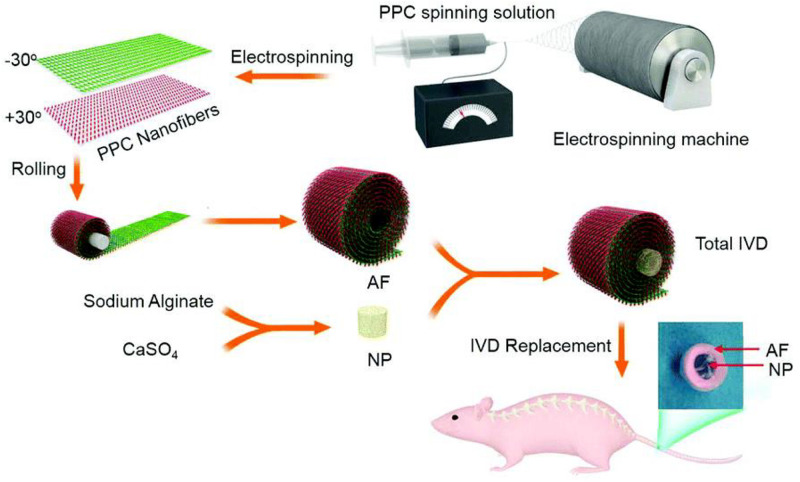
Schematic illustration of the procedure of IVD preparation and replacement using blended PCL/PLGA/type I Collagen spinning solution. Reproduced from Yang et al. (2017) with permission from Copyright 2017 Royal Society of Chemistry.

References

    1. Alcantar N. A., Aydil E. S., Israelachvili J. N. (2000). Polyethylene glycol-coated biocompatible surfaces. J. Biomed. Mater. Res. 51 343–351. 10.1002/1097-4636(20000905)51:3<343::aid-jbm7>3.0.co;2-d - DOI - PubMed
    1. Alinejad Y., Adoungotchodo A., Grant M. P., Epure L. M., Antoniou J., Mwale F., et al. (2019). Injectable chitosan hydrogels with enhanced mechanical properties for nucleus pulposus regeneration. Tissue Eng. Part A 25 303–313. 10.1089/ten.tea.2018.0170 - DOI - PubMed
    1. Bao Q. B., McCullen G. M., Higham P. A., Dumbleton J. H., Yuan H. A. (1996). The artificial disc: theory, design and materials. Biomaterials 17 1157–1167. 10.1016/0142-9612(96)84936-2 - DOI - PubMed
    1. Bao Q. B., Yuan H. A. (2000). Artificial disc technology. Neurosurg. Focus 9 1–7. 10.3171/foc.2000.9.4.14 - DOI - PubMed
    1. Bao W. R., Li M. L., Yang Y. Y., Wan Y., Wang X., Bi N., et al. (2020). Advancements and frontiers in high performance of natural hydrogels for cartilage tissue engineering. Front. Chem. 8:53. 10.3389/fchem.2020.00053 - DOI - PMC - PubMed

LinkOut - more resources