


Antimicrobial Activity of Chitosan-Based Films Enriched with Green Tea Extracts on Murine Norovirus, Escherichia coli, and Listeria innocua
- PMID: 32714970
- PMCID: PMC7355381
- DOI: 10.1155/2020/3941924
Antimicrobial Activity of Chitosan-Based Films Enriched with Green Tea Extracts on Murine Norovirus, Escherichia coli, and Listeria innocua
Abstract
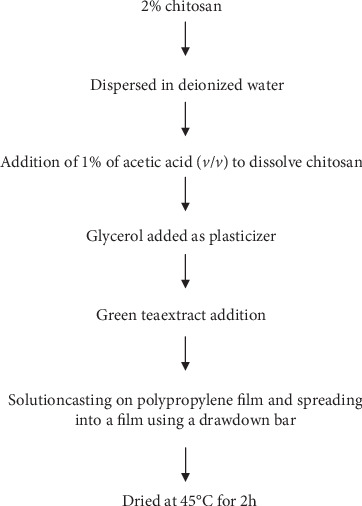
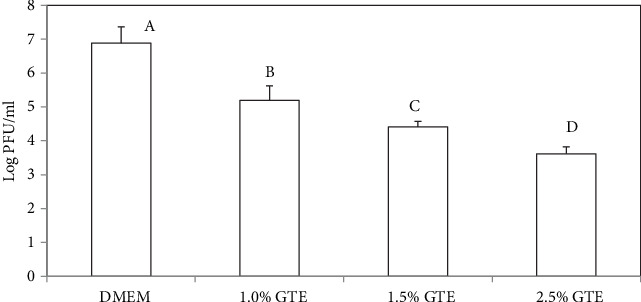
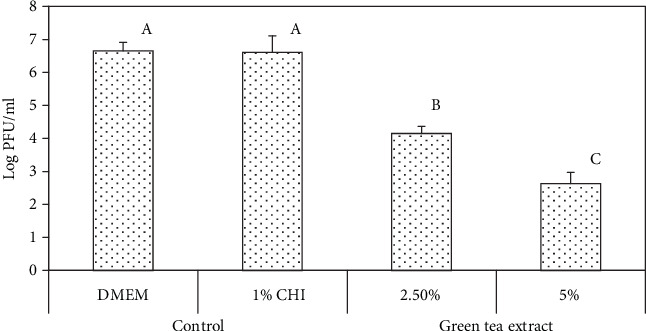
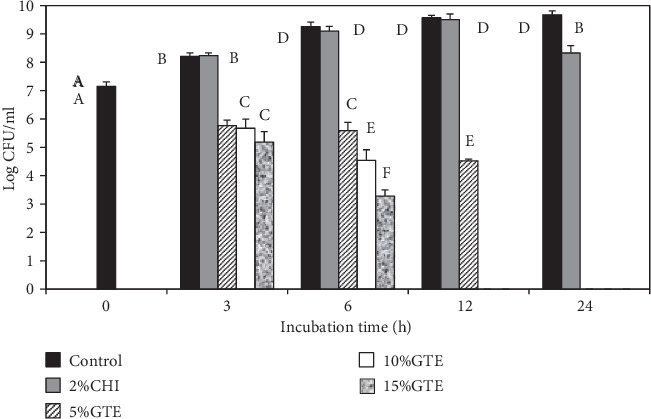
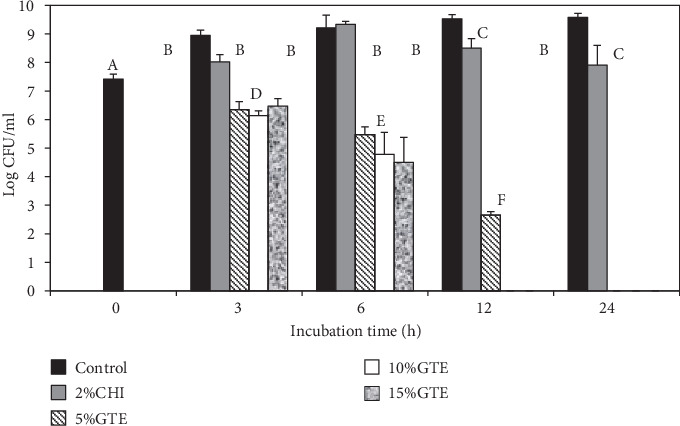
Edible films can be designed to serve as carriers of antimicrobial agents and be used to control pathogenic foodborne viruses and bacteria. This research tested this concept by dissolving green tea extract (GTE) in chitosan film-forming solutions (FFS) and using it to prepare dried chitosan edible films. As a control, the GTE was also dissolved in deionized water (DW). The FFS and the dried chitosan films with the GTE and the DW without chitosan were all evaluated against murine norovirus (MNV-1), Escherichia coli K12, and Listeria innocua. Both the FFS and the DW with GTE were incubated with ~107 PFU/ml of the virus suspensions for 3 h. The chitosan films with GTE were incubated for 4 and 24 h at 23 ± 1°C. The results showed that the DW containing 1, 1.5, and 2.5% aqueous GTE, significantly (p < 0.05) reduced MNV-1 plaques by 1.7, 2.5, and 3.3 logs after 3 h exposure, respectively. Similarly, FFS containing 2.5 and 5.0% GTE reduced MNV-1 counts by 2.5 and 4.0 logs, respectively, after 3 h exposure. The dried chitosan films with 5, 10, and 15% GTE were also effective against MNV-1 infectivity. After 24 h incubation, the 5 and 10% chitosan GTE films produced significant (p < 0.05) titer reductions of 1.6 and 4.5 logs, respectively. Chitosan films containing 15% GTE reduced MNV-1 plaques to undetectable levels in 24 h. All chitosan GTE films reduced E. coli K12 and L. innocua populations to undetectable levels in tryptic soy broth after 24 h exposure. The results of this study showed that edible films enriched with GTE have potential to reduce both foodborne viruses and bacteria.
Copyright © 2020 Collins Amankwaah et al.
Conflict of interest statement
The authors declare that there is no conflict of interest regarding the publication of this article.
Figures

References
-
- CDC. CDC estimates of foodborne illness in the United States. 2011. May 2011, http://www.cdc.gov/foodborneburden/2011-foodborne-estimates.html.
-
- Mehyar G. F., Holley R. A. Active packaging and nonthermal processing. In: Pascall M. A., Han J. H., editors. Packaging for Nonthermal Processing of Food. 2nd. Boca Raton: CRC press; 2018. pp. 15–41.
-
- Bastarrachea L., Dhawan S., Sablani S. S. Engineering properties of polymeric-based antimicrobial films for food Packaging: A Review. Food Engineering Reviews. 2011;3(2):79–93. doi: 10.1007/s12393-011-9034-8. - DOI
LinkOut - more resources
Full Text Sources
Molecular Biology Databases
Research Materials
