Review
. 2020 Oct;52(5):321-342.
doi: 10.1007/s10863-020-09846-4. Epub 2020 Jul 26.

Lipid composition of the cancer cell membrane

Affiliations
Review

Lipid composition of the cancer cell membrane

Wojciech Szlasa et al. J Bioenerg Biomembr. 2020 Oct.

Abstract

Cancer cell possesses numerous adaptations to resist the immune system response and chemotherapy. One of the most significant properties of the neoplastic cells is the altered lipid metabolism, and consequently, the abnormal cell membrane composition. Like in the case of phosphatidylcholine, these changes result in the modulation of certain enzymes and accumulation of energetic material, which could be used for a higher proliferation rate. The changes are so prominent, that some lipids, such as phosphatidylserines, could even be considered as the cancer biomarkers. Additionally, some changes of biophysical properties of cell membranes lead to the higher resistance to chemotherapy, and finally to the disturbances in signalling pathways. Namely, the increased levels of certain lipids, like for instance phosphatidylserine, lead to the attenuation of the immune system response. Also, changes in lipid saturation prevent the cells from demanding conditions of the microenvironment. Particularly interesting is the significance of cell membrane cholesterol content in the modulation of metastasis. This review paper discusses the roles of each lipid type in cancer physiology. The review combined theoretical data with clinical studies to show novel therapeutic options concerning the modulation of cell membranes in oncology.

Keywords: Cancer cells; Lipid membrane; Membrane composition.


Conflict of interest statement

The authors declare no conflict of interest.

Figures
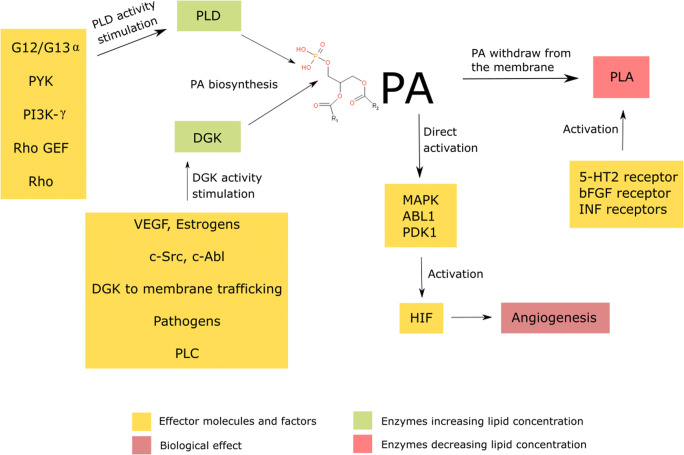
Fig. 1.
Fig. 1.
Phosphatidic acid (PA) biosynthesis is being stimulated by VEGF, estrogens, c-Src and c-Abl. Pathogens, PLC and DGK trafficking towards cell membrane increase the PA biosynthesis. The lipid directly activates MAPK, ABL1 and PDK1 kinases, leading to the HIF activation and thus neovascularization. Conversely, factors stimulating PLD, like PYK, PI3K-gamma, G12/13 alpha subunits activation, Pho GEF and Rho, lead to the increased activity of PLD, which catalyzes the PA degradation; DGK - diacylglycerol kinase, PLD – phospholipase D, VEGF – vascular endothelial growth factor, c-Src - Proto-oncogene tyrosine-protein kinase Src, c-Abl - Abl protein-tyrosine kinase, PLC – phospholipase C, HIF - hypoxia-inducible factor, MAPK - mitogen-activated protein kinases, ABL1 - Abelson murine leukaemia viral oncogene homolog 1, PDK1 - Phosphoinositide-dependent kinase-1, G12/G13α – α subunits of heterotrimeric G proteins, PYK - pyruvate kinase, PI3K-γ - phosphoinositide 3-kinase γ, Rho - Ras homologous protein factor, Rho GEF – Rho guanine exchanging factor;
Fig. 2.
Fig. 2.
Phosphoinositides (PI) metabolism and action scheme. Diphorylated phosphatidylinositol forms are responsible for cancer-related microsomes exocytosis, G-protein stabilization and constant activation, actin filaments prometastatic organization and GRK2 mediated proliferator signal transduction. Various mono-phosphorylated forms of phosphatidylinositol are responsible for membrane curvature modulation or induction of proliferation; PIP-3/4/5P - phosphatidylinositol 3/4/5-phosphate, PIP-3,5P - phosphatidylinositol 3,5-diphosphate, PIP-4,5P - phosphatidylinositol 4,5-diphosphate, PIP-3,4,5P - phosphatidylinositol 3,4,5-trisphosphate, ING2 - inhibitor of growth protein 2, p53 - transformation-related protein 53, AKT – protein kinase B, PDK1 - protein 3-phosphoinositide-dependent protein kinase-1, BTK - Bruton's tyrosine kinase, GRK2 - G-protein-coupled receptor kinase 2; PI PLC - PI specific phospholipase C.
Fig. 3.
Fig. 3.
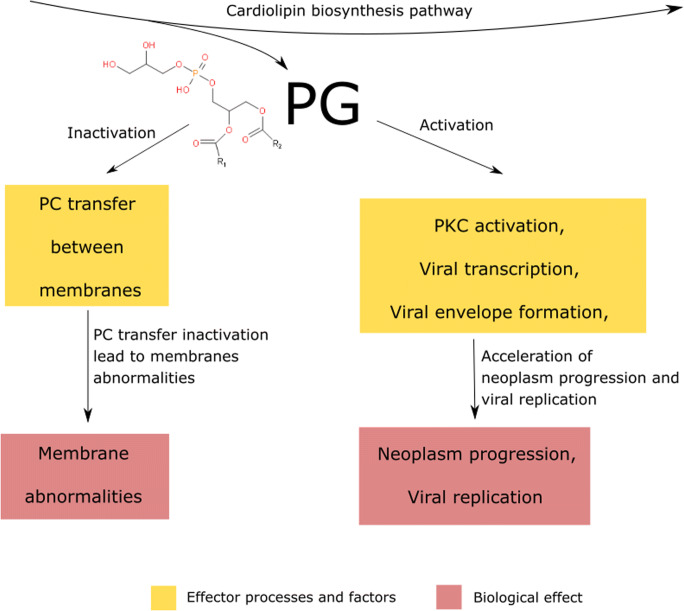
Phosphatidylglycerol (PG) is being synthesized as the intermediate metabolite in cardiolipin biosynthesis pathway. The lipid inhibits PC transfer between membranes, leading to the cancerous membrane abnormalities. PG activatess PKC, viral transcription and envelope formation, leading to the neoplasm progression and increased ratio of viral replication; PC - phosphatidylcholine, PKC – protein kinase C;
Fig. 4.
Fig. 4.
Phosphatidylserine (PS) biosynthesis is being catalyzed by PS synthase I or II. The degradation is catalyzed by PD decarboxylase. The increased PS content in the cell membrane leads to cancer cell protection from the immune response. However, the increase in PS in the outer membrane of the cell leads to the escalation of apoptosis signaling.
Fig. 5
Fig. 5
Phosphatidylethanolamine (PE) is being synthesized by the induction of PC N-methyltransferase, PS decarboxylase and CDP-ethanolamine pathway. The increased PE content in cell membrane leads to the activation of PEBP, which desensitizes the cell from the proapoptotic signals. Conversely, PE directly modulates the chaperone functions of the membrane-associated proteins. PC - phosphatidylcholine, PS - phosphatidylserine, PEBP – phosphatidylethanolamine binding protein.
Fig. 6.
Fig. 6.
Phosphatidylcholine (PC) content in the cell membrane increases by the induction of the Kennedy pathway, PE N-methyltransferase and CDP-choline pathway. Conversely, the induction of PC N-methyltransferase, PLC and PLD leads to PC degradation. PC is the easily accessible energy for the cell which could be used for cancerous proliferation; PE - phosphatidylethanolamine, PLC - phosphatidylcholine, PLD – phospholipase D, CDP - cytidine diphosphate;
Figure 7.
Figure 7.
Cholesterol is the key regulator of the membrane’s fluidity. The increased membrane rigidity leads to the drug resistance by modulation of xenobiotics transporters and the physical changes in the plasmalemma, Conversely, the enhanced fluidity enables the cell to penetrate through the extracellular matrix and circulation.
Fig. 8.
Fig. 8.
Sphingomyelin and ceramide metabolism is regulated by sphingomyelinase activity. The catalysis of choline detachment leads to cell apoptosis. However, in cancer cells, the sphingomyelinase activity is upregulated and results in the sphingomyelin extensive accumulation. The lipid enables tumor progression and autophagy negative regulation.
Fig. 9
Fig. 9
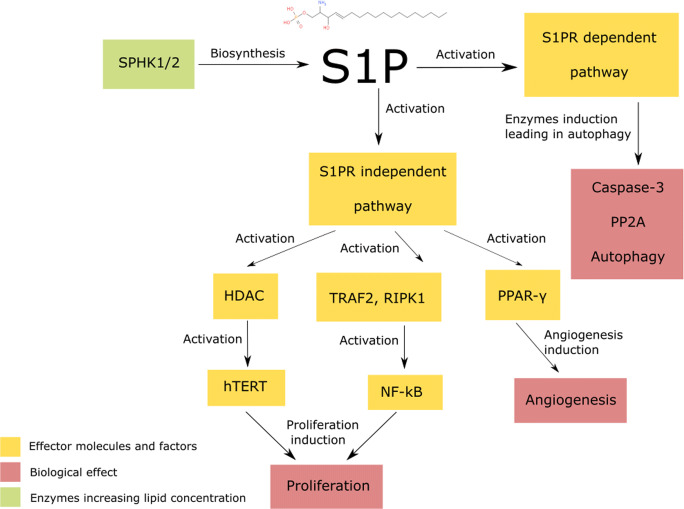
Sphingosine-1-phosphate (S1P) acts in both S1PR dependent and independent pathways. The induction of S1PR dependent pathway leads to the autophagy induction. The S1PR independent pathway activity results in increased angiogenesis and cancer proliferation; SPHK1/2 – sphingosine-1-phosphate kinase 1/2, S1PR - sphingosine-1-phosphate receptor, HDAC – histone deacetylase, hTERT – human telomerase reverse transcriptase, TRAF2 - TNF receptor-associated factor 2, RIPK1 - receptor-interacting serine/threonine-protein kinase 1, NF-kB – nuclear factor kB, PPAR-γ - peroxisome proliferator-activated receptor γ, S1PR – sphingosine-1-phosphate receptor, PP2A - protein phosphatase 2A;

References

    1. Alvarez SE, Harikumar KB, Hait NC, Allegood J, Strub GM, Kim EY, Maceyka M, Jiang H, Luo C, Kordula T, Milstien S, Spiegel S. Sphingosine-1-phosphate is a missing cofactor for the E3 ubiquitin ligase TRAF2. Nature. 2010;465(7301):1084–1088. doi: 10.1038/nature09128. - DOI - PMC - PubMed
    1. Alves, A. C., Ribeiro, D., Nunes, C., & Reis, S. (2016). Biophysics in cancer: The relevance of drug-membrane interaction studies. Biochim. Biophys. Acta - Biomembr. Elsevier B.V. 10.1016/j.bbamem.2016.06.025 - PubMed
    1. Arikketh D, Nelson R, Vance JE. Defining the importance of phosphatidylserine synthase-1 (PSS1): Unexpected viability of PSS1-deficient mice. J. Biol. Chem. 2008;283(19):12888–12897. doi: 10.1074/jbc.M800714200. - DOI - PubMed
    1. Arlauckas, S. P., Popov, A. V., & Delikatny, E. J. (2016). Choline kinase alpha - Putting the ChoK-hold on tumor metabolism. Prog. Lipid Res. Elsevier Ltd. 110.1016/j.plipres.2016.03.005 - PMC - PubMed
    1. Arun SN, Xie D, Howard AC, Zhong Q, Zhong X, McNeil PL, Bollag WB. Cell wounding activates phospholipase D in primary mouse keratinocytes. J. Lipid Res. 2013;54(3):581–591. doi: 10.1194/jlr.M027060. - DOI - PMC - PubMed

Publication types