Review
. 2020 Jun 19;127(1):34-50.
doi: 10.1161/CIRCRESAHA.120.316574. Epub 2020 Jun 18.

Epigenetic and Transcriptional Networks Underlying Atrial Fibrillation

Affiliations
Review

Epigenetic and Transcriptional Networks Underlying Atrial Fibrillation

Antoinette F van Ouwerkerk et al. Circ Res. .

Erratum in

Abstract

Genome-wide association studies have uncovered over a 100 genetic loci associated with atrial fibrillation (AF), the most common arrhythmia. Many of the top AF-associated loci harbor key cardiac transcription factors, including PITX2, TBX5, PRRX1, and ZFHX3. Moreover, the vast majority of the AF-associated variants lie within noncoding regions of the genome where causal variants affect gene expression by altering the activity of transcription factors and the epigenetic state of chromatin. In this review, we discuss a transcriptional regulatory network model for AF defined by effector genes in Genome-wide association studies loci. We describe the current state of the field regarding the identification and function of AF-relevant gene regulatory networks, including variant regulatory elements, dose-sensitive transcription factor functionality, target genes, and epigenetic states. We illustrate how altered transcriptional networks may impact cardiomyocyte function and ionic currents that impact AF risk. Last, we identify the need for improved tools to identify and functionally test transcriptional components to define the links between genetic variation, epigenetic gene regulation, and atrial function.

Keywords: atrial fibrillation; genetic variation; genome-wide association study; myocytes, cardiac; transcription factors.


Figures
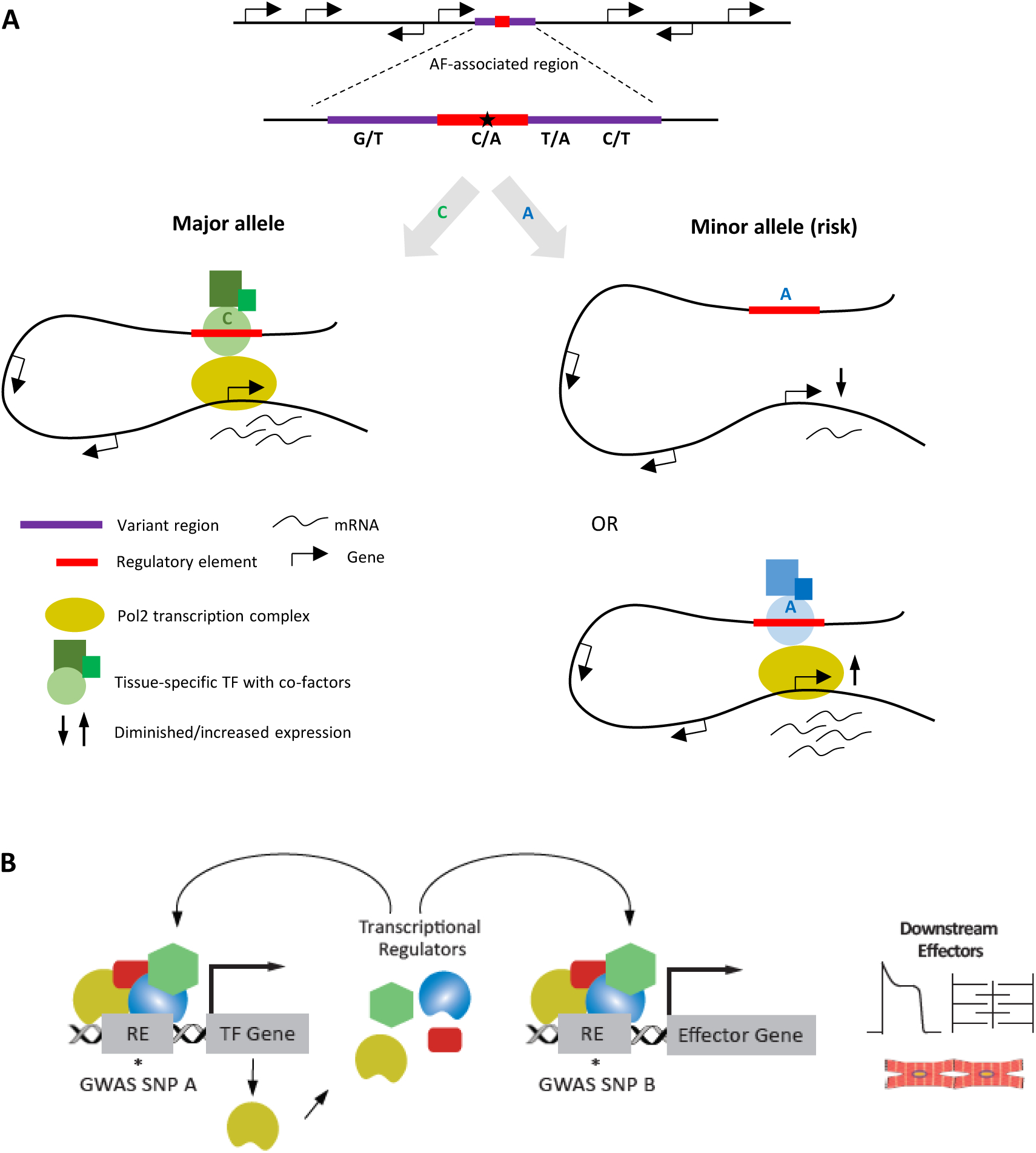
Figure 1.
Figure 1.
Simplified scheme depicting the relation between noncoding variants clustered in variant regions, variant regulatory elements, transcription factor (TF) dose and target genes. A) An AF-associated region is depicted with neighboring genes. The major allele of an AF-associated variant lies in a regulatory element, which interacts with transcription factors and cofactors leading to physiological levels of transcription of (a) target gene(s) through physical interaction. On the right, two situations are depicted that could result from the presence of a minor (risk) allele in the regulatory element. The risk allele could interfere with binding of the correct TF, leading to diminished expression of target genes. The risk allele could cause altered binding affinity favoring another TF, causing (tissue-specific) gain/loss of expression of target gene(s), that results in atrial fibrillation predisposition. B) Variation in a regulatory element (RE) can lead to the altered expression level of a gene for a TF (yellow) or target effector gene. The changed dose of the TF influences the expression of many effector genes, possibly including its own gene. (Illustration Credit: Ben Smith).
Figure 2.
Figure 2.
Schematic of PITX2 functions within a left atrial cardiomyocyte. It has been established that TBX5 is a transcriptional activator of PITX2. PITX2 is then capable of regulating gene expression throughout the genome, having both activating and repressing capabilities. Direct PITX2 targets, validated largely by luciferase assays and ChIP-seq, are listed by cellular function. While direct ion channel and gap junction genes were some of the first PITX2 targets discovered, there is now evidence in multiple model organisms that PITX2 is also capable of regulating cardiomyocyte metabolism and the antioxidant response to stress. Furthermore, PITX2 has been shown to directly alter microRNA transcription, which in turn can globally regulate gene expression in the cardiomyocyte. It is important to note that there are additional putative PITX2 targets not listed here that have been discovered through RNA sequencing experiments of PITX2 deficient murine models; however, these transcriptional alterations need further validation to distinguish direct targets of PITX2 from secondary effects. Overall, these transcriptional targets of PITX2 are able to determine critical physiological outputs of the cardiomyocyte, such as regulating cardiac rhythm and sarcomere structure. (Illustration Credit: Ben Smith).
Figure 3.
Figure 3.
Transcription factor networks control the expression of effector genes defining properties relevant for atrial structure, function and rhythm. Tbx5 and Pitx2 interact antagonistically as transcriptional activator and repressor, respectively, to co-regulate a gene regulatory network that governs effector genes involved in calcium cycling, sodium currents, potassium currents, and cell-cell conduction. Other transcription factors such as Gata4 and Nkx2–5 are also known to interact with Tbx5 and Pitx2 to co-regulate genes involved in atrial structural development and electrophysiological properties. The interactions of other transcription factors (such as Prrx1) in AF physiology and their role in atrial rhythm remain to be determined.
Figure 4.
Figure 4.
UCSC track showing the locus containing PRRX1 associated with AF and different datasets used for regulatory element and target gene identification. USCS browser view with lead variants, topologically associated domains (Juicebox TADs)(Durand et al., 2016;Robinson et al., 2018), identified enhancers (Tucker et al., 2017), SNPs associated with AF (p<10–4) (Roselli et al., 2018), annotated genes, promoter capture Hi-C (PCHi-C) data (Montefiori et al., 2018), ATAC-seq representing accessible chromatin in cardiomyocytes of left atria (Hill et al., 2019; van Ouwerkerk et al., 2019), EMERGE enhancer prediction (van Duijvenboden et al., 2015;van Ouwerkerk et al., 2019) and expression of left atria whole tissue (van Ouwerkerk et al., 2019).
Figure 5.
Figure 5.
Commonly employed approaches and challenges to study the mechanistic link between genetic variation and AF predisposition. Technical challenges and unmet needs include: 1) Relevant cell type- and condition-specific (hypertension, aging etc.) conformation and transcriptome data are required to define candidate AF associated genes. 2) Relevant cell type- and condition-specific epigenetic data are required to identify physiologically relevant variant regulatory elements. 3) Assays to define physiologically relevant functions of regulatory elements (activation, repression, conformation, combinatorial) are required. 4) Sensitive models to recapitulate the effect of variants are needed.

References

    1. Fox CS. Parental Atrial Fibrillation as a Risk Factor for Atrial Fibrillation in Offspring. Jama [Internet]. 2004;291:2851. Available from: http://jama.jamanetwork.com/article.aspx?doi=10.1001/jama.291.23.2851 - PubMed
    1. Lubitz SA, Sinner MF, Lunetta KL, Makino S, Pfeufer A, Rahman R, Veltman CE, Barnard J, Bis JC, Danik SP, et al. Independent Susceptibility Markers for Atrial Fibrillation on Chromosome 4q25. Circulation. 2010;122:976–984. - PMC - PubMed
    1. Nattel S, Dobrev D. Electrophysiological and molecular mechanisms of paroxysmal atrial fibrillation. Nat Rev Cardiol [Internet]. 2016;13:575–590. Available from: 10.1038/nrcardio.2016.118 - DOI - PubMed
    1. Roselli C, Chaffin MD, Weng L-C, Aeschbacher S, Ahlberg G, Albert CM, Almgren P, Alonso A, Anderson CD, Aragam KG, , et al. Multi-ethnic genome-wide association study for atrial fibrillation. Nat Genet [Internet]. 2018;1. Available from: http://www.nature.com/articles/s41588-018-0133-9 - PMC - PubMed
    1. Nielsen JB, Thorolfsdottir RB, Fritsche LG, Zhou W, Skov MW, Graham SE, Herron TJ, McCarthy S, Schmidt EM, Sveinbjornsson G, et al. Biobank-driven genomic discovery yields new insight into atrial fibrillation biology. Nat. Genet 2018;50:1234–1239. - PMC - PubMed

Publication types