Review
. 2020 Jul 23;12(8):2014.
doi: 10.3390/cancers12082014.

Src Family Tyrosine Kinases in Intestinal Homeostasis, Regeneration and Tumorigenesis

Affiliations
Review

Src Family Tyrosine Kinases in Intestinal Homeostasis, Regeneration and Tumorigenesis

Audrey Sirvent et al. Cancers (Basel). .

Abstract

Src, originally identified as an oncogene, is a membrane-anchored tyrosine kinase and the Src family kinase (SFK) prototype. SFKs regulate the signalling induced by a wide range of cell surface receptors leading to epithelial cell growth and adhesion. In the intestine, the SFK members Src, Fyn and Yes regulate epithelial cell proliferation and migration during tissue regeneration and transformation, thus implicating conserved and specific functions. In patients with colon cancer, SFK activity is a marker of poor clinical prognosis and a potent driver of metastasis formation. These tumorigenic activities are linked to SFK capacity to promote the dissemination and tumour-initiating capacities of epithelial tumour cells. However, it is unclear how SFKs promote colon tumour formation and metastatic progression because SFK-encoding genes are unfrequently mutated in human cancer. Here, we review recent findings on SFK signalling during intestinal homeostasis, regeneration and tumorigenesis. We also describe the key nongenetic mechanisms underlying SFK tumour activities in colorectal cancer, and discuss how these mechanisms could be exploited in therapeutic strategies to target SFK signalling in metastatic colon cancer.

Keywords: Src; cancer therapy; cell signalling; colon cancer; intestinal epithelium; tyrosine kinase.


Conflict of interest statement

The authors declare no conflict of interest.

Figures
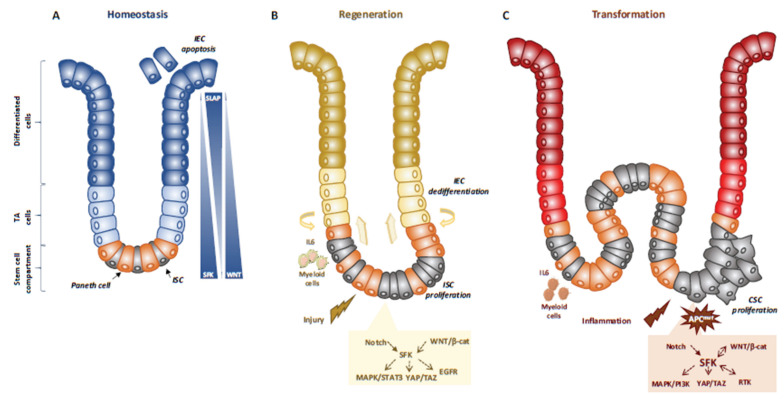
Figure 1
Figure 1
SFKs in intestinal homeostasis, regeneration and transformation. (A) SFKs regulate ISC proliferation, Paneth cell differentiation and IEC survival during intestinal homeostasis. SFKs, Wnt and Slap activity in the intestinal epithelium is indicated. (B) SFKs mediate intestinal regeneration by activating ISC proliferation. (C) SFKs mediate tumour formation induced by activating CSC survival. Src signalling involved in intestinal regeneration and transformation is indicated.
Figure 2
Figure 2
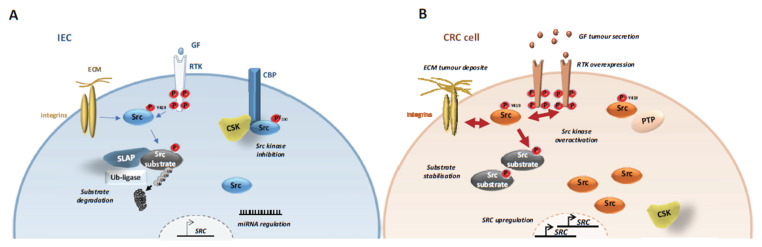
Mechanisms underlying SFK tumour activity in CRC cells. SFK tumour activation implicates abnormal SRC gene upregulation via SRC amplification, transcription and protein stabilisation. Additionally, SFK kinase activity is deregulated via downregulation of its negative regulator CSK and overactivation of their upstream receptors. Finally, SFK signalling is elevated by abnormal substrate stabilization via SLAP inactivation (A) Src signaling in normal intestinal epithelial cells (IEC). (B) Src signalling in CRC cells.
Figure 3
Figure 3
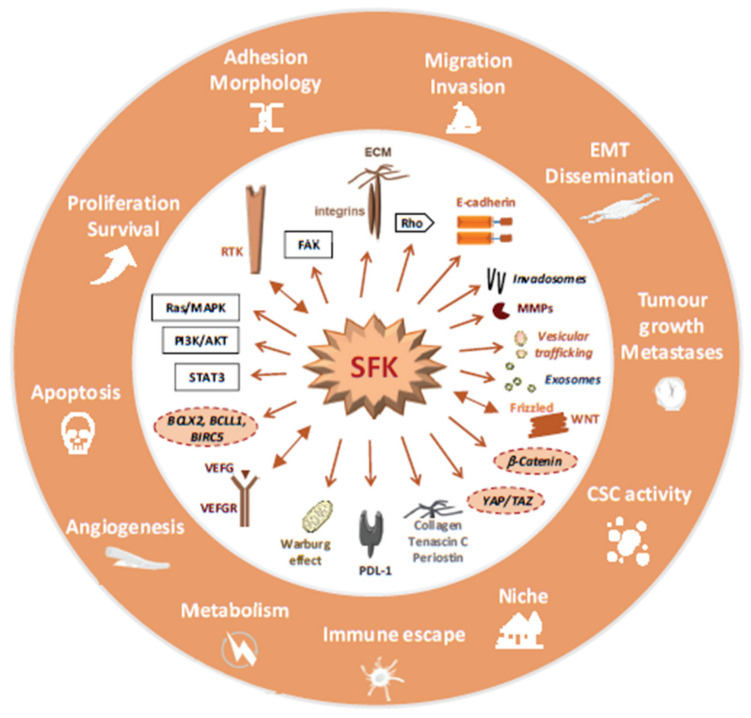
A model summarizing SFK signalling in CRC, molecular and cellular processes activated by excessive SFK activity in CRC is highlighted.
Figure 4
Figure 4
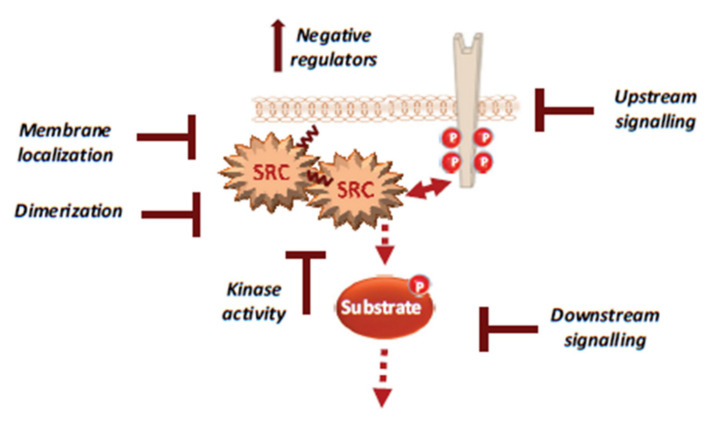
Therapeutic strategies to efficiently target Src signalling in CRC, including drug inhibition of Src UD signalling, kinase dimerisation, membrane localisation, drugs that reactivate Src inhibitors and drugs that inhibit activity of downstream signals.

References

    1. Brenner H., Kloor M., Pox C.P. Colorectal cancer. Lancet. 2014;383:1490–1502. doi: 10.1016/S0140-6736(13)61649-9. - DOI - PubMed
    1. Bray F., Ferlay J., Soerjomataram I., Siegel R.L., Torre L.A., Jemal A. Global cancer statistics 2018: GLOBOCAN estimates of incidence and mortality worldwide for 36 cancers in 185 countries. CA Cancer J. Clin. 2018;68:394–424. doi: 10.3322/caac.21492. - DOI - PubMed
    1. Vanharanta S., Massague J. Origins of metastatic traits. Cancer Cell. 2013;24:410–421. doi: 10.1016/j.ccr.2013.09.007. - DOI - PMC - PubMed
    1. Comprehensive molecular characterization of human colon and rectal cancer. Nature. 2012;487:330–337. doi: 10.1038/nature11252. - DOI - PMC - PubMed
    1. Guinney J., Dienstmann R., Wang X., de Reynies A., Schlicker A., Soneson C., Marisa L., Roepman P., Nyamundanda G., Angelino P., et al. The consensus molecular subtypes of colorectal cancer. Nat. Med. 2015;21:1350–1356. doi: 10.1038/nm.3967. - DOI - PMC - PubMed

LinkOut - more resources