Review
. 2020 Aug 20;26(9):1306-1314.
doi: 10.1093/ibd/izaa181.

The Thrilling Journey of SARS-CoV-2 into the Intestine: From Pathogenesis to Future Clinical Implications

Affiliations
Review

The Thrilling Journey of SARS-CoV-2 into the Intestine: From Pathogenesis to Future Clinical Implications

Franco Scaldaferri et al. Inflamm Bowel Dis. .

Abstract

Severe acute respiratory syndrome coronavirus 2 (SARS-CoV-2) infection has a direct impact on the gastrointestinal system, as up to 50% of fecal samples from coronavirus disease 2019 (COVID-19) patients contain detectable viral RNA despite a negative rhino-pharyngeal swab. This finding, together with an intestinal expression of angiotensin conversion enzyme 2 protein, suggests a possible fecal-oral transmission for SARS-CoV-2. Furthermore, gastrointestinal (GI) symptoms are common in COVID-19 patients including watery diarrhea, vomiting-particularly in children-nausea, and abdominal pain. Pathogenesis of SARS-CoV-2 infection presents significant similarities to those of some immune-mediated diseases, such as inflammatory bowel diseases or rheumatoid arthritis, leading to the hypothesis that targeted therapies used for the treatment of immune-mediated disease could be effective to treat (and possibly prevent) the main complications of COVID-19. In this review, we synthesize the present and future impact of SARS-CoV-2 infection on the gastrointestinal system and on gastroenterology practice, hypothesizing a potential role of the "gut-lung axis" and perhaps of the gut and lung microbiota into the interindividual differential susceptibility to COVID-19 19 disease. Finally, we speculate on the reorganization of outpatient gastroenterology services, which need to consider, among other factors, the major psychological impact of strict lockdown measures on the whole population.

Keywords: immune-mediated disease; immunomodulators; lung-gut axis; microbiota.


Figures

Figure 1.
Figure 1.
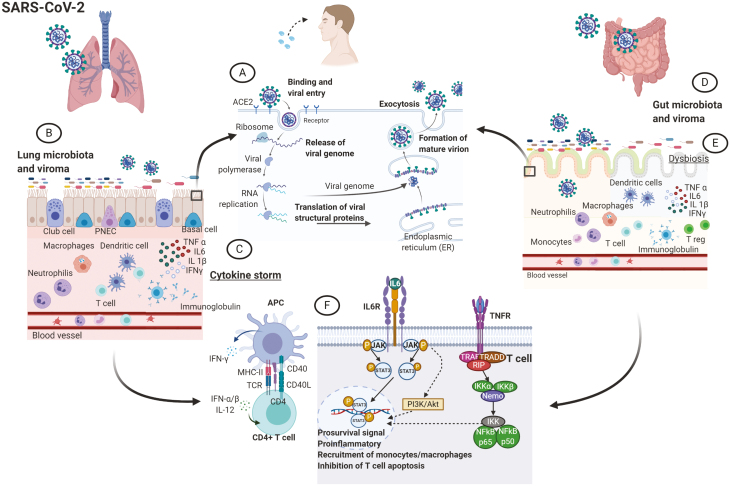
The lung-gut axis in COVID-19. Both lung and gut epithelium expresses the ACE2 receptor, recognized by SARS-CoV-2 to entry in the host cells where the virus starts to replicate (A). In the lung (B), once the virus has entered the cells, it prompts immune system activation characterized by pro-inflammatory cytokines and immune cell recruitment. If viral clearance is not sufficient, the immune response further progresses toward a cytokine storm syndrome (C). In the gut (D), the virus targets the cells and elicits the immune response in a similar fashion, although it is not yet clear whether the magnitude of the inflammatory response reaches the same level of the lung. Possibly, the immune response could lead to a dysbiosis (E) with a propagation of the pro-inflammatory state. Antigen presenting cells (APCs) are involved in the activation of the immune system in response to various exogenous triggers (F) from virus and bacteria: COVID-19 can activate inflammatory pathways that present some similarities with some immune-mediated diseases, such as IBD or rheumatoid arthritis. Abbreviations: IFN, interferon; IKK, inhibitory kappa B kinases; NF-kB: nuclear factor kappa-light-chain-enhancer of activated B cells; PNEC, pulmonary neuroendocrine cells; RNA, ribonucleic acid; STAT, signal transducer and activator of transcription; TNFR, tumor-necrosis factor receptor; TRADD, TNFR1-associated death domain protein; TRAF, tumor necrosis factor receptor-associated factors; T reg, T regulatory cell; NEMO, NF-κB essential modulator.

References

    1. Huang C, Wang Y, Li X, et al. . Clinical features of patients infected with 2019 novel coronavirus in Wuhan, China. Lancet. 2020;395:497–506. - PMC - PubMed
    1. Zhu N, Zhang D, Wang W, et al. ; China Novel Coronavirus Investigating and Research Team A novel Coronavirus from patients with pneumonia in China, 2019. N Engl J Med. 2020;382:727–733. - PMC - PubMed
    1. Jin Y, Yang H, Ji W, et al. . Virology, epidemiology, pathogenesis, and control of covid-19. Viruses. 2020;12. - PMC - PubMed
    1. Wan Y, Li J, Shen L, et al. . Enteric involvement in hospitalised patients with COVID-19 outside Wuhan. Lancet Gastroenterol Hepatol. 2020. - PMC - PubMed
    1. Guan WJ, Ni ZY, Hu YHY, et al. . Clinical characteristics of Coronavirus disease 2019 in China. N Engl J Med. 2020;382:1708–1720. - PMC - PubMed