Review
. 2020 Jul 24;9(8):1773.
doi: 10.3390/cells9081773.

Implications of Insulin-Like Growth Factor-1 in Skeletal Muscle and Various Diseases

Affiliations
Review

Implications of Insulin-Like Growth Factor-1 in Skeletal Muscle and Various Diseases

Syed Sayeed Ahmad et al. Cells. .

Abstract

Skeletal muscle is an essential tissue that attaches to bones and facilitates body movements. Insulin-like growth factor-1 (IGF-1) is a hormone found in blood that plays an important role in skeletal myogenesis and is importantly associated with muscle mass entity, strength development, and degeneration and increases the proliferative capacity of muscle satellite cells (MSCs). IGF-1R is an IGF-1 receptor with a transmembrane location that activates PI3K/Akt signaling and possesses tyrosine kinase activity, and its expression is significant in terms of myoblast proliferation and normal muscle mass maintenance. IGF-1 synthesis is elevated in MSCs of injured muscles and stimulates MSCs proliferation and myogenic differentiation. Mechanical loading also affects skeletal muscle production by IGF-1, and low IGF-1 levels are associated with low handgrip strength and poor physical performance. IGF-1 is potentially useful in the management of Duchenne muscular dystrophy, muscle atrophy, and promotes neurite development. This review highlights the role of IGF-1 in skeletal muscle, its importance during myogenesis, and its involvement in different disease conditions.

Keywords: IGF-1; MSCs; myogenesis; skeletal muscle.


Conflict of interest statement

The authors declare no conflict of interest.

Figures
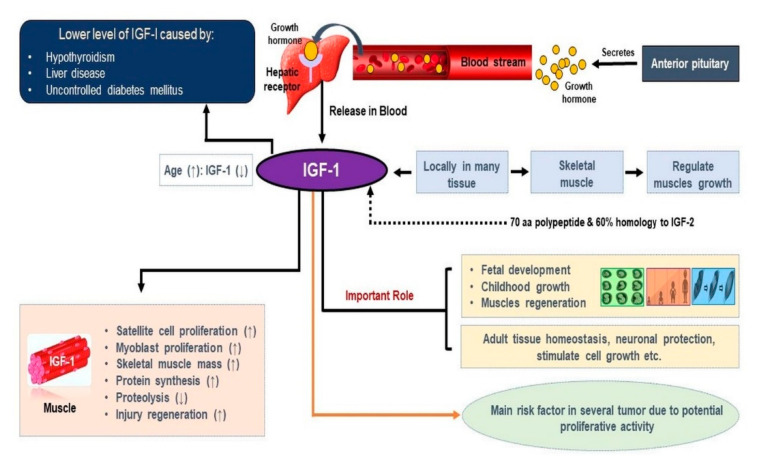
Figure 1
Figure 1
Role of insulin-like growth factor-1 (IGF-1) in skeletal muscle. IGF-1 is responsible for fetal development, child growth, and muscle regeneration, and elevated IGF-1 levels are required for muscle satellite cell (MSC) and myoblast proliferation, postinjury regeneration, and the increase of skeletal mass.
Figure 2
Figure 2
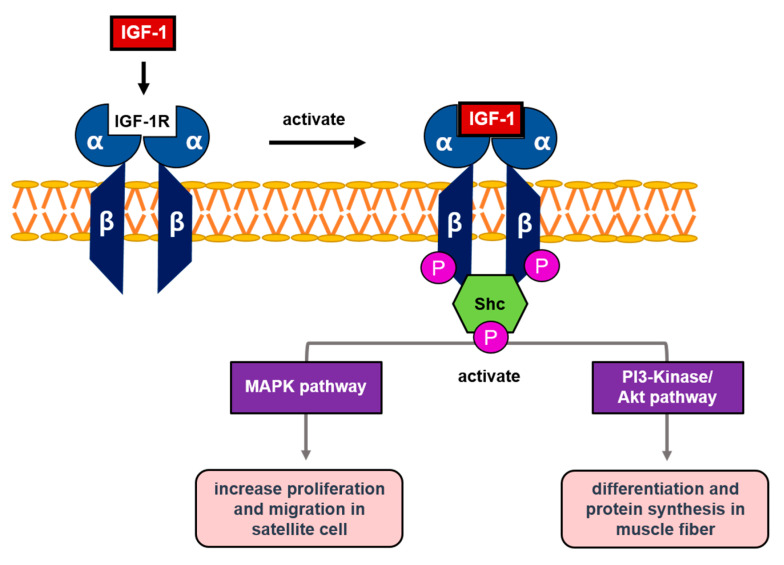
The molecular mechanism of IGF-1. IGF-1 interacts with its receptor (IGF-1R), and thus, activates the PI3K/Akt and mitogen-activated protein kinase (MAPK) pathways, which regulate MSC proliferation and differentiation.
Figure 3
Figure 3
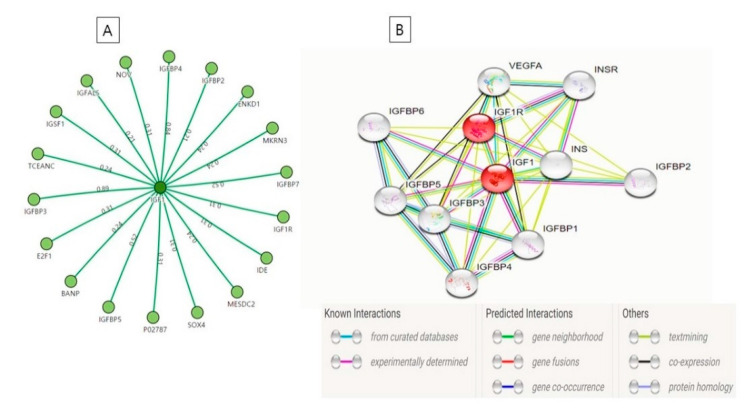
Protein-Protein interactions of IGF-1 with its associated proteins generated by (A) SIGnaling Network Open Resource, (B) STRING.
Figure 4
Figure 4
The mechanistic role of IGF-1 during skeletal muscle differentiation. The figure shows signaling interactions during muscle differentiation as predicted by SIGnaling Network Open Resource (SIGNOR).
Figure 5
Figure 5
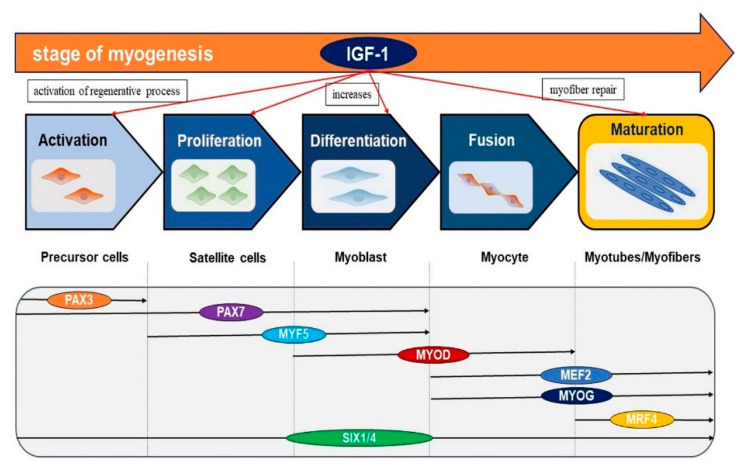
Role of IGF-1 in myogenesis. IGF-1 is activated during muscle regeneration and increases MSC proliferation and differentiation. In addition, IGF-1 promotes myofiber repairs.

References

    1. Frontera W.R., Ochala J. Skeletal muscle: A brief review of structure and function. Calcif. Tissue Int. 2015;96:183–195. doi: 10.1007/s00223-014-9915-y. - DOI - PubMed
    1. Kim T., Ahmad K., Shaikh S., Jan A.T., Seo M.G., Lee E.J., Choi I. Dermatopontin in skeletal muscle extracellular matrix regulates myogenesis. Cells. 2019;8:332. doi: 10.3390/cells8040332. - DOI - PMC - PubMed
    1. Langlois S., Cowan K.N. Regulation of skeletal muscle myoblast differentiation and proliferation by pannexins. Adv. Exp. Med. Biol. 2017;925:57–73. doi: 10.1007/5584_2016_53. - DOI - PubMed
    1. Lee E.J., Pokharel S., Jan A.T., Huh S., Galope R., Lim J.H., Lee D.M., Choi S.W., Nahm S.S., Kim Y.W., et al. Transthyretin: A transporter protein essential for proliferation of myoblast in the myogenic program. Int. J. Mol. Sci. 2017;18:115. doi: 10.3390/ijms18010115. - DOI - PMC - PubMed
    1. Halper J. Growth factors as active participants in carcinogenesis: A perspective. Vet. Pathol. 2010;47:77–97. doi: 10.1177/0300985809352981. - DOI - PubMed

Publication types

MeSH terms

Substances

LinkOut - more resources