


Exercise Levels and Preferences in Cancer Patients: A Cross-Sectional Study
- PMID: 32722265
- PMCID: PMC7432474
- DOI: 10.3390/ijerph17155351
Exercise Levels and Preferences in Cancer Patients: A Cross-Sectional Study
Abstract
Background: Despite the benefits related to physical exercise, large numbers of cancer patients are not sufficiently active.
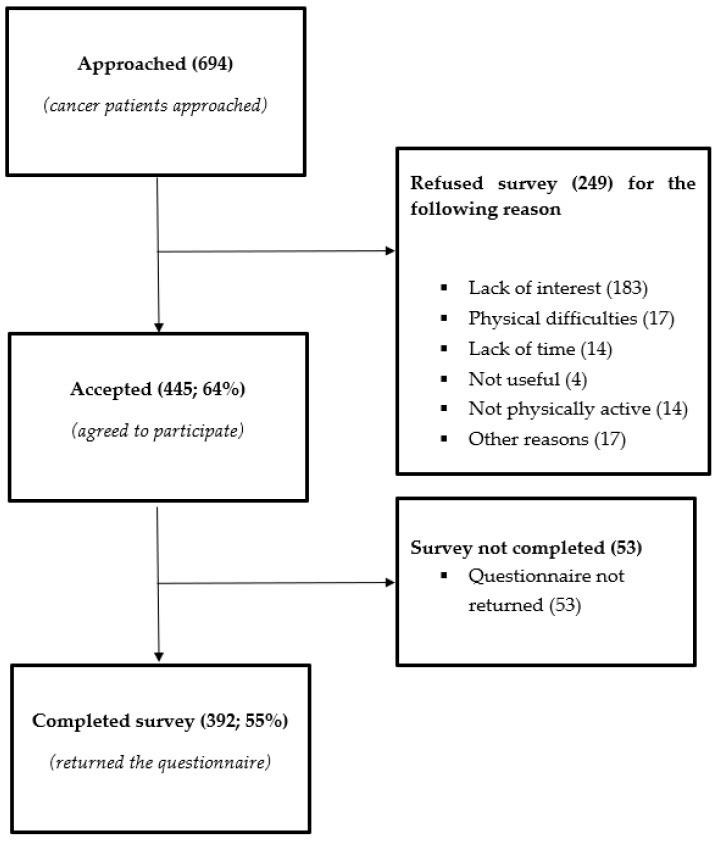
Methods: To investigate exercise levels and preferences in cancer patients, a cross-sectional study was conducted on a random sample of 392 cancer outpatients who anonymously completed a questionnaire investigating general and medical characteristics, and expressed willingness to participate in exercise programs. Current exercise levels were estimated with the Leisure Score Index (LSI).
Results: Most patients (93%) were insufficiently active but 80% declared an interest in exercise programs. Patients preferred oncologist-instructed programs and specified particular exercise needs. Multivariate logistic regression showed that willingness to exercise was associated with education (OR: 1.87; 95% CI: 1.15-3.04 beyond age 14 years vs. up to 14 years) and current physical activity (OR: 1.92; 95% CI: 1.92-3.63 for sweat-inducing activity >2 times/week vs. <1 time/week). Patients given chemotherapy were less inclined to exercise (OR: 0.45; 95% CI: 0.23-0.86) than those who did not. LSI was lower if cancer stage was advanced (β: -0.36; 95% CI: -0.75 to -0.02) than if it was in remission. High LSI was also associated with longer education, lower BMI, and longer time after diagnosis.
Conclusion: Cancer patients are insufficiently active but are willing to participate in personalized exercise programs. Information from this survey may help in designing personalized interventions so these patients will achieve sufficient exercise.
Keywords: adherence; cancer; exercise; health promotion; preferences.
Conflict of interest statement
M.M. reports personal fees from Pfizer, EUSA Pharma and Astra Zeneca. S.P. received honoraria or speakers’ fees from Astra-Zeneca, Eli-Lilly, BMS, Boehringer Ingelheim, MSD, Roche and Istituto Gentili. All remaining authors have declared no conflicts of interest.
Figures
References
-
- Airtum A. I Numeri Del Cancro in Italia. Intermedia Editore; Roma, Italy: 2019.
Publication types
MeSH terms
LinkOut - more resources
Full Text Sources
Medical
