Review
. 2020 Jul 25;21(15):5275.
doi: 10.3390/ijms21155275.

Gut Microbiome Modulation for Preventing and Treating Pediatric Food Allergies

Affiliations
Review

Gut Microbiome Modulation for Preventing and Treating Pediatric Food Allergies

Margherita Di Costanzo et al. Int J Mol Sci. .

Abstract

The increasing prevalence and severity of pediatric food allergies (FA) demands innovative preventive and therapeutic strategies. Emerging evidence suggests a pivotal role for the gut microbiome in modulating susceptibility to FA. Studies have demonstrated that alteration of gut microbiome could precede FA, and that particular microbial community structures early in life could influence also the disease course. The identification of gut microbiome features in pediatric FA patients is driving new prevention and treatment approaches. This review is focused on the potential role of the gut microbiome as a target for FA prevention and treatment.

Keywords: dysbiosis; food allergy; gut microbiome.


Conflict of interest statement

The authors declare no conflict of interest.

Figures
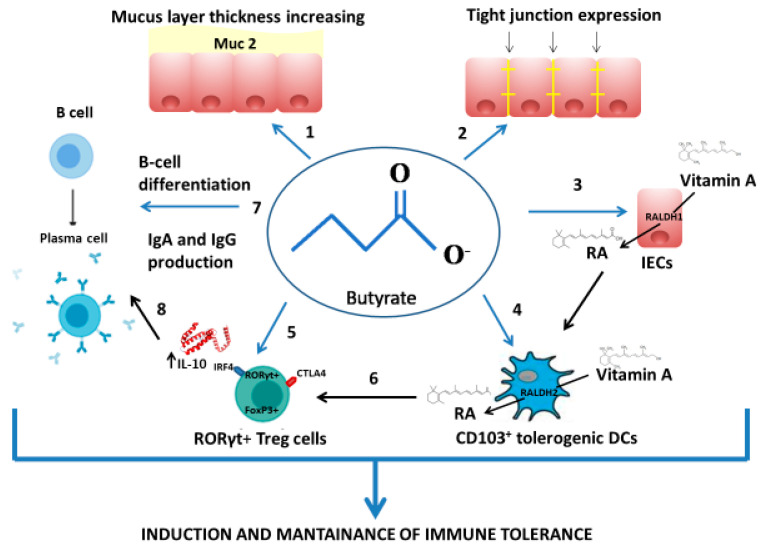
Figure 1
Figure 1
Butyrate exerts immune and nonimmune mechanisms of action against food allergy (FA). Butyrate can improve gut epithelial barrier integrity, increasing mucus layer thickness (enhancing mucin genes’ expression, in particular Muc2) (1) and tight junction expression (2). Among immune mechanisms, butyrate acts on intestinal epithelial cells (IECs) through two different pathways: (a) the inhibition of histone deacetylases (HDAC) 1 and 3 with subsequent increases in retinaldehyde dehydrogenases (RALDH) 1 activity and retinoic acid (RA) levels (3); (b) the interaction with G-protein-coupled receptor (GPR) 43, with subsequent increases in Vitamin A metabolism and epithelial barrier integrity. The effect of butyrate on dendritic cells (DCs) results in increasing RALDH2 activity and RA levels through direct (interaction with GPR109A expressed by DCs) and indirect (RA produced by IECs) mechanisms (4). Butyrate is also able to induce retinoic acid-related orphan receptor γt (RORγt)+ Forkhead box P3 (FoxP3)+ T regulatory (Treg) cells thanks to the inhibition of HDAC6 and 9, which leads to increase of FoxP3 gene expression, as well as the production and suppressive function of Treg cells (5). The induction of RORγt+ FoxP3+ Treg cells is also mediated by DCs interaction (6). Butyrate may induce B-cell differentiation and IgA and IgG production through HDAC inhibition which leads to acetylation of specific genes involved in B-cell differentiation and/or IgG and IgA production (7). Moreover, butyrate increases the cellular metabolism necessary for B-cell differentiation and Ig production. These mechanisms are also strongly influenced by IL-10 secreted by Treg cells (8). In the figure, the blue arrows indicate the direct effect of butyrate, the black arrows indicate the indirect effect of butyrate.
Figure 2
Figure 2
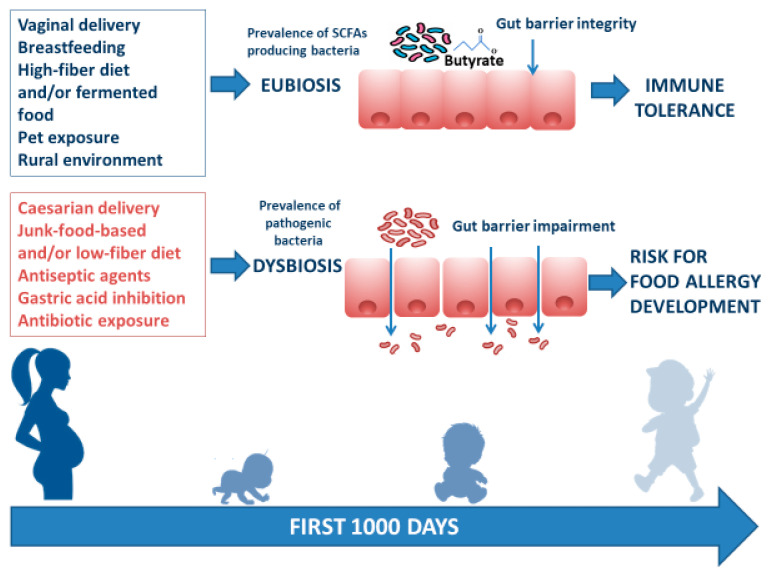
Infant gut microbiome composition and function is related to multiple environmental factors. The “first 1000 days” start from intrauterine development to the first 2 years of life and represent the frame of gut microbiome structure and function shaping. The ideal path begins with a full-term gestational period, followed by spontaneous delivery, breastfeeding provided by a mother following a Mediterranean diet lifestyle, earlier rural environmental exposure, and infant intake of a high-fiber diet and/or fermented food. All these factors are responsible for gut eubiosis, with a prevalence of SCFA-producing bacteria and gut barrier integrity, laying foundations for a healthy status and for a long-lasting protection against noncommunicable chronic diseases (such as FA) later in life. Conversely, caesarian delivery, from a mother following a junk-food-based and/or low-fiber diet, and direct or indirect childhood exposure to antiseptic agents and drugs (mainly antibiotics and gastric acidity inhibitors) leads to gut dysbiosis with prevalence of pathogenic bacteria, reduction of immunomodulatory factor production, increased gut barrier permeability, and a risk for FA development.

References

    1. Sicherer S.H., Sampson H.A. Food allergy: A review and update on epidemiology, pathogenesis, diagnosis, prevention, and management. J. Allergy Clin. Immunol. 2018;141:41–58. doi: 10.1016/j.jaci.2017.11.003. - DOI - PubMed
    1. Gupta R., Holdford D., Bilaver L., Dyer A., Holl J.L., Meltzer D. The economic impact of childhood food allergy in the United States. JAMA Pediatr. 2013;167:1026–1031. doi: 10.1001/jamapediatrics.2013.2376. - DOI - PubMed
    1. Rook G.A. 99th Dahlem conference on infection, inflammation and chronic inflammatory disorders: Darwinian medicine and the ‘hygiene’ or ‘old friends’ hypothesis. Clin. Exp. Immunol. 2010;160:70–79. - PMC - PubMed
    1. Rook G.A., Lowry C.A., Raison C.L. Microbial ‘Old Friends’, immunoregulation and stress resilience. Evol. Med. Public Health. 2013;2013:46–64. doi: 10.1093/emph/eot004. - DOI - PMC - PubMed
    1. Hanski I., von Hertzen L., Fyhrquist N., Koskinen K., Torppa K., Laatikainen T., Karisola P., Auvinen P., Paulin L., Mäkelä M.J., et al. Environmental biodiversity, human microbiota, and allergy are interrelated. Proc. Natl. Acad. Sci. USA. 2012;109:8334–8339. doi: 10.1073/pnas.1205624109. - DOI - PMC - PubMed