. 2020 Dec;9(1):1761-1770.
doi: 10.1080/22221751.2020.1796528.

Lassa fever in Benin: description of the 2014 and 2016 epidemics and genetic characterization of a new Lassa virus

Affiliations

Lassa fever in Benin: description of the 2014 and 2016 epidemics and genetic characterization of a new Lassa virus

Anges Yadouleton et al. Emerg Microbes Infect. 2020 Dec.

Abstract

We report two outbreaks of Lassa fever that occurred in Benin in 2014 and 2016 with 20 confirmed cases and 50% (10/20) mortality. Benin was not previously considered to be an endemic country for Lassa fever, resulting in a delay to diagnose the disease and its human transmission. Molecular investigations showed the viral genomes to be similar to that of the Togo strain, which is genetically very different from other known strains and confirms the existence of a new lineage. Endemic circulation of Lassa virus in a new territory and the genetic diversity thus confirm that this virus represents a growing threat for West African people. Given the divergence of the Benin strain from the prototypic Josiah Sierra Leone strain frequently used to generate vaccine candidates, the efficacy of vaccine candidates should also be demonstrated with this strain.

Keywords: Benin; Lassa fever; Lassa virus; genome; new lineage; outbreak; phylogeny; serology.


Conflict of interest statement

No potential conflict of interest was reported by the author(s).

Figures
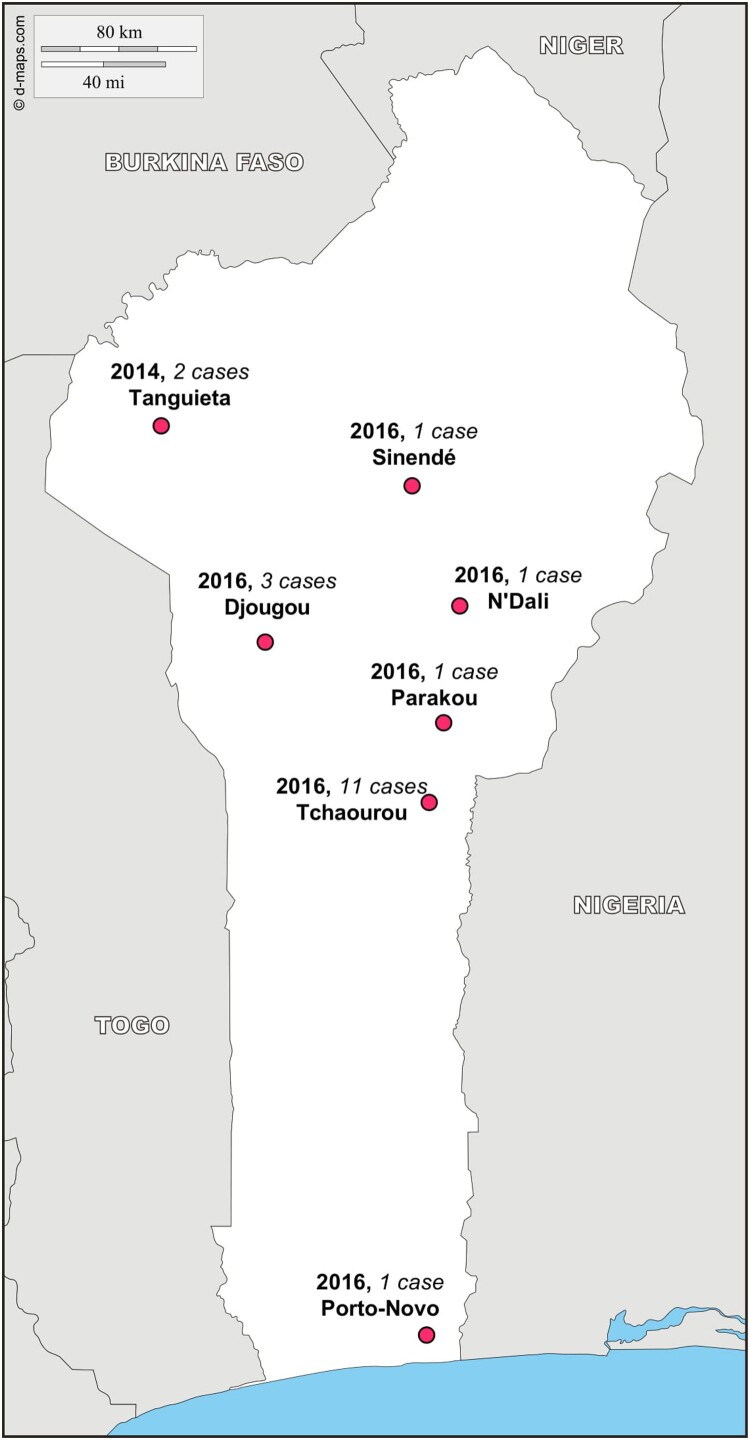
Figure 1.
Figure 1.
Location of the 20 confirmed cases, 2 in 2014 and 18 in 2016, by commune of notification. Tanguieta is located in the department of Atacora, Sinendé, N’Dali, Parakou, and Tchaourou in the department of Borgou Departement, Djougou in the department of Donga, and Porto Novo in the department of Ouémé.
Figure 2.
Figure 2.
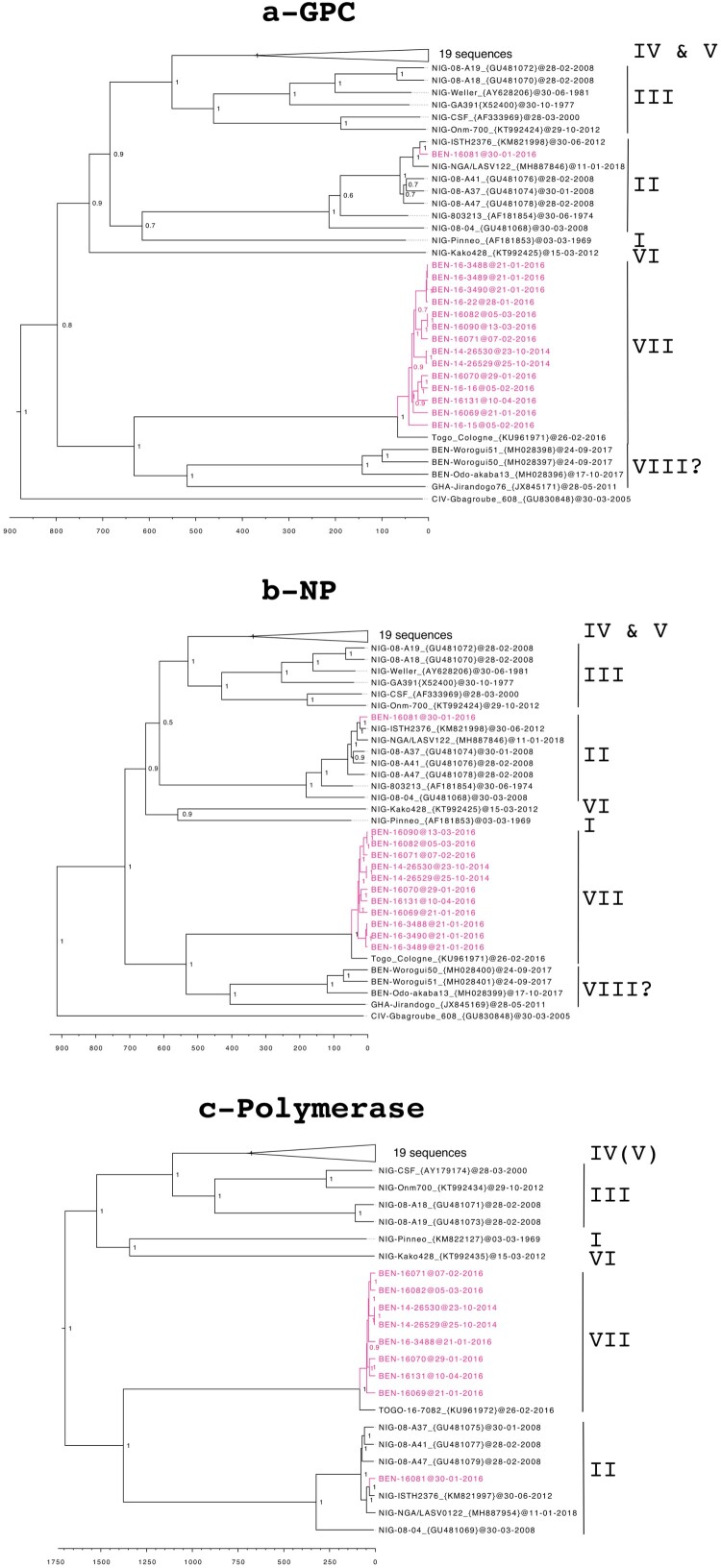
Time-calibrated phylogeny of the Lassa virus strains from Benin, 2014–2016 (in pink), showing the trees created using the glycoprotein precursor (a), the nucleoprotein (b), and the polymerase (c). The trees are based on nucleotide sequences and posterior support values are shown at the nodes. Lineages are noted to the right of each tree and the scale axis represents the time in years. The GPC tree was inferred from 55 sequences, the NP tree from 52 sequences, and the L free from 41 sequences. The 19 sequences belonging to lineages IV and V have been collapsed, as they appear to be phylogenetically very distant, to make the figure more readable. However, the detailed list of the sequences used in this study are available in supplementary information.

References

    1. Buckley SM, Casals J, Downs WG.. Isolation and antigenic characterization of Lassa virus. Nature. 1970;227:174. doi: 10.1038/227174a0 - DOI - PubMed
    1. Frame JD, Baldwin JMJ, Gocke DJ, et al. Lassa fever, a new virus disease of man from West Africa. Am J Trop Med Hyg. 1970;19(4):670–676. doi: 10.4269/ajtmh.1970.19.670 - DOI - PubMed
    1. Bausch DG, Demby AH, Coulibaly M, et al. Lassa fever in Guinea: I. epidemiology of human disease and clinical observations. Vector Borne Zoonotic Dis. 2001;1(4):269–281. doi: 10.1089/15303660160025903 - DOI - PubMed
    1. Fichet-Calvet E, Rogers DJ.. Risk maps of Lassa fever in West Africa. PLoS Negl Trop Dis. 2009;3(3):e388. doi: 10.1371/journal.pntd.0000388 - DOI - PMC - PubMed
    1. Gunther S, Emmerich P, Laue T, et al. Imported Lassa fever in Germany: molecular characterization of a new Lassa virus strain. Emerg Infect Dis. 2000 Sep-Oct;6(5):466–476. doi: 10.3201/eid0605.000504 - DOI - PMC - PubMed