


Intestinal Perforations Associated With a High Mortality and Frequent Complications During an Epidemic of Multidrug-resistant Typhoid Fever in Blantyre, Malawi
- PMID: 32725231
- PMCID: PMC7388708
- DOI: 10.1093/cid/ciaa405
Intestinal Perforations Associated With a High Mortality and Frequent Complications During an Epidemic of Multidrug-resistant Typhoid Fever in Blantyre, Malawi
Abstract
Background: Typhoid fever remains a major source of morbidity and mortality in low-income settings. Its most feared complication is intestinal perforation. However, due to the paucity of diagnostic facilities in typhoid-endemic settings, including microbiology, histopathology, and radiology, the etiology of intestinal perforation is frequently assumed but rarely confirmed. This poses a challenge for accurately estimating burden of disease.
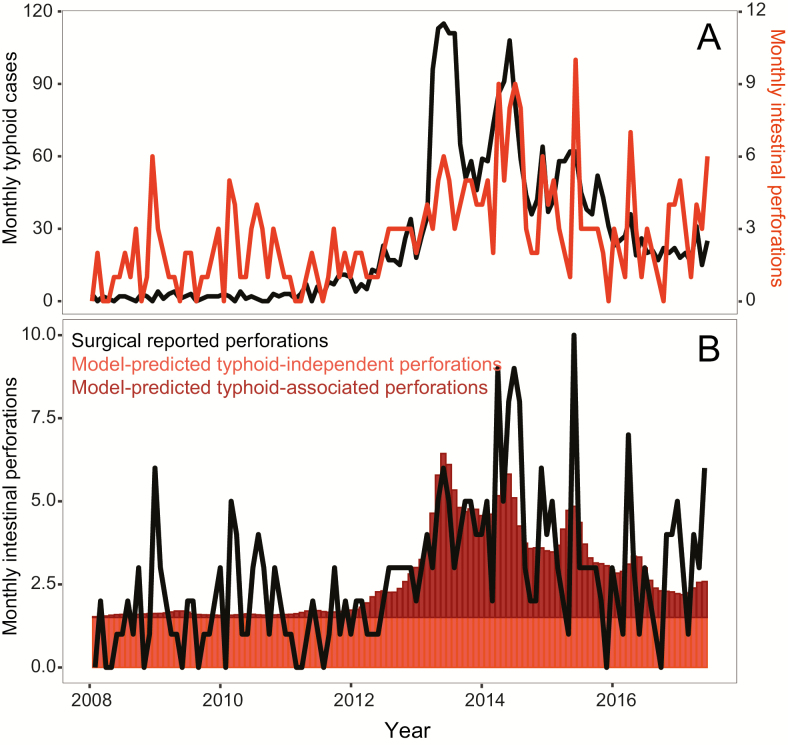
Methods: We recruited a prospective cohort of patients with confirmed intestinal perforation in 2016 and performed enhanced microbiological investigations (blood and tissue culture, plus tissue polymerase chain reaction [PCR] for Salmonella Typhi). In addition, we used a Poisson generalized linear model to estimate excess perforations attributed to the typhoid epidemic, using temporal trends in S. Typhi bloodstream infection and perforated abdominal viscus at Queen Elizabeth Central Hospital from 2008-2017.
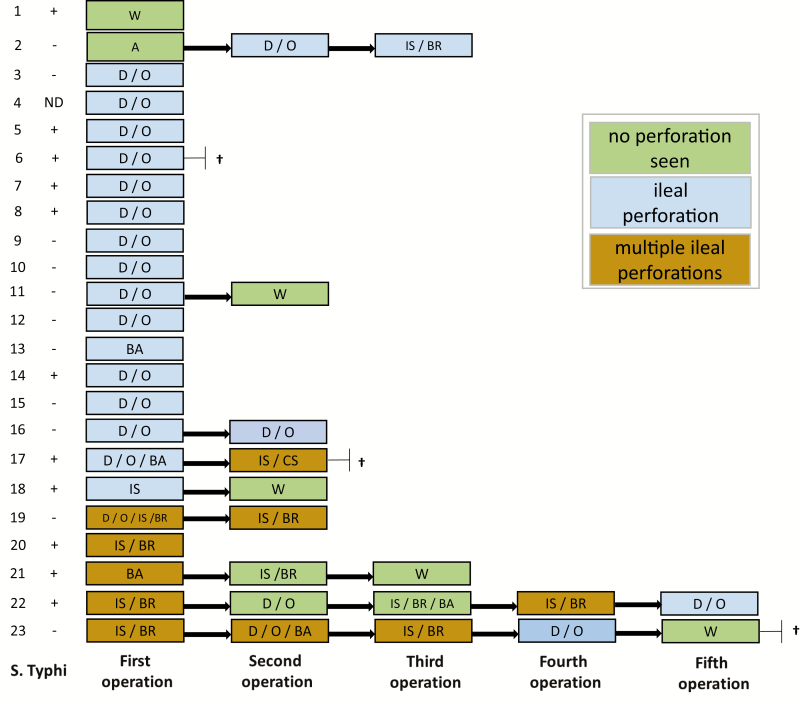
Results: We recruited 23 patients with intraoperative findings consistent with intestinal perforation. 50% (11/22) of patients recruited were culture or PCR positive for S. Typhi. Case fatality rate from typhoid-associated intestinal perforation was substantial at 18% (2/11). Our statistical model estimates that culture-confirmed cases of typhoid fever lead to an excess of 0.046 perforations per clinical typhoid fever case (95% CI, .03-.06). We therefore estimate that typhoid fever accounts for 43% of all bowel perforation during the period of enhanced surveillance.
Conclusions: The morbidity and mortality associated with typhoid abdominal perforations are high. By placing clinical outcome data from a cohort in the context of longitudinal surgical registers and bacteremia data, we describe a valuable approach to adjusting estimates of the burden of typhoid fever.
Keywords: Salmonella Typhi; antimicrobial resistance; complication; surgery.
© The Author(s) 2020. Published by Oxford University Press for the Infectious Diseases Society of America.
Figures
References
-
- Parry CM, Hien TT, Dougan G, White NJ, Farrar JJ. Typhoid fever. N Engl J Med 2002; 347:1770–82. - PubMed
-
- Butler T, Knight J, Nath SK, Speelman P, Roy SK, Azad MA. Typhoid fever complicated by intestinal perforation: a persisting fatal disease requiring surgical management. Rev Infect Dis 1985; 7:244–56. - PubMed
-
- Bitar R, Tarpley J. Intestinal perforation in typhoid fever: a historical and state-of-the-art review. Rev Infect Dis 1985; 7:257–71. - PubMed
Publication types
MeSH terms
LinkOut - more resources
Full Text Sources
