Mineral Trioxide Aggregate Applications in Endodontics: A Review
- PMID: 32726858
- PMCID: PMC7536098
- DOI: 10.1055/s-0040-1713073
Mineral Trioxide Aggregate Applications in Endodontics: A Review
Abstract
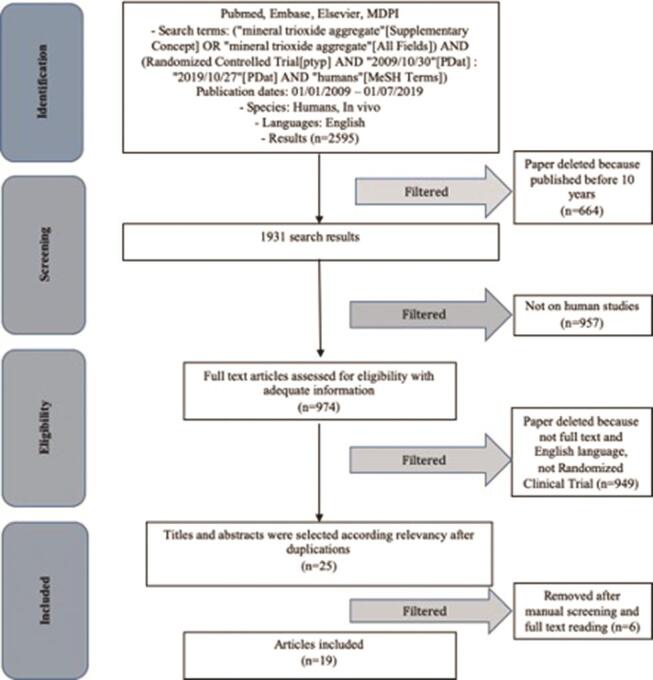
A current topic in dentistry concerns the biocompatibility of the materials, and in particular, conservative dentistry and endodontics ones. The mineral trioxide aggregate (MTA) is a dental material with biocompatibility properties to oral and dental tissues. MTA was developed for dental root repair in endodontic treatment and it is formulated from commercial Portland cement, combined with bismuth oxide powder for radiopacity. MTA is used for creating apical plugs during apexification, repairing root perforations during root canal therapy, treating internal root resorption, and pulp capping. The objective of this article is to investigate MTA features from a clinical point of view, even compared with other biomaterials. All the clinical data regarding this dental material will be evaluated in this review article. Data obtained from the analysis of the past 10 years' literature highlighted 19 articles in which the MTA clinical aspects could be recorded. The results obtained in this article are an important step to demonstrate the safety and predictability of oral rehabilitations with these biomaterials and to promote a line to improve their properties in the future.
Conflict of interest statement
Conceptualization, methodology, validation, formal analysis, investigation, resources, data curation, original draft preparation, and review and editing of the manuscript were done by G.C., M.D.T., and L.F.; visualization was performed by D.R., L.N., and C.D.A.; data were curated by G.A., M.T., F.G., and A.T.; L.L. supervised the entire work and L.F. performed project administration.None declared.
Figures
References
-
- Tu M G, Sun K T, Wang T H et al. Effects of mineral trioxide aggregate and bioceramics on macrophage differentiation and polarization in vitro. J Formos Med Assoc. 2019;118(10):1458–1465. - PubMed
-
- Serin Kalay T. Effects of intracoronal bleaching agents on the surface properties of mineral trioxide aggregate. Odontology. 2019;107(04):465–472. - PubMed
-
- Lopes M B, Soares V CG, Fagundes F HR et al. Analysis of molecular changes induced by mineral trioxide aggregate on sPLA2. Braz Dent J. 2019;30(05):453–458. - PubMed
-
- Liu Y, Liu X M, Bi J et al. Cell migration and osteo/odontogenesis stimulation of iRoot FS as a potential apical barrier material in apexification. Int Endod J. 2020;53(04):467–477. - PubMed
-
- Lin YT, Lin YJ. Success rates of mineral trioxide aggregate, ferric sulfate, and sodium hypochlorite pulpotomies: a prospective 24-month study. J Formos Med Assoc 2019 - PubMed
LinkOut - more resources
Full Text Sources
Medical
Miscellaneous