Review
. 2020 Jul 29;5(1):134.
doi: 10.1038/s41392-020-00256-x.

The model of cytokine release syndrome in CAR T-cell treatment for B-cell non-Hodgkin lymphoma

Affiliations
Review

The model of cytokine release syndrome in CAR T-cell treatment for B-cell non-Hodgkin lymphoma

Jianshu Wei et al. Signal Transduct Target Ther. .

Abstract

Chimeric antigen receptor T (CAR T) cell therapy has demonstrated efficacy in the treatment of haematologic malignancies. However, the accompanying adverse events, the most common of which is cytokine release syndrome (CRS), substantially limit its wide application. Due to its unique physiological characteristics, CRS in CAR T-cell treatment for B-cell non-Hodgkin lymphoma (B-NHL) may exhibit some special features. Although existing guidelines had greatly promoted the recognition and management of CRS, many recommendations are not fully applicable to B-NHL. Therefore, it is imperative to identify responses that are specific to CRS observed following CAR T treatment for B-NHL. Based on underlying biological processes and known pathophysiological mechanisms, we tentatively propose a new model to illustrate the occurrence and evolution of CAR T-cell-therapy-related CRS in B-NHL. In this model, tumour burden and bone marrow suppression are considered determinants of CRS. Novel phenomena after CAR T-cell infusion (such as local inflammatory response) are further identified. The proposed model will help us better understand the basic biology of CRS and recognize and manage it more rationally.


Conflict of interest statement

W.D.H. certifies that the contribution and competing interests statements included in this paper are correct and have been approved by all coauthors. The authors declare no competing interests.

Figures
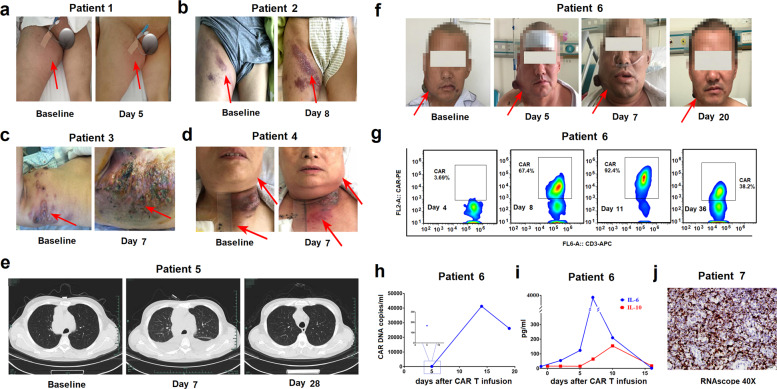
Fig. 1
Fig. 1
Clinical manifestations of local cytokine release syndrome (L-CRS). af In the early stage of CAR T-cell treatment, B-NHL patients may exhibit a significant local inflammatory response, mainly manifested as local swelling and redness. For example, patient 6 had a significant L-CRS response within 5 days after receiving CAR T treatment, but during this period, the proportion of CAR T cells to CD3 positive cells (g), the number of CAR DNA copies in PB (h) and the level of IL-6 in PB (i) remained at a low level. j The RNAscope results of patient 7 indicated that a large number of CAR T cells infiltrated into B-NHL lesions. B-NHL B-cell non-Hodgkin lymphoma, CAR chimeric antigen receptor, IL-6 interleukin-6, PB peripheral blood
Fig. 2
Fig. 2
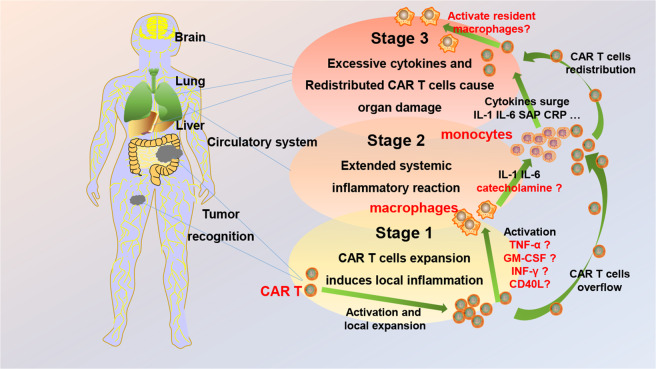
A new model to illustrate the occurrence and evolution of chimeric antigen receptor T (CAR T) cell therapy-related adverse events (AEs) in B-cell non-Hodgkin lymphoma (B-NHL). Stage 1: CAR T cells converge upon tumour cells and kill them. The early distribution of CAR T cells is localized, and the activated CAR T cells release cytokines that in turn trigger a series of local inflammatory reactions, defined in this paper as local cytokine release syndrome (L-CRS). Stage 2: Locally elevated CAR T-cell numbers and cytokine ‘overflow’ into the circulatory system occur, which may boost systemic cytokine release syndrome (S-CRS). Stage 3: CAR T cells redistribute into bone marrow and normal organs, such as the liver, lung and brain. The redistributed CAR T cells might activate tissue-resident immune cells to cause local organ damage and other AEs. TNF tumour necrosis factor, GM-CSF granulocyte-macrophage colony-stimulating factor, IFN interferon, CCL-3 C-C motif chemokine ligand 3 (also known as macrophage inflammatory protein 1α, MIP-1α), IL interleukin, SAP serum amyloid P component, CRP C-reactive protein, BM bone marrow
Fig. 3
Fig. 3
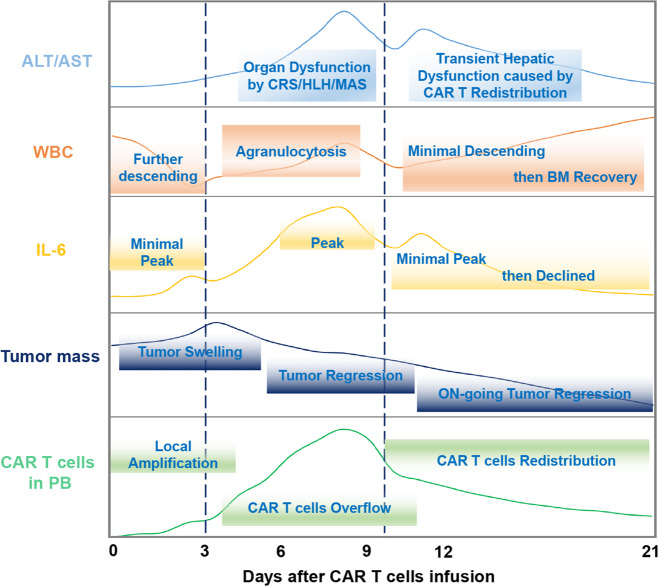
The in vivo kinetics of chimeric antigen receptor T (CAR T) cells and associated events in the early stage of CAR T-cell therapy for B-cell non-Hodgkin lymphoma (B-NHL). Within ~3 days after infusion, CAR T cells proliferate locally in the tumour, and the number of CAR T cells in the peripheral blood (PB) increases slowly, accompanied by enlargement of tumour lesions, a mild rise in IL-6 in the PB and an initial minimal peak and further decline of white blood cell (WBC) counts caused by preconditioning chemotherapy. Within ~3–10 days after infusion, a large number of CAR T cells overflow from the tumour site into the PB, accompanied by obvious regression of tumours, a rapid rise in IL-6 in PB to a peak (of note, the peak level of IL-6 is generally seen 1–2 days earlier than that of CAR T-cell numbers), a slow rise in WBC count (due to the accumulation of CAR T cells in PB) and agranulocytosis and organ damage caused by cytokine release syndrome (CRS) or haemophagocytic lymphohistiocytosis/macrophage activation syndrome (HLH/MAS). Within about 10–21 days after infusion, the peripheral CAR T cells redistribute into BM and normal organs (prompted by a rapid decrease in CAR T cells in PB), accompanied by ongoing tumour regression, a minimal peak and then continuous decline in IL-6 levels (possibly because the redistributed CAR T cells activate monocytes/macrophages in the BM and normal tissues) and WBC count recovery after a minimal dip accompanied by transient hepatic dysfunction. IL-6 interleukin-6, AST aspartate aminotransferase, ALT alanine aminotransferase, BM bone marrow

References

    1. Grupp SA, et al. Chimeric antigen receptor-modified T cells for acute lymphoid leukemia. N. Engl. J. Med. 2013;368:1509–1518. - PMC - PubMed
    1. Maude SL, et al. Chimeric antigen receptor T cells for sustained remissions in leukemia. N. Engl. J. Med. 2014;371:1507–1517. - PMC - PubMed
    1. Wang X, et al. Phase 1 studies of central memory-derived CD19 CAR T-cell therapy following autologous HSCT in patients with B-cell NHL. Blood. 2016;127:2980–2990. - PMC - PubMed
    1. Schuster SJ, et al. Chimeric antigen receptor T cells in refractory B-cell lymphomas. N. Engl. J. Med. 2017;377:2545–2554. - PMC - PubMed
    1. Kochenderfer JN, et al. Lymphoma remissions caused by anti-CD19 chimeric antigen receptor T cells are associated with high serum interleukin-15 levels. J. Clin. Oncol. 2017;35:1803–1813. - PMC - PubMed

Publication types

MeSH terms