. 2020 Jul 29;10(1):12666.
doi: 10.1038/s41598-020-69689-2.

Highly stretchable sensing array for independent detection of pressure and strain exploiting structural and resistive control

Affiliations

Highly stretchable sensing array for independent detection of pressure and strain exploiting structural and resistive control

Ryosuke Matsuda et al. Sci Rep. .

Abstract

Stretchable physical sensors are crucial for the development of advanced electrical systems, particularly wearable devices and soft robotics. Currently available stretchable sensors that detect both pressure and strain are based on piezoelectric, piezoresistive, or piezocapacitive effects. The range of pressure sensing is 1-800 kPa with large deformations being within the range of deformations of parts of the human body, such as elbows and knees. However, these devices cannot easily allow simultaneous and independent detection of pressure and strain with sensor arrays at large tensions (> 50%) because strain affects the pressure signal. In this study, we propose a monolithic silicone-based array of pressure and strain sensors that can simultaneously and independently detect the in-plane biaxial tensile deformation and pressure. To realize these functionalities, the deformation of the device structure was optimized using a hetero-silicone substrate made of two types of silicone with different hardness characteristics and porous silicone bodies. In addition, the resistances of the sensors were controlled by adjusting a mixture based on carbon nanoparticles to improve the sensitivity and independence between the pressure and strain sensors. These concepts demonstrate the potential of this approach and its compatibility with the current architectures of stretchable physical sensors.


Conflict of interest statement

The authors declare no competing interests.

Figures
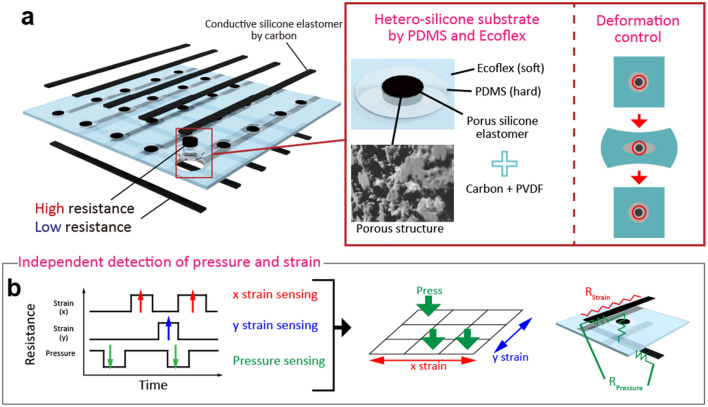
Figure 1
Figure 1
Stretchable pressure sensing array for independent detection of x and y tensions. (a) Schematic of the array. This silicone substrate is made of two different silicone types with different hardness values. Harder silicone, PDMS, can suppress the deformation of pressure sensing elements during tension. (b) Schematic of measurement methods and signals of a pressure mapping sensor subjected to strain deformation. This sensor can independently sense three different stimuli, namely pressure, x-, and y-directional strains.
Figure 2
Figure 2
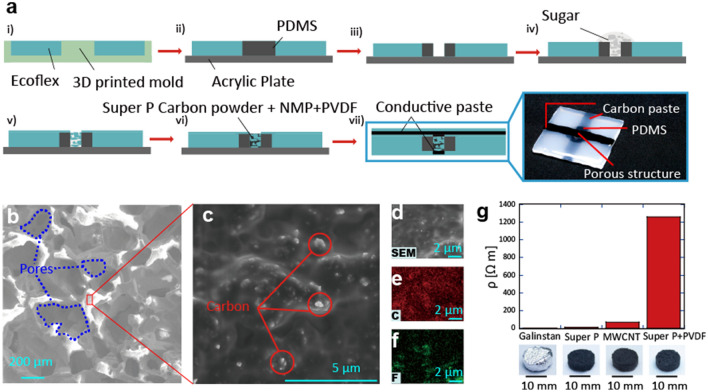
Fabrication process and characteristics of a single-pixel device. (a) Fabrication process. (b,c) Scanning electron microscopy (SEM) image of porous pressure sensing element infiltrated by a carbon/PVDF mixture. Higher magnification SEM image of the porous silicone. (df) SEM and energy dispersive spectroscopy (EDS) analytics of carbon and fluorine in the pressure sensing element. (g) Resistance differences according to the conductive material in the porous silicone.
Figure 3
Figure 3
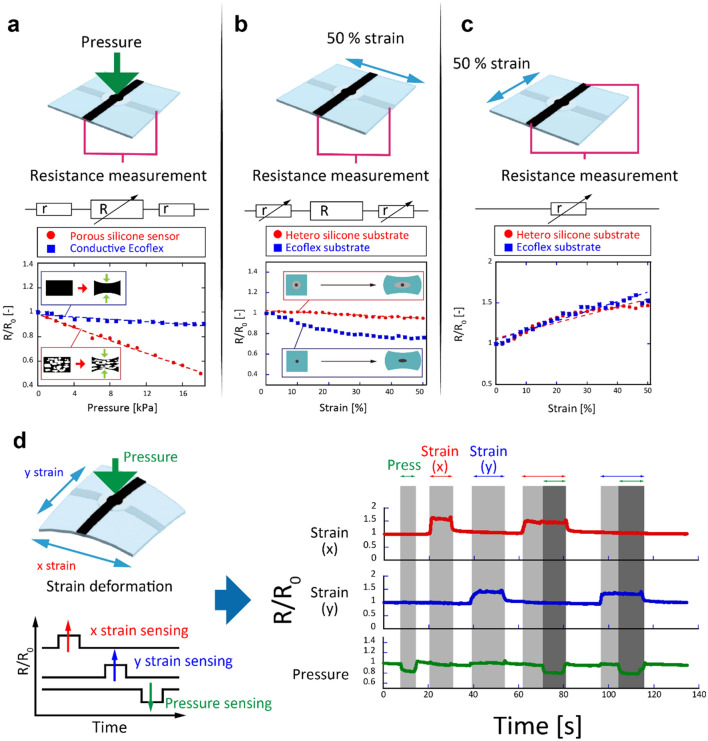
Sensing characteristics of a single-pixel device. (a) Resistance variation of a pressure sensor composed of porous and conductive silicone with respect to pressure. Resistance “r” in this figure is low and resistance “R” is high. (b) Resistance variation of pressure sensors on the entire Ecoflex and hetero-substrates subjected to 50% strain deformation. (c) Resistance increases with respect to strain deformation. (d) Demonstration of independent pressure and x and y strain detection using a single-pixel device. The resistance along the x and y axes increased while this device was strained in the x and y directions. In contrast, the pressure sensor resistance decreased while the sensor of the device was pressed. In this demonstration, the pressure and strain stimuli were sensed independently while the stimuli were applied simultaneously.
Figure 4
Figure 4
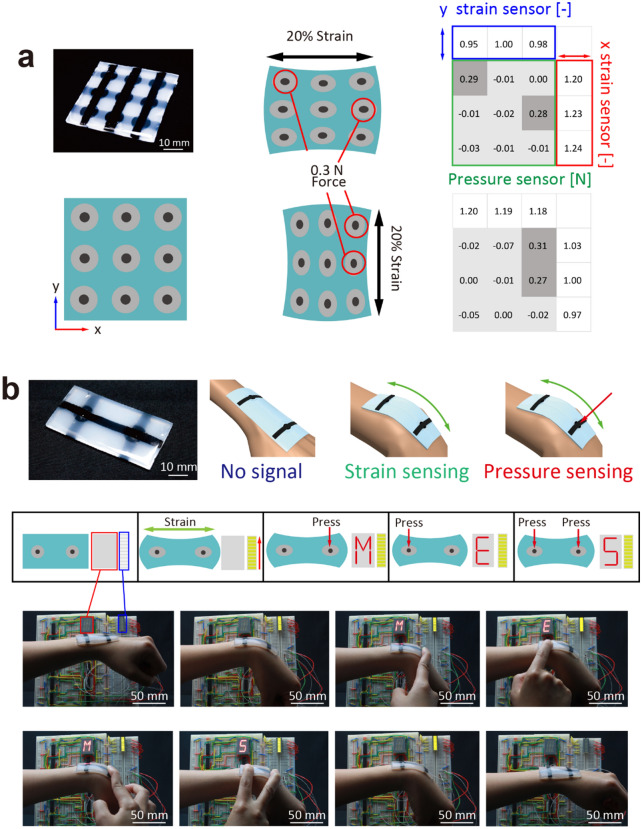
Demonstration of functionality of a multipixel device. (a) Maps of pressure and strain using the 9-pixel device. The device achieved 9-pixel mapping of pressure when subjected to large strains. In addition, it sensed strain using six conductive lines based on a passive matrix. (b) Demonstration of display controlled by a 2-pixel device with a strain indicator. The digital display controlled by the 2-pixel device shows the word “MEMS” and works like a keyboard. In addition, the strain indicator, which was composed of an LED bar, was turned based on the amount of strain. Pressure and strain sensing were independently controlled by each motion.

References

    1. Amjadi M, Pichitpajongkit A, Lee S, Ryu S, Park I. Highly stretchable and sensitive strain sensor based on silver nanowire-elastomer nanocomposite. ACS Nano. 2014;8:5154–5163. doi: 10.1021/nn501204t. - DOI - PubMed
    1. Yan C, et al. Highly stretchable piezoresistive graphene-nanocellulose nanopaper for strain sensors. Adv. Mater. 2014;26:2022–2027. doi: 10.1002/adma.201304742. - DOI - PubMed
    1. Lu N, Lu C, Yang S, Rogers J. Highly sensitive skin-mountable strain gauges based entirely on elastomers. Adv. Funct. Mater. 2012;22:4044–4050. doi: 10.1002/adfm.201200498. - DOI
    1. Amjadi M, Kyung KU, Park I, Sitti M. Stretchable, skin-mountable, and wearable strain sensors and their potential applications: A review. Adv. Funct. Mater. 2016;26:1678–1698. doi: 10.1002/adfm.201504755. - DOI
    1. Liu Y, Pharr M, Salvatore GA. Lab-on-skin: A review of flexible and stretchable electronics for wearable health monitoring. ACS Nano. 2017;11:9614–9635. doi: 10.1021/acsnano.7b04898. - DOI - PubMed

Publication types