Review
. 2020 Sep;17(9):901-913.
doi: 10.1038/s41423-020-0502-z. Epub 2020 Jul 29.

New insights into the evasion of host innate immunity by Mycobacterium tuberculosis

Affiliations
Review

New insights into the evasion of host innate immunity by Mycobacterium tuberculosis

Qiyao Chai et al. Cell Mol Immunol. 2020 Sep.

Abstract

Mycobacterium tuberculosis (Mtb) is an extremely successful intracellular pathogen that causes tuberculosis (TB), which remains the leading infectious cause of human death. The early interactions between Mtb and the host innate immune system largely determine the establishment of TB infection and disease development. Upon infection, host cells detect Mtb through a set of innate immune receptors and launch a range of cellular innate immune events. However, these innate defense mechanisms are extensively modulated by Mtb to avoid host immune clearance. In this review, we describe the emerging role of cytosolic nucleic acid-sensing pathways at the host-Mtb interface and summarize recently revealed mechanisms by which Mtb circumvents host cellular innate immune strategies such as membrane trafficking and integrity, cell death and autophagy. In addition, we discuss the newly elucidated strategies by which Mtb manipulates the host molecular regulatory machinery of innate immunity, including the intranuclear regulatory machinery, the ubiquitin system, and cellular intrinsic immune components. A better understanding of innate immune evasion mechanisms adopted by Mtb will provide new insights into TB pathogenesis and contribute to the development of more effective TB vaccines and therapies.

Keywords: Autophagy; Innate immune receptors; Innate immunity; Mycobacterium tuberculosis; Ubiquitin system.


Conflict of interest statement

The authors declare no competing interests.

Figures
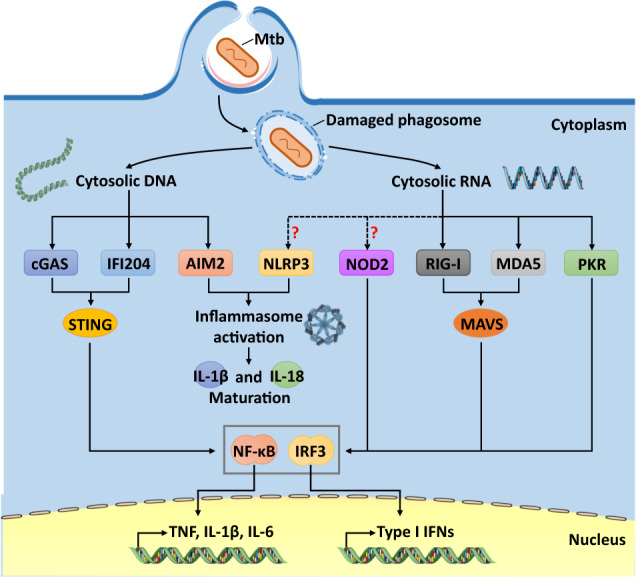
Fig. 1
Fig. 1
Host cytosolic DNA- and RNA-sensing pathways for the immune recognition of Mtb. Upon infection, Mtb is internalized into phagosomes by host phagocytic cells. Mtb-induced phagosome damage releases bacterial DNA and RNA into the host cytosol. The cytosolic sensors cGAS, IFI204, and AIM2 recognize Mtb DNA, while RIG-I, MDA5, and PKR detect RNA. Although NLRP3 and NOD2 also respond to Mtb infection, it remains unclear whether they are directly activated by Mtb RNA. Activated cytosolic DNA/RNA sensors further induce the activation of inflammasomes or NF-κB- and IRF3-mediated innate immune pathways to regulate host anti-Mtb responses
Fig. 2
Fig. 2
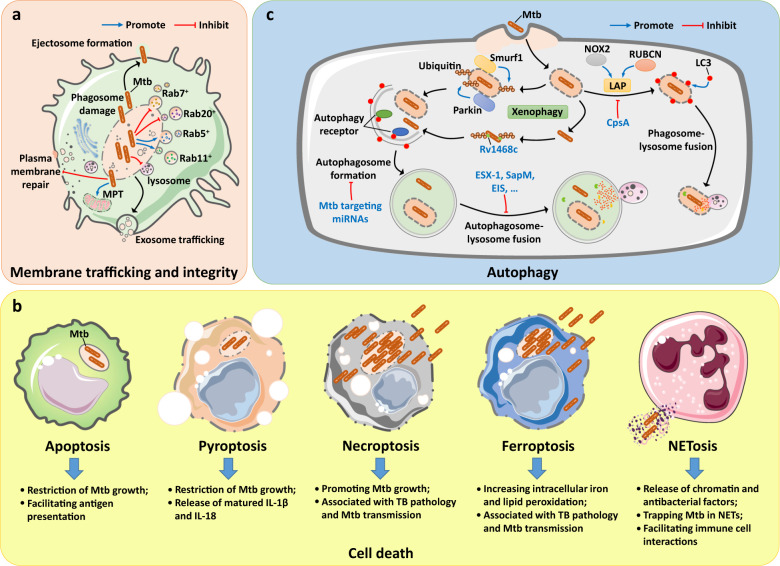
Host cellular innate immune events during Mtb infection. a Mtb regulates cellular membrane trafficking and integrity. Mtb permits Rab5+ and Rab11+ but restricts Rab7+ and Rab20+ endosome recruitment to the phagosome. In addition, Mtb prevents phagosome–lysosome fusion and causes phagosome damage enabling its escape into the host cytosol. Furthermore, Mtb induces mitochondrial membrane permeability transition (MPT), inhibits host cell plasma membrane repair, and regulates ejectosome formation and exosome trafficking. b Host cell death modalities upon Mtb infection. Diverse cell death modes may be induced during Mtb infection, and of these types, apoptosis and pyroptosis are proposed to restrict bacterial intracellular growth and facilitate anti-Mtb immune responses, whereas necroptosis and ferroptosis benefit Mtb replication and transmission. In addition, neutrophil extracellular trap (NET)-associated NETosis likely traps Mtb in NETs and facilitates immune cell interactions. c Mtb modulates the host autophagy process. Both the xenophagy and LC3-associated phagocytosis (LAP) pathways contribute to host autophagy-related immune clearance of Mtb. The anti-Mtb xenophagy pathway is alternatively mediated by the E3 ubiquitin ligases Parkin- and Smurf1-dependent ubiquitination of Mtb and Mtb phagosomes or by direct binding of ubiquitin to Mtb surface Rv1468c; the LAP pathway is mediated by NOX2 and RUBCN, which promote LC3 recruitment on Mtb phagosomes. However, Mtb could disrupt both xenophagy and LAP pathways by modulating host miRNAs or by employing a range of protein effectors, such as ESX-1, SapM, EIS, and CpsA
Fig. 3
Fig. 3
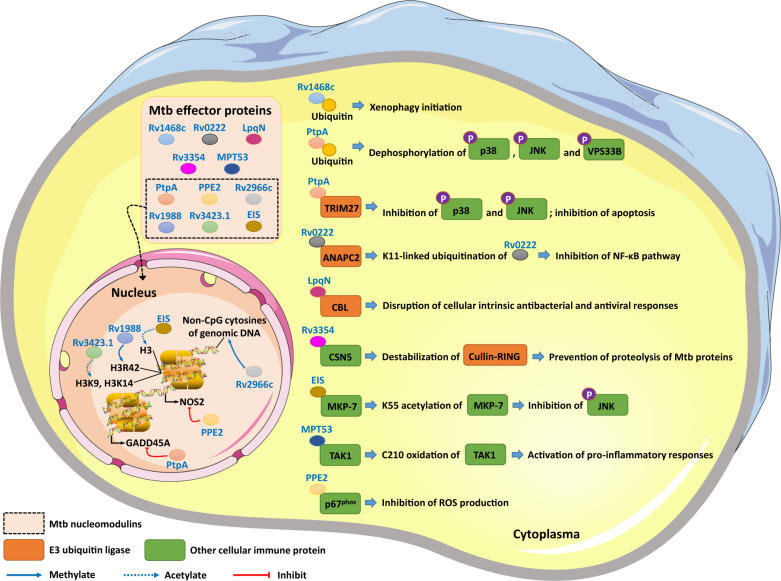
Mtb effector molecules targeting the host cellular and molecular regulatory machinery of innate and intrinsic immunity. Upon infection, Mtb delivers a wide range of effector proteins into host cells for direct interaction with the molecular components of the host ubiquitin system and other intrinsic cellular immune proteins, thus subverting host innate immunity. In parallel, some Mtb effectors are identified as nucleomodulins, which enter into the host nucleus and are involved in epigenetic and transcriptional regulation of host innate immune responses

References

    1. World Health Organization. Global Tuberculosis Report 2019. (WHO, Geneva, 2019).
    1. Shah NS, et al. Transmission of extensively drug-resistant tuberculosis in south Africa. N. Engl. J. Med. 2017;376:243–253. - PMC - PubMed
    1. Jasenosky LD, Scriba TJ, Hanekom WA, Goldfeld AE. T cells and adaptive immunity to Mycobacterium tuberculosis in humans. Immunol. Rev. 2015;264:74–87. - PubMed
    1. Fremond CM, et al. Fatal Mycobacterium tuberculosis infection despite adaptive immune response in the absence of MyD88. J. Clin. Investig. 2004;114:1790–1799. - PMC - PubMed
    1. Carlos D, et al. TLR2-dependent mast cell activation contributes to the control of Mycobacterium tuberculosis infection. Microbes Infect. 2009;11:770–778. - PubMed

Publication types