


Evaluation of Korean-Language COVID-19-Related Medical Information on YouTube: Cross-Sectional Infodemiology Study
- PMID: 32730221
- PMCID: PMC7425748
- DOI: 10.2196/20775
Evaluation of Korean-Language COVID-19-Related Medical Information on YouTube: Cross-Sectional Infodemiology Study
Abstract
Background: In South Korea, the number of coronavirus disease (COVID-19) cases has declined rapidly and much sooner than in other countries. South Korea is one of the most digitalized countries in the world, and YouTube may have served as a rapid delivery mechanism for increasing public awareness of COVID-19. Thus, the platform may have helped the South Korean public fight the spread of the disease.
Objective: The aim of this study is to compare the reliability, overall quality, title-content consistency, and content coverage of Korean-language YouTube videos on COVID-19, which have been uploaded by different sources.
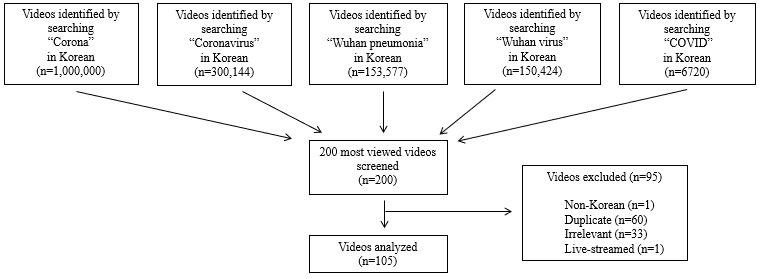
Methods: A total of 200 of the most viewed YouTube videos from January 1, 2020, to April 30, 2020, were screened, searching in Korean for the terms "Coronavirus," "COVID," "Corona," "Wuhan virus," and "Wuhan pneumonia." Non-Korean videos and videos that were duplicated, irrelevant, or livestreamed were excluded. Source and video metrics were collected. The videos were scored based on the following criteria: modified DISCERN index, Journal of the American Medical Association Score (JAMAS) benchmark criteria, global quality score (GQS), title-content consistency index (TCCI), and medical information and content index (MICI).
Results: Of the 105 total videos, 37.14% (39/105) contained misleading information; independent user-generated videos showed the highest proportion of misleading information at 68.09% (32/47), while all of the government-generated videos were useful. Government agency-generated videos achieved the highest median score of DISCERN (5.0, IQR 5.0-5.0), JAMAS (4.0, IQR 4.0-4.0), GQS (4.0, IQR 3.0-4.5), and TCCI (5.0, IQR 5.0-5.0), while independent user-generated videos achieved the lowest median score of DISCERN (2.0, IQR 1.0-3.0), JAMAS (2.0, IQR 1.5-2.0), GQS (2.0, IQR 1.5-2.0), and TCCI (3.0, IQR 3.0-4.0). However, the total MICI was not significantly different among sources. "Transmission and precautionary measures" were the most commonly covered content by government agencies, news agencies, and independent users. In contrast, the most mentioned content by news agencies was "prevalence," followed by "transmission and precautionary measures."
Conclusions: Misleading videos had more likes, fewer comments, and longer running times than useful videos. Korean-language YouTube videos on COVID-19 uploaded by different sources varied significantly in terms of reliability, overall quality, and title-content consistency, but the content coverage was not significantly different. Government-generated videos had higher reliability, overall quality, and title-content consistency than independent user-generated videos.
Keywords: COVID-19; YouTube; consumer health information; health communication; health education; infectious disease outbreaks; infodemic; infodemiology; infoveillance; internet; misinformation; multimedia; public health surveillance; social media.
©Hana Moon, Geon Ho Lee. Originally published in the Journal of Medical Internet Research (http://www.jmir.org), 12.08.2020.
Conflict of interest statement
Conflicts of Interest: None declared.
Comment on
-
National Response to COVID-19 in the Republic of Korea and Lessons Learned for Other Countries.Health Syst Reform. 2020 Jan 1;6(1):e1753464. doi: 10.1080/23288604.2020.1753464. Health Syst Reform. 2020. PMID: 32347772
References
-
- Smartphone usage in South Korea - statistics & facts. Statista. https://www.statista.com/topics/5340/smartphone-usage-in-south-korea/
-
- Jin-young C. YouTube ranks 1st in S. Korea for number of users. Businesskorea. 2018. Jan 05, [2020-05-17]. http://www.businesskorea.co.kr/news/articleView.html?idxno=20222.
-
- Fox S. The social life of health information. Pew Research Center. 2014. Jan 15, http://pewrsr.ch/1hYp7Oy.
-
- Guttmann A. Social media platforms used by marketers worldwide 2019. Statista. https://www.statista.com/statistics/259379/social-media-platforms-used-b...
Publication types
MeSH terms
LinkOut - more resources
Full Text Sources
Miscellaneous
