


The safety and feasibility of a Halliwick style of aquatic physiotherapy for falls and balance dysfunction in people with Parkinson's Disease: A single blind pilot trial
- PMID: 32730325
- PMCID: PMC7392279
- DOI: 10.1371/journal.pone.0236391
The safety and feasibility of a Halliwick style of aquatic physiotherapy for falls and balance dysfunction in people with Parkinson's Disease: A single blind pilot trial
Abstract
Background: There is growing evidence that aquatic physiotherapy may be effective for people with Parkinson's Disease (PD) but most studies have investigated land based type exercises in the aquatic environment. Few studies have examined customised aquatic therapies such as the Halliwick concept which focuses on trunk rotation and core stabilisation.
Objective: The primary aim was to determine the feasibility of a Halliwick style aquatic physiotherapy intervention for people with PD. The secondary aim was to compare the Halliwick intervention with traditional aquatic and land based physiotherapy in terms of disease severity, balance and fear of falling.
Methods: Halliwick style aquatic, traditional aquatic and land based physiotherapy were trialled in a single blind pilot study. All interventions ran for 60 minutes per week over 12 weeks. Feasibility outcomes were safety, adherence and attrition. Secondary outcomes included the Unified Parkinson's Disease Rating Scale motor subsection (UPDRS-III), Berg Balance Scale (BBS), Mini BESTest and modified Falls Efficacy Scale (mFES).
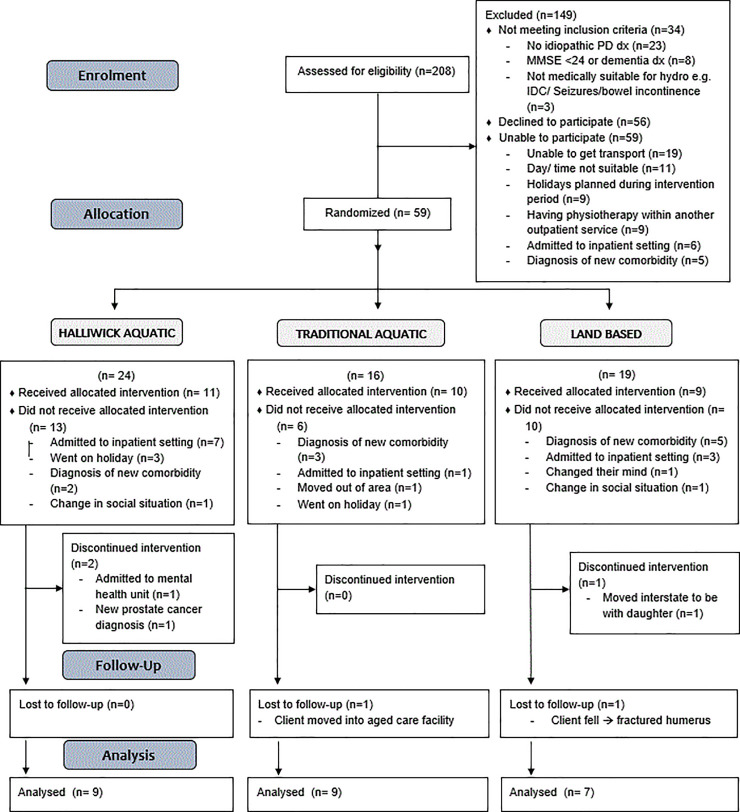
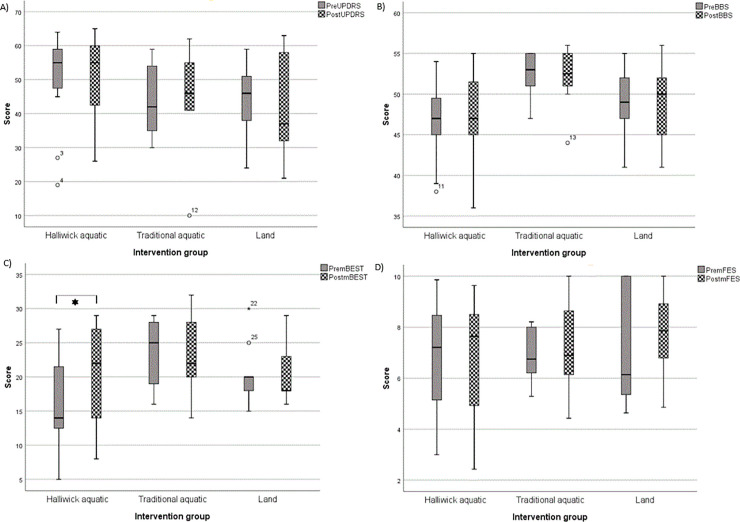
Results: 30 participants with moderate PD were recruited. Participant mean age was 72 years (SD 8.4; range 51-86) with moderate disease severity (median Hoehn & Yahr score 3; IQR 1).No falls occurred during intervention sessions, however ten participants reported falls during the study period. No other adverse consequences were reported. All groups had adherence over 85%. No within group significant differences were found in UPDRS-III, BBS or mFES scores post-intervention for all groups, but the Halliwick aquatic group improved significantly in the Mini BESTest post-intervention (p = 0.011, 95% CI -7.36,-1.31, t (10) = -2.98).
Conclusions: Despite people with PD being a vulnerable population, aquatic physiotherapy, including the Halliwick style is a safe treatment option. Promising results for balance in the Halliwick aquatic group were observed, but further studies with larger sample sizes is required to increase confidence in the results.
Conflict of interest statement
The authors have declared that no competing interests exist.
Figures
References
-
- Heisters D. Parkinson's: Symptoms, treatments and research. British journal of nursing (Mark Allen Publishing). 2011;20(9):548–54. - PubMed
Publication types
MeSH terms
LinkOut - more resources
Full Text Sources
Medical
Miscellaneous
