


Dual Targeting of Mesothelin and CD19 with Chimeric Antigen Receptor-Modified T Cells in Patients with Metastatic Pancreatic Cancer
- PMID: 32730744
- PMCID: PMC7647666
- DOI: 10.1016/j.ymthe.2020.07.017
Dual Targeting of Mesothelin and CD19 with Chimeric Antigen Receptor-Modified T Cells in Patients with Metastatic Pancreatic Cancer
Abstract
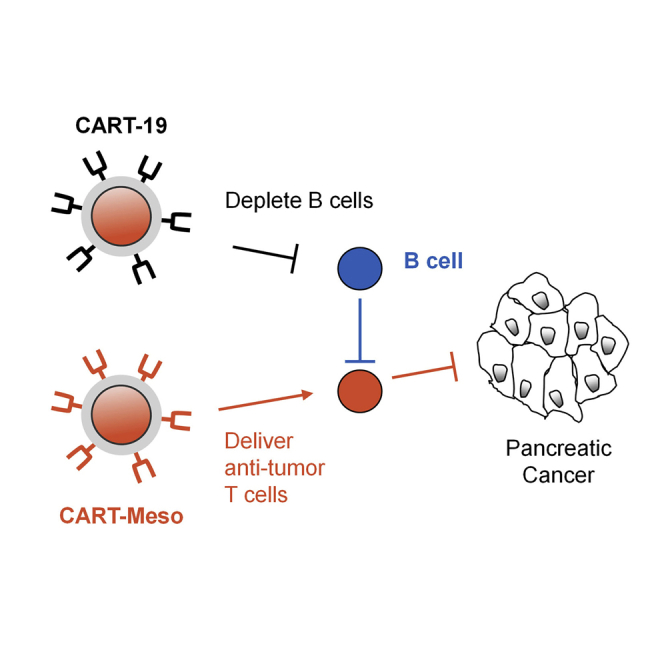
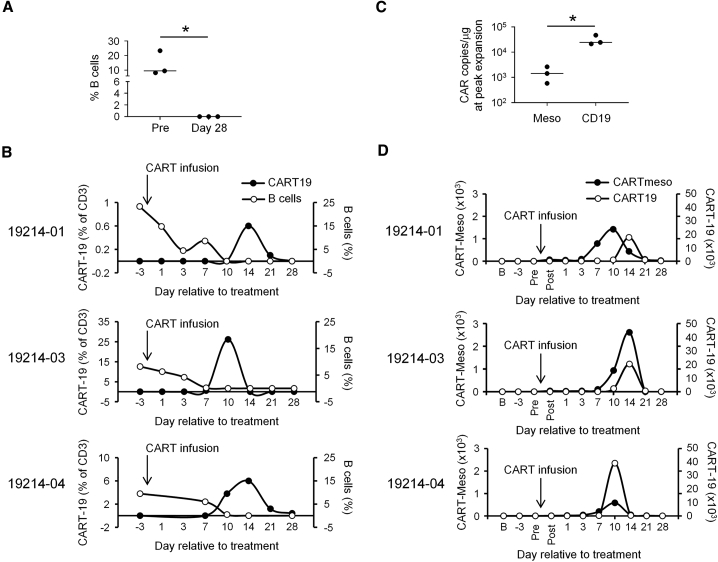
B cells infiltrate pancreatic ductal adenocarcinoma (PDAC) and in preclinical cancer models, can suppress T cell immunosurveillance in cancer. Here, we conducted a pilot study to assess the safety and feasibility of administering lentiviral-transduced chimeric antigen receptor (CAR)-modified autologous T cells redirected against mesothelin to target tumor cells along with CART cells redirected against CD19 to deplete B cells. Both CARs contained 4-1BB and CD3ζ signaling domains. Three patients with chemotherapy-refractory PDAC received 1.5 g/m2 cyclophosphamide prior to separate infusions of lentiviral-transduced T cells engineered to express chimeric anti-mesothelin immunoreceptor SS1 (CART-Meso, 3 × 10⁷/m2) and chimeric anti-CD19 immunoreceptor (CART-19, 3 × 10⁷/m2). Treatment was well tolerated without dose-limiting toxicities. Best response was stable disease (1 of 3 patients). CART-19 (compared to CART-Meso) cells showed the greatest expansion in the blood, although persistence was transient. B cells were successfully depleted in all subjects, became undetectable by 7-10 days post-infusion, and remained undetectable for at least 28 days. Together, concomitant delivery of CART-Meso and CART-19 cells in patients with PDAC is safe. CART-19 cells deplete normal B cells but at the dose tested in these 3 subjects did not improve CART-Meso cell persistence.
Keywords: B cells; CD19; chimeric antigen receptor; mesothelin; pancreatic cancer.
Copyright © 2020 The American Society of Gene and Cell Therapy. Published by Elsevier Inc. All rights reserved.
Figures
References
-
- Beatty G.L., Eghbali S., Kim R. Deploying Immunotherapy in Pancreatic Cancer: Defining Mechanisms of Response and Resistance. Am. Soc. Clin. Oncol. Educ. Book. 2017;37:267–278. - PubMed
-
- Beatty G.L., O’Hara M.H., Lacey S.F., Torigian D.A., Nazimuddin F., Chen F., Kulikovskaya I.M., Soulen M.C., McGarvey M., Nelson A.M. Activity of Mesothelin-Specific Chimeric Antigen Receptor T Cells Against Pancreatic Carcinoma Metastases in a Phase 1 Trial. Gastroenterology. 2018;155:29–32. - PMC - PubMed
-
- Haas A.R., Tanyi J.L., O’Hara M.H., Gladney W.L., Lacey S.F., Torigian D.A., Soulen M.C., Tian L., McGarvey M., Nelson A.M. Phase I Study of Lentiviral-Transduced Chimeric Antigen Receptor-Modified T Cells Recognizing Mesothelin in Advanced Solid Cancers. Mol. Ther. 2019;27:1919–1929. - PMC - PubMed
Publication types
MeSH terms
Substances
Grants and funding
LinkOut - more resources
Full Text Sources
Medical
Research Materials
