. 2020 Jul 28;10(8):125.
doi: 10.3390/life10080125.

The Messy Alkaline Formose Reaction and Its Link to Metabolism

Affiliations

The Messy Alkaline Formose Reaction and Its Link to Metabolism

Arthur Omran et al. Life (Basel). .

Abstract

Sugars are essential for the formation of genetic elements such as RNA and as an energy/food source. Thus, the formose reaction, which autocatalytically generates a multitude of sugars from formaldehyde, has been viewed as a potentially important prebiotic source of biomolecules at the origins of life. When analyzing our formose solutions we find that many of the chemical species are simple carboxylic acids, including α-hydroxy acids, associated with metabolism. In this work we posit that the study of the formose reaction, under alkaline conditions and moderate hydrothermal temperatures, should not be solely focused on sugars for genetic materials, but should focus on the origins of metabolism (via metabolic molecules) as well.

Keywords: Cannizzaro reaction; RNA world; chemical evolution; formaldehyde; formose reaction; metabolism; metabolism first; proto-metabolism; sugars.


Conflict of interest statement

The authors declare no conflict of interest.

Figures
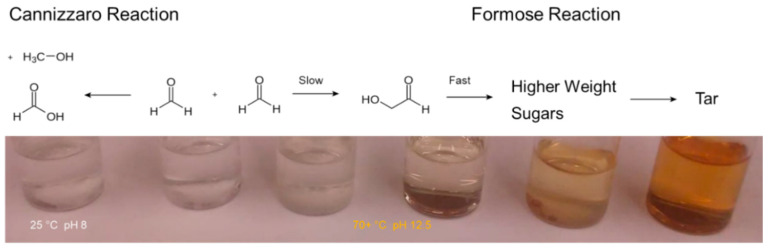
Figure 1
Figure 1
A classical view of the formose reaction. When heated under alkaline conditions formaldehyde solutions turn yellow in color. This yellowing is due to the production of sugars and their subsequent polymerization and dehydration into chromophoric species. The Cannizzaro reaction, which occurs concurrently, does not produce a color change.
Figure 2
Figure 2
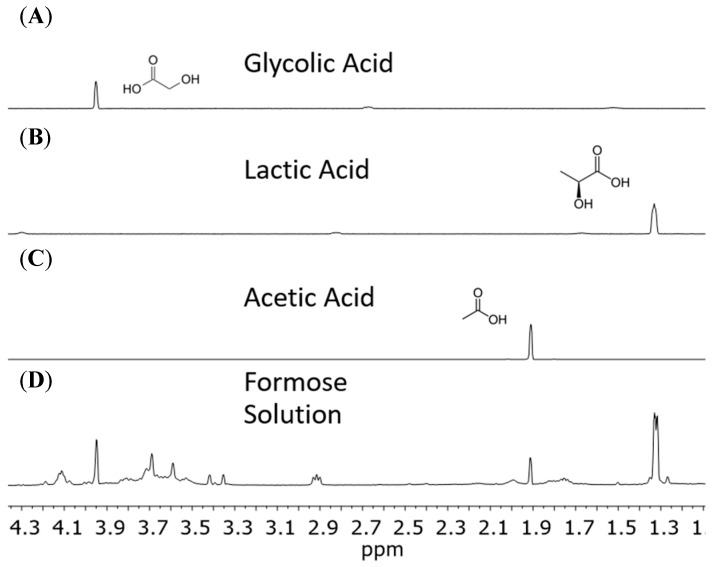
Standards of carboxylic acids compared to a formose solution using proton NMR. Standards are at 10 mM in a pH 7.5 solution with DSS and D2O. Spectra (AC) represent standard glycolic acid, lactic acid, and acetic acid, respectively. The magnified spectrum (D) represents a formose reaction run at pH 12.5 and 120 °C catalyzed using Ca2+. Formose solution was titrated with HCl down to a pH of 7.5 after autoclaving and cooling down to room temperature.
Figure 3
Figure 3
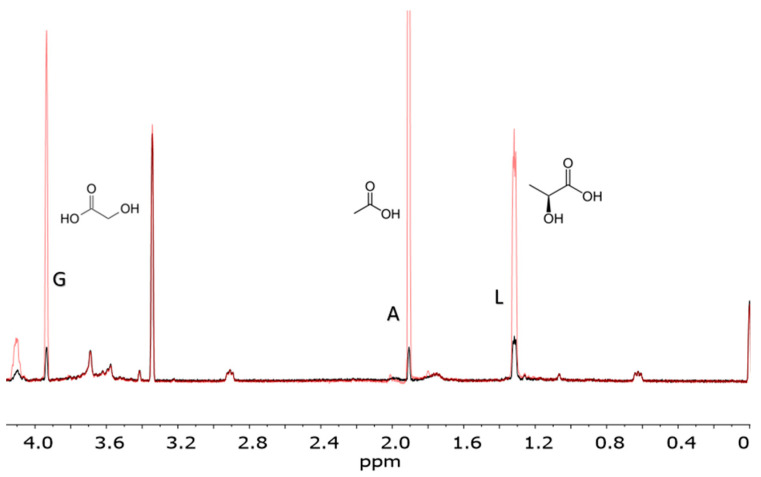
Carboxylic acids spiked into a formose solution. The red spectral lines represent the spiked-in set, and include added lactic acid, glycolic acid, and acetic acid to a formose solution. The black spectral lines represent the formose products with no additional carboxylic acids spiked-in. Spectra were measured from a formose reaction run at pH 12.5 and 120 °C catalyzed using Ca2+.The abbreviations G, A, and L stand for glycolic acid, acetic acid, and lactic acid, respectively. This reaction was performed at pH 12.5, 120 °C, the product solution was cooled and titrated to pH 7.5 before NMR analysis.
Figure 4
Figure 4
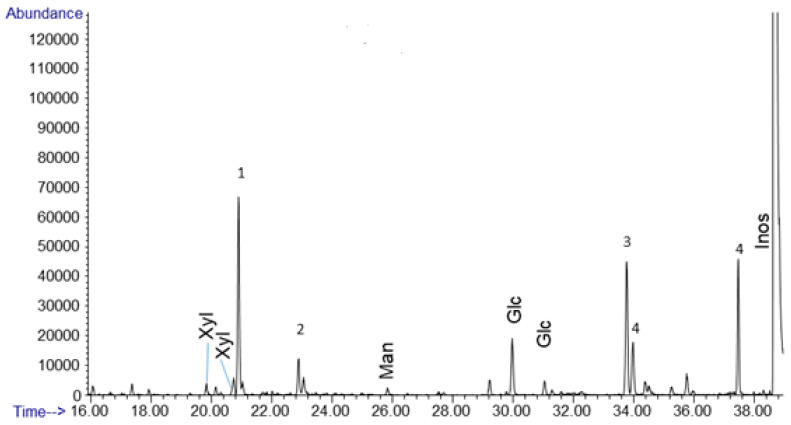
Gas chromatogram for an uncatalyzed formose reaction. 1 M formaldehyde w/0.5 M methanol at pH 12.5 heated at 80 °C for 1 h. Glc, Man, and Xyl, represent glucose, mannose, and xylose, respectively. Peaks labeled 1 and 2 are organic acids coeluting with xylose, likely including saccharinic acids. Peak 3 is sorbitol and peak 4 is myo-inositol, these were formed from the inositol standard, not the formose reaction.
Figure 5
Figure 5
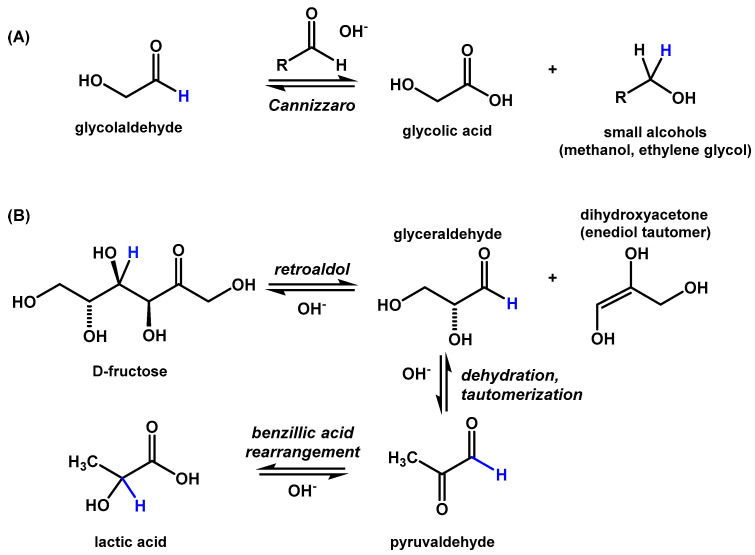
Reaction scheme for the formation of glycolic and lactic acids. (A) Glycolaldehyde is transformed into glycolic acid by a base-catalyzed Cannizzaro reaction with an additional small aldehyde, for example, formaldehyde or a second equivalent of glycolaldehyde. (B) Fructose is transformed into lactic acid by a retroaldol reaction followed by a benzillic acid rearrangement.

References

    1. Butlerow A. Ueber einige Derivate des Jodmethylens. Ann. Chem. Pharm. 1859;111:242–252. doi: 10.1002/jlac.18591110219. - DOI
    1. Hofmaann A.W. Untersuchung Über das Hämatoidin. Ber. Dtsch. Chem. Ges. 1867;8:665–669.
    1. Hofmann A.W. HERSTELLUNG VON FORMALDEHYD. Ber. Dtsch. Chem. Ges. 1869;2:152–159. doi: 10.1002/cber.18690020175. - DOI
    1. Butlerow A. Bildung einer zuckerartigen Substanz durch Synthese. Justus Liebigs Ann. Chem. 1861;120:295–298. doi: 10.1002/jlac.18611200308. - DOI
    1. Loew O. Über Bildung von Zuckerarten aus Formaldehyd. Ber. Dtsch. Chem. Ges. 1889;22:470–478. doi: 10.1002/cber.188902201107. - DOI

LinkOut - more resources