Review
. 2020 Jul 28;11(8):859.
doi: 10.3390/genes11080859.

A Reappraisal of the Evolutionary and Developmental Pathway of Apomixis and Its Genetic Control in Angiosperms

Affiliations
Review

A Reappraisal of the Evolutionary and Developmental Pathway of Apomixis and Its Genetic Control in Angiosperms

Gianni Barcaccia et al. Genes (Basel). .

Abstract

Apomixis sensu stricto (agamospermy) is asexual reproduction by seed. In angiosperms it represents an easy byway of life cycle renewal through gamete-like cells that give rise to maternal embryos without ploidy reduction (meiosis) and ploidy restitution (syngamy). The origin of apomixis still represents an unsolved problem, as it may be either evolved from sex or the other way around. This review deals with a reappraisal of the origin of apomixis in order to deepen knowledge on such asexual mode of reproduction which seems mainly lacking in the most basal angiosperm orders (i.e., Amborellales, Nymphaeales and Austrobaileyales, also known as ANA-grade), while it clearly occurs in different forms and variants in many unrelated families of monocots and eudicots. Overall findings strengthen the hypothesis that apomixis as a whole may have evolved multiple times in angiosperm evolution following different developmental pathways deviating to different extents from sexuality. Recent developments on the genetic control of apomixis in model species are also presented and adequately discussed in order to shed additional light on the antagonist theories of gain- and loss-of-function over sexuality.

Keywords: agamospermy; apomixis evolution; basal angiosperms (ANA-grade); polycomb-group proteins; reproductive systems; sporocyteless.


Conflict of interest statement

The authors declare no conflict of interest.

Figures
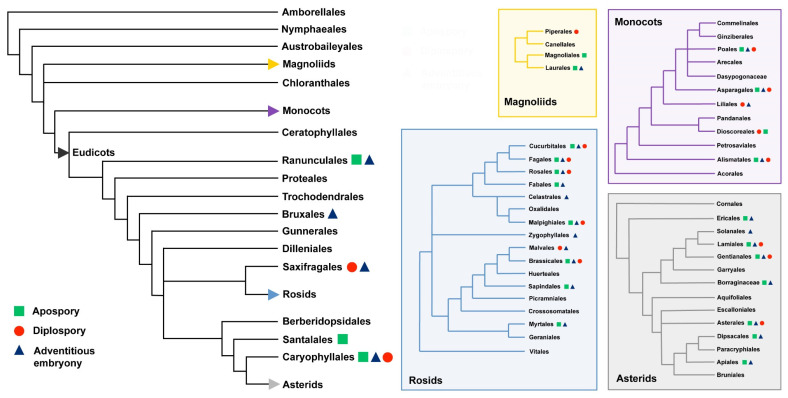
Figure 1
Figure 1
Distribution of the main types of apomixis (i.e., apospory, diplospory and adventitious embryony) among the main clades, orders and families of flowering plants. Detailed information for subclusters belonging to Magnoliids, Monocots, Rosids and Asterids are reported in the coloured boxes. Experimental evidences on apomictic pathways for taxonomic units are derived from [10,29] while phylogenetic trees are modified from [30].
Figure 2
Figure 2
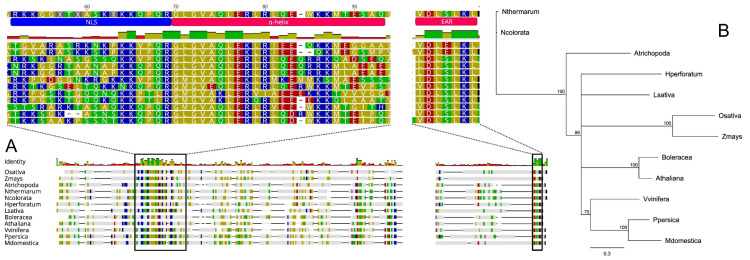
Bioinformatic analysis of the SPL/NZZ gene homologs in plant species representing the two major groups of angiosperms, monocotyledons and dicotyledons, including different basal angiosperm lineages belonging to the families Amborellaceae and Nymphaeaceae. (A) MUSCLE-based amino acid alignment of 11 putative SPL/NOZZLE sequences retrieved from Zea mays (KY110964.1), Oryza sativa (LOC_Os01g11430.1), Hypericum perforatum (apomictic species, OBUPD-D1 Hpctg51499), Brassica oleracea (Bol013057), Malus domestica (MD11G1234600), Prunus persica (Prupe.4G192500.1), Vitis vinifera (VIT_219s0014g03940.1), Lactuca sativa (Lsat_1_v5_gn_0_5400), Amborella trichopoda (XP_006833114.1), Nymphaea colorata (XP031473161.1), Nymphaea thermarum (KAF3782288.1), putative orthologues of SPL protein of Arabidopsis thaliana (AT4G27330). On the top of the panel the three main functional domains that resulted conserved among the 12 proteins are highlighted. NLS is a basic region rich in Arginine (R) and Lysine (K) that is thought to represent a putative nuclear localization signal; the α-helix sequence (also known as SPL-motif) is crucial for the constitution of homodimers and heterodimers, binding and inhibiting CINCINNATA (CIN)-like TEOSINTE BRANCHED1/CYCLOIDEA/PCF (TCP) transcription factors (TF); the EAR motif in the C-terminal region recruits TOPLESS/TOPLESS-RELATED (TPL/TPR) proteins to co-suppress the activity of the CIN-like TCP family. (B) Similarity-based neighbor-joining analysis performed using the 12 amino acid sequences with bootstrap values supporting all major nodes.

References

    1. Hand M.L., Koltunow A.M.G. The genetic control of apomixis: Asexual seed formation. Genetics. 2014;197:441–450. doi: 10.1534/genetics.114.163105. - DOI - PMC - PubMed
    1. Bernstein H., Bernstein C. Evolutionary Origin and Adaptive Function of Meiosis. In: Bernstein C., editor. Meiosis. InTechOpen; Rijeka, Croatia: 2013. pp. 41–76.
    1. Bernstein H., Bernstein C., Michod R.E. Sex in microbial pathogens. Infect. Genet. Evol. 2018;57:8–25. doi: 10.1016/j.meegid.2017.10.024. - DOI - PubMed
    1. Cavalier-Smith T. Origin of the cell nucleus, mitosis and sex: Roles of intracellular coevolution. Biol. Direct. 2010;5:1–78. doi: 10.1186/1745-6150-5-7. - DOI - PMC - PubMed
    1. Hanson S.J., Schurko A.M., Hecox-Lea B., Mark Welch D.B., Stelzer C.P., Logsdon J.M. Inventory and phylogenetic analysis of meiotic genes in monogonont rotifers. J. Hered. 2013;104:357–370. doi: 10.1093/jhered/est011. - DOI - PMC - PubMed

MeSH terms

LinkOut - more resources