


Impact of Acuity Circles on Outcomes for Pediatric Liver Transplant Candidates
- PMID: 32732840
- PMCID: PMC7319877
- DOI: 10.1097/TP.0000000000003079
Impact of Acuity Circles on Outcomes for Pediatric Liver Transplant Candidates
Abstract
Background: In December 2018, United Network for Organ Sharing approved an allocation scheme based on recipients' geographic distance from a deceased donor (acuity circles [ACs]). Previous analyses suggested that ACs would reduce waitlist mortality overall, but their impact on pediatric subgroups was not considered.
Methods: We applied Scientific Registry of Transplant Recipients data from 2011 to 2016 toward the Liver Simulated Allocation Model to compare outcomes by age and illness severity for the United Network for Organ Sharing-approved AC and the existing donor service area-/region-based allocation schemes. Means from each allocation scheme were compared using matched-pairs t tests.
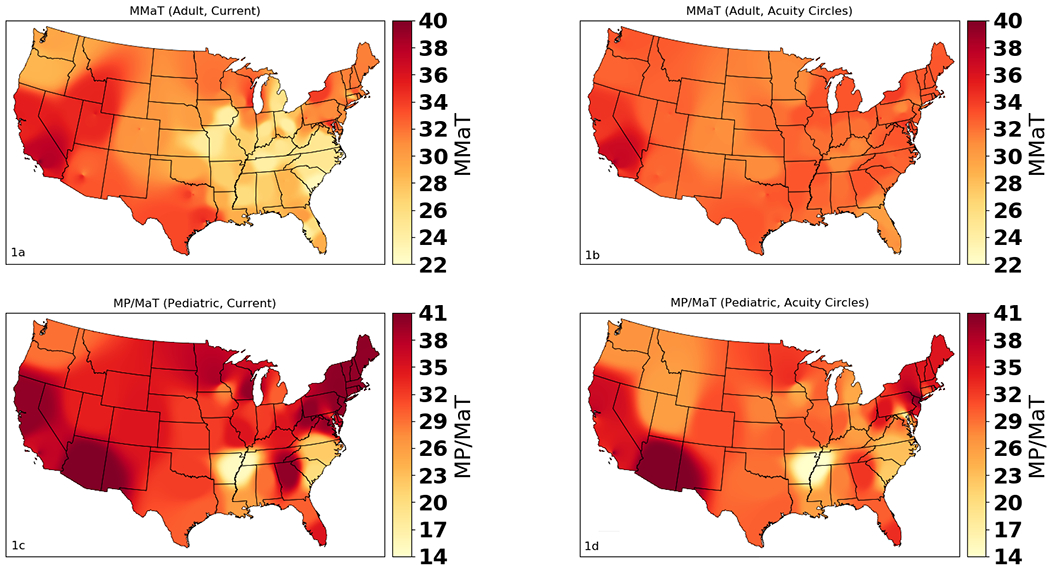
Results: During a 3-year period, AC allocation is projected to decrease waitlist deaths in infants (39 versus 55; P < 0.001), children (32 versus 50; P < 0.001), and teenagers (15 versus 25; P < 0.001). AC allocation would increase the number of transplants in infants (707 versus 560; P < 0.001), children (677 versus 547; P < 0.001), and teenagers (404 versus 248; P < 0.001). AC allocation led to decreased median pediatric end-stage liver disease/model for end-stage liver disease at transplant for infants (29 versus 30; P = 0.01), children (26 versus 29; P < 0.001), and teenagers (26 versus 31; P < 0.001). Additionally, AC allocation would lead to fewer transplants in status 1B in children (97 versus 103; P = 0.006) but not infants or teenagers. With AC allocation, 77% of pediatric donor organs would be allocated to pediatric candidates, compared to only 46% in donor service area-/region-based allocation (P < 0.001).
Conclusions: AC allocation will likely address disparities for pediatric liver transplant candidates and recipients by increasing transplants and decreasing waitlist mortality. It is more consistent with federally mandated requirements for organ allocation.
Figures
References
-
- National Organ Transplant Act. Pub L No. 98–507, 98 STAT. 2339. 1984. Available at https://www.govinfo.gov/content/pkg/STATUTE-98/pdf/STATUTE-98-Pg2339.pdf Accessed July 3, 2019.
-
- Institute of Medicine, Committee on Organ Procurement and Transplantation Policy, Division of Health Sciences Policy. Organ Procurement and Transplantation: Assessing Current Policies and the Potential Impact of the DHHS Final Rule. Washington DC: National Academies Press; 1999. 10.17226/9628. - DOI - PubMed
Publication types
MeSH terms
Grants and funding
LinkOut - more resources
Full Text Sources
Medical
