Review
. 2020 Jul 8:14:716.
doi: 10.3389/fnins.2020.00716. eCollection 2020.

Systems Biology Approaches to Understand the Host-Microbiome Interactions in Neurodegenerative Diseases

Affiliations
Review

Systems Biology Approaches to Understand the Host-Microbiome Interactions in Neurodegenerative Diseases

Dorines Rosario et al. Front Neurosci. .

Abstract

Neurodegenerative diseases (NDDs) comprise a broad range of progressive neurological disorders with multifactorial etiology contributing to disease pathophysiology. Evidence of the microbiome involvement in the gut-brain axis urges the interest in understanding metabolic interactions between the microbiota and host physiology in NDDs. Systems Biology offers a holistic integrative approach to study the interplay between the different biologic systems as part of a whole, and may elucidate the host-microbiome interactions in NDDs. We reviewed direct and indirect pathways through which the microbiota can modulate the bidirectional communication of the gut-brain axis, and explored the evidence of microbial dysbiosis in Alzheimer's and Parkinson's diseases. As the gut microbiota being strongly affected by diet, the potential approaches to targeting the human microbiota through diet for the stimulation of neuroprotective microbial-metabolites secretion were described. We explored the potential of Genome-scale metabolic models (GEMs) to infer microbe-microbe and host-microbe interactions and to identify the microbiome contribution to disease development or prevention. Finally, a systemic approach based on GEMs and 'omics integration, that would allow the design of sustainable personalized anti-inflammatory diets in NDDs prevention, through the modulation of gut microbiota was described.

Keywords: Alzheimer’s disease; Parkinson’s disease; biologic network; biomarker discovery; dietary therapy; microbiota-gut-brain axis; neurodegenerative diseases; systems biology.


Figures

FIGURE 1
FIGURE 1
Neurodegenerative diseases (NDDs) are a broad range of complex neurological disorders, however, presenting shared hallmarks. The pathophysiology of NDDs comprises multifactorial etiologies, where genetic, environmental, and behavioral factors contribute with causal roles. Even though being distinctly manifested (e.g., compromised cognition in Alzheimer’s disease or motor functions in Parkinson’s disease), at the molecular level, there are many shared perturbed mechanisms comprising hallmarks of NDDs, which in turn leads to several potential target approaches for earlier diagnosis and effective therapeutics from a personalized medicine perspective.
FIGURE 2
FIGURE 2
Chronic neuroinflammation associated with disease-specific immune responses is a hallmark of Neurodegenerative diseases (NDDs). Thus, triggers of redox state imbalance and mechanisms promoting a proinflammatory brain response have been the target of therapeutic approaches. (A) An individual’s microbiota composition is strongly influenced by life style factors and personal clinical history. At the gut level, the intestinal microbiota plays an essential role in the modulation of the bidirectional gut-brain axis, through immune, endocrine and neurochemical direct and indirect pathways. There is evidence of symbiotic and dysbiotic gut microbiota assuming a preventive or promoter role in development and progression of NDDs, respectively. (B) Exacerbated neuroinflammation, due to chronic oxidative stress accompanied by dysregulated inflammatory response, is a Hallmark of NDDs. Increased levels of ROS and RNS stimulates the secretion of proinflammatory molecules (e.g., cytokines and chemokines), which in turn leads to microglia and astrocytes activation. Under these neuro-proinflammatory response, peripheral myeloid cells are recruited to the central nervous system (CNS), which intensifies microglia and astrocyte activation. Such a cascade of mechanisms is capable of perpetuating the proinflammatory response in the brain microenvironment, consequently loosing neuroinflammation regulation in NDDs. There are several mechanisms being studied that promote proinflammatory response, such as mitochondrial dysfunctions, aggregation of neurotoxic plaques, which can be stimulated by the invasion of microorganisms and respective fragments to the CNS, as well as by certain microbial metabolites with brain damaging profile. (C) Perturbation of the redox balance state and immune landscape healthy-state of the CNS of specific brain regions underlies disease-specific signatures of the neuroinflammatory microenvironment, which have been targeted in attempted therapeutic approaches. There is a list of studied neuroactive-microbial molecules improving brain function and cognition. These neuroprotective metabolites are microbially metabolized and secreted upon the ingestion of prebiotics. Thus, evidencing the potential of a dietary-based intervention as a complementary therapeutic in NDDs. Moreover, administration of probiotics in order to modulation microbiota has been revealed to be promising due to the role of intestinal microbiota in the bidirectional interactions between the gut and the CNS, as seen through the consumption of Bifidobacterium breve strain A1 by AD mice, which demonstrated a preventive role in cognitive dysfunction.
FIGURE 3
FIGURE 3
Endocrine, immune, metabolic and vagal direct and indirect pathways for bidirectional communication of the gut-brain axis. Changes in the bacterial abundances and development of gut dysfunctional state (dysbiosis) impacts host and Central Nervous System (CNS) functions, often associated to disease. Consequently, there is a shift in microbial-derived products. Short-chain fatty acids (SCFAs), derived from the microbial digestion of dietary fiber, play a crucial role in the regulation of microglia and brain immune responses. The production of SCFAs, neuroprotective biochemicals essential to host metabolism, is compromised under a state of intestinal dysbiosis, which impacts the CNS function. Increased levels of Trimethylamine N-oxide (TMAO), a gut microbial-mediated metabolite, has been linked to aging and cognitive impairment. The microbial metabolism of tryptophan, leading to the production of, for instance, the neurotransmitter serotonin, is also compromised under dysbiotic states. On the other hand, stress at the CNS level can impact intestinal function and promote gut microbial perturbations. Thus, the CNS is capable of recruiting the same mechanisms to modulate the gut microbial composition, such as by the stimulus of cortisol secretion. Cortisol can have an influence on immune cells recruitment and cytokines secretion, as well as on the epithelial barrier permeability. Compromised integrity of the gut epithelial barrier allows the translocation of overgrowth pathobionts and neurotoxic microbial fragments, such as lipopolysaccharides (LPS), which can later reach and cross a compromised blood-brain barrier. The microbes and their secreted metabolites shape the host-immune system and vice-versa. A dysbiotic intestinal microbiota can hijack the host-immune system and modulate the inflammasome signaling. Note: figure was adopted from references (Grenham et al., 2011; Cryan and Dinan, 2012).
FIGURE 4
FIGURE 4
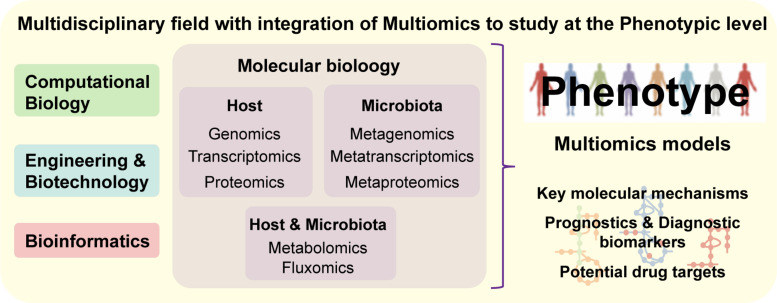
Systems Biology is a multidisciplinary field combining experts from distinct scientific areas and integrating multiomics data, in order to understand complex systems at the phenotypic level. Based on experimental-derived knowledge, systems medicine allows the analysis of molecular mechanisms underlying complex networks representative of biological systems, which makes it an approach with great potential for identification of diagnostic biomarkers and/or drug targets.
FIGURE 5
FIGURE 5
A proper understanding of NDDs complexity requires a holistic approach, since it is challenging to identify key cellular and molecular mechanisms that culminate in such phenotypes. (A) Systems biology approaches aim to understand biological interactions occurring within different biologic entities by utilizing mathematical models and network biology representing existing connections between cells and/or tissues. Integrating the data into biological networks, allow to understand interactions between signaling and regulatory pathways occur within the system. (B) Reaction-associated enzymes and encoded genes are represented in GEMs (Orth et al., 2010; Zhang and Hua, 2015) with stoichiometric (mass and energy) balance, which enables flux balance analysis (FBA), the study of systemic metabolic responses and analysis of the flow of metabolites through the network (Orth et al., 2010; Mardinoglu and Nielsen, 2012; Zhang and Hua, 2015). Essentiality analysis (EA), based on FBA, works at a single level and allows the identification of essential genes and reactions, the knockout or inhibition of which would interrupt a vital biological function. Complementary, synthetic lethality analysis (SLA) can identify combinations of genes or reactions that when simultaneously knocked out or inhibited can disrupt an essential biological function (Zhang and Hua, 2015).

References

    1. Aarsland D., Creese B., Politis M., Chaudhuri K. R., Ffytche D. H., Weintraub D., et al. (2017). Cognitive decline in Parkinson disease. Nat. Rev. Neurol. 13 217–231. 10.1038/nrneurol.2017.27 - DOI - PMC - PubMed
    1. Agren R., Liu L., Shoaie S., Vongsangnak W., Nookaew I., Nielsen J. (2013). The RAVEN toolbox and its use for generating a genome-scale metabolic model for Penicillium chrysogenum. PLoS Comput. Biol. 9:e1002980. 10.1371/journal.pcbi.1002980 - DOI - PMC - PubMed
    1. Agusti A., García-Pardo M. P., López-Almela I., Campillo I., Maes M., Romaní-Pérez M., et al. (2018). Interplay between the gut-brain axis. Obesity and cognitive function. Front. Neurosci. 12:155. 10.3389/fnins.2018.00155 - DOI - PMC - PubMed
    1. Anand R., Gill K. D., Mahdi A. A. (2014). Therapeutics of Alzheimer’s disease: past, present and future. Neuropharmacology 76(Pt A), 27–50. 10.1016/j.neuropharm.2013.07.004 - DOI - PubMed
    1. Arnold S. E., Arvanitakis Z., Macauley-Rambach S. L., Koenig A. M., Wang H.-Y., Ahima R. S., et al. (2018). Brain insulin resistance in type 2 diabetes and Alzheimer disease: concepts and conundrums. Nat. Rev. Neurol. 14 168–181. 10.1038/nrneurol.2017.185 - DOI - PMC - PubMed