. 2020 Jul 7:11:1512.
doi: 10.3389/fmicb.2020.01512. eCollection 2020.

Validation of Droplet Digital Polymerase Chain Reaction for Salmonella spp. Quantification

Affiliations

Validation of Droplet Digital Polymerase Chain Reaction for Salmonella spp. Quantification

Carolina Villamil et al. Front Microbiol. .

Abstract

Salmonellosis is a foodborne disease caused by Salmonella spp. Although cell culture is the gold standard for its identification, validated molecular methods are becoming an alternative, because of their rapidity, selectivity, and specificity. A simplex and duplex droplet digital polymerase chain reaction (ddPCR)-based method for the identification and quantification of Salmonella using ttr, invA, hilA, spaQ, and siiA gene sequences was validated. The method has high specificity, working interval between 8 and 8,000 cp/μL in ddPCR reaction, a limit of detection of 0.5 copies/μL, and precision ranging between 5 and 10% measured as a repeatability standard deviation. The relative standard measurement uncertainty was between 2 and 12%. This tool will improve food safety in national consumption products and will increase the competitiveness in agricultural product trade.

Keywords: Salmonella; bioanalysis; droplet digital PCR; food safety; validation.


Figures

FIGURE 1
FIGURE 1
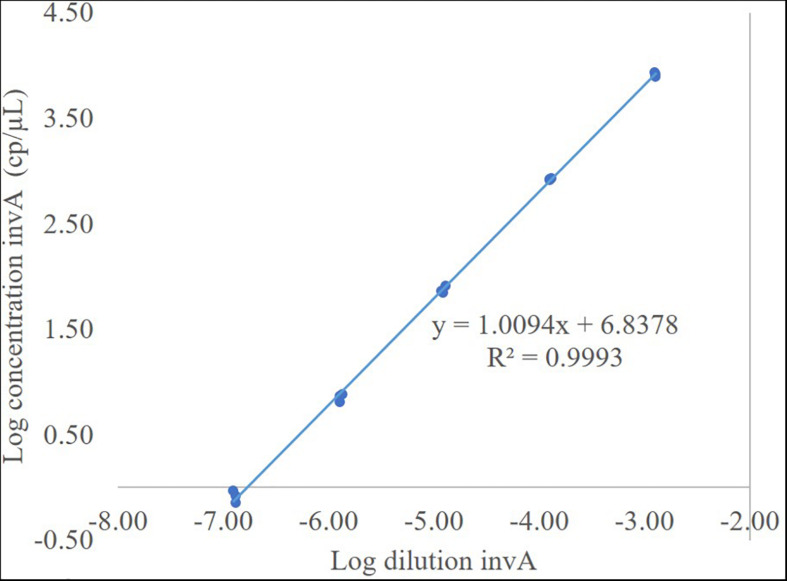
The working interval for invA. Total DNA gravimetric dilution in Log scale vs. DNA concentration (cp/μL) in Log scale.
FIGURE 2
FIGURE 2
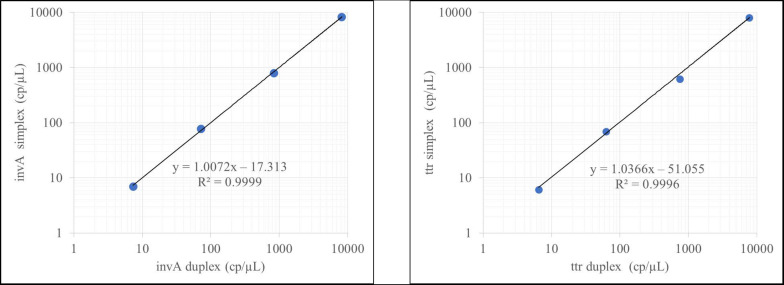
Duplex evaluation for the invA-ttr assay.
FIGURE 3
FIGURE 3
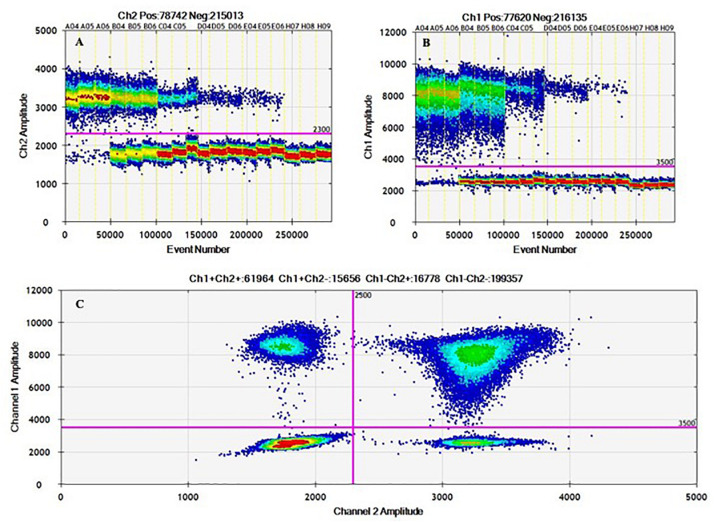
1D and 2D ddPCR heat maps from working interval evaluation for duplex mode using hila – siiA targets. Evaluation of the working interval for hilA (A) and siiA (B) in the 1D plot (droplets vs. fluorescence amplitude), and 2D plot (channel one fluorescence (FAM) vs. channel two fluorescence (HEX) for each droplet; (C).
FIGURE 4
FIGURE 4
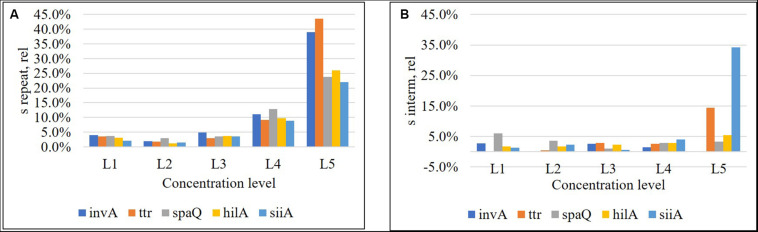
Relative repeatability standard deviation (A) and relative intermediate standard deviation (B) of the method for each target sequence. Concentration levels were, L1: 8,000 cp/μL, L2: 800 cp/μL, L3: 80 cp/μL, L4: 8 cp/μL, and L5: 1 cp/μL.
FIGURE 5
FIGURE 5
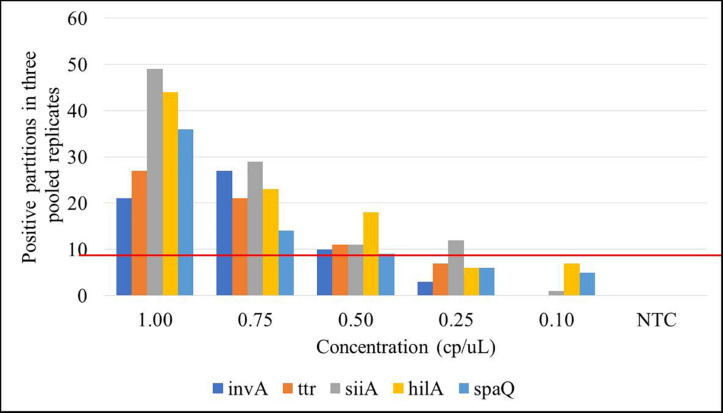
Limit of detection (LOD) for the targets under study. Each bar represents the positive partitions over the three pooled replicates within the 5 concentration levels (L1: 8,000 cp/μL, L2: 800 cp/μL, L3: 80 cp/μL, L4: 8 cp/μL, and L5: 1 cp/μL) compared to the no template control (NTC). Red line represents the selected threshold: nine positive partitions.
FIGURE 6
FIGURE 6
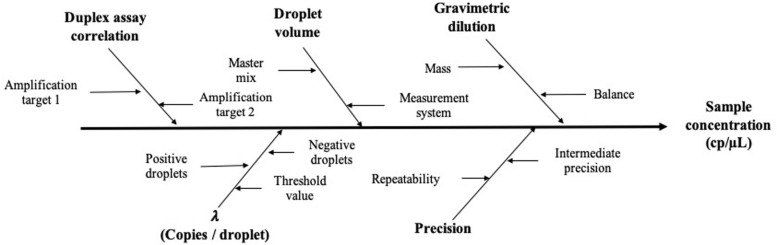
Schematic representation of the main factors affecting the measurement value and its uncertainty.
FIGURE 7
FIGURE 7
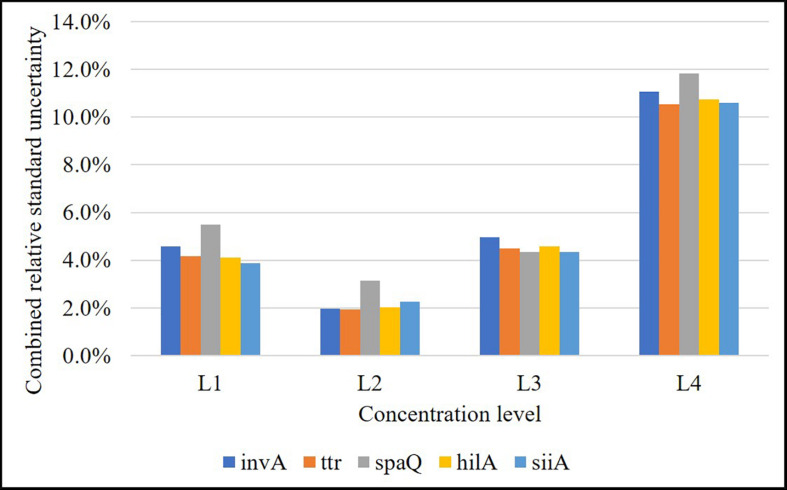
Relative combined uncertainty for each target in each concentration level over the working range (L1: 8,000 cp/μL, L2: 800 cp/μL, L3: 80 cp/μL, and L4: 8 cp/μL in reaction). Level 2 is the one with the lowest uncertainty (approximately 2%).
FIGURE 8
FIGURE 8
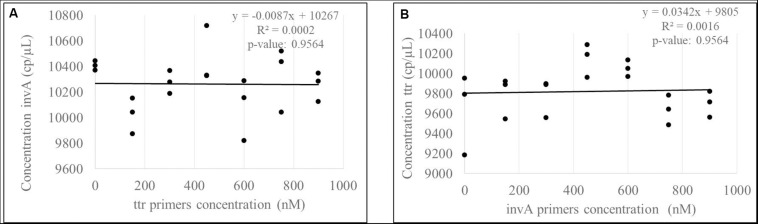
Evaluation of correlation between invA (A) -ttr (B) multiplex amplification. According to p-values, there are not a significant correlation between targets.
FIGURE 9
FIGURE 9
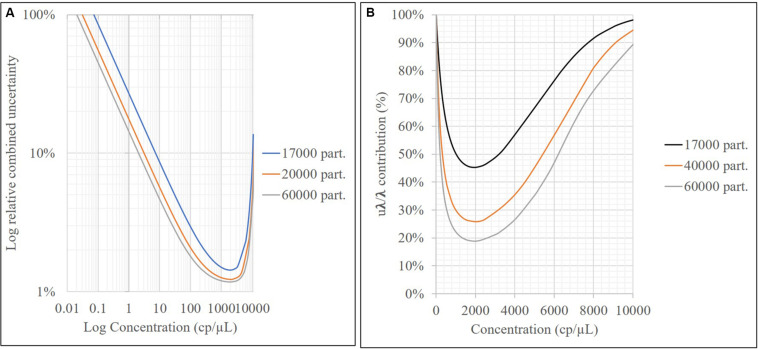
Relative uncertainty associated with the model (A) and contribution of uλ/λ to mathematical model uncertainty vs. the sample concentration (cp/μL) for different partition numbers (B).

References

    1. Atashpaz S., Khani S., Barzegari A., Barar J., Vahed S. Z., Azarbaijani R., et al. (2010). A robust universal method for extraction of genomic DNA from bacterial species. Microbiology 79 538–542. 10.1134/S0026261710040168 - DOI - PubMed
    1. Ben Hassena A., Barkallah M., Fendri I., Grosset N., Ben Neila I., Gautier M., et al. (2015). Real time PCR gene profiling and detection of Salmonella using a novel target: the siiA gene. J. Microbiol. Methods 109 9–15. 10.1016/j.mimet.2014.11.018 - DOI - PubMed
    1. BioRad (2018). Droplet Digital PCR Applications Guide. Available online at: http://www.bio-rad.com/webroot/web/pdf/lsr/literature/Bulletin_6407.pdf (accessed April 18, 2020).
    1. Boddicker J. D., Knosp B. M., Jones B. D. (2003). Transcription of the Salmonella invasion gene activator, hilA, requires HilD activation in the absence of negative regulators. J. Bacteriol. 185 525–533. 10.1128/JB.185.2.525 - DOI - PMC - PubMed
    1. Boer M. D., de Boer R. F., Lameijer A., Sterne E., Skidmore B., Suijkerbuijk A. W. M., et al. (2019). Selenite enrichment broth to improve the sensitivity in molecular diagnostics of Salmonella. J. Microbiol. Methods 157 59–64. 10.1016/j.mimet.2018.12.018 - DOI - PubMed

LinkOut - more resources