


Redefining Medication Management in Dialysis: A Kidney Pharmacy Quality Pyramid
- PMID: 32734211
- PMCID: PMC7380411
- DOI: 10.1016/j.xkme.2019.06.008
Redefining Medication Management in Dialysis: A Kidney Pharmacy Quality Pyramid
Abstract
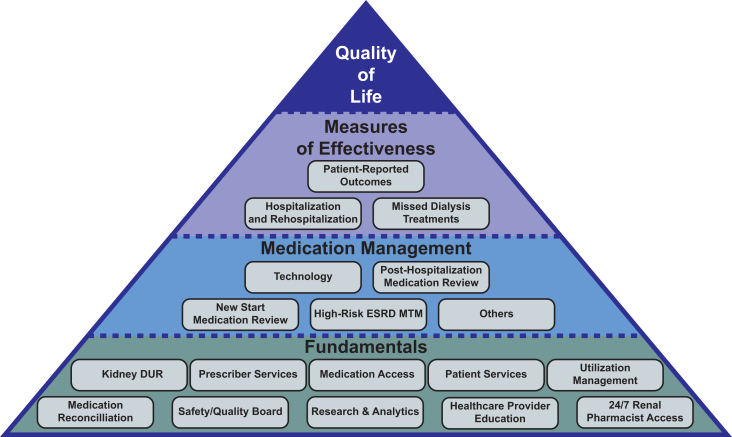
Patients with end-stage renal disease treated with dialysis are often prescribed complex medication regimens, placing them at risk for drug-drug interactions and other medication-related problems. Particularly in the context of a broader interest in more patient-centered value-based care, improving medication management is an increasingly important focus area. However, current medication management metrics, designed for the broader patient population, may not be well suited to the specific needs of patients with kidney disease, especially given the complexity of medication regimens used by dialysis patients. We propose a kidney pharmacy-focused quality pyramid that is intended to provide a framework to guide dialysis organizations, health care providers, and/or clinicians with respect to an optimal medication management approach for dialysis patients. Incorporation of core programs in medication management, including medication reconciliation, safety programs, and medication therapy management for patients at high risk for medication-related problems, may result in improved outcomes. Although a growing body of evidence supports the concept that active medication management can improve medication adherence and reduce medication-related problems, these strategies are viewed as costly and are not widely deployed. However, if done effectively, pharmacy-led medication management has the potential to be one of the more cost-effective disease management strategies and may greatly improve outcomes for these complex patients.
Keywords: end-stage renal disease; medication management; pharmacy.
© 2019 The Authors.
Figures
References
-
- Alexa, How Much Is This Going to Hurt? Calibrating Amazon's Entry Into Healthcare. 2017. https://www.zerohedge.com/news/2017-11-20/alexa-going-hurt-these-compani...
-
- El Morabet N., Uitvlugt E.B., van den Bemt B.J.F., van den Bemt P., Janssen M.J.A., Karapinar-Carkit F. Prevalence and preventability of drug-related hospital readmissions: a systematic review. J Am Geriatr Soc. 2018;66(3):602–608. - PubMed
-
- National Pharmaceutical Council Noncompliance with medications: an economic tragedy with important implications for health care reform. 1994. http://www.npcnow.org/publication/noncompliance-medications-economic-tra...
-
- Network for Excellence in Health Initiative. Thinking Outside the Pillbox: A System-wide Approach to Improving Patient Medication Adherence for Chronic Disease. New England Healthcare Initiative; 2009. https://www.nehi.net/publications/17-thinking-outside-the-pillbox-asyste...
-
- DiMatteo M.R., Giordani P.J., Lepper H.S., Croghan T.W. Patient adherence and medical treatment outcomes: a meta-analysis. Med Care. 2002;40(9):794–811. - PubMed
Publication types
LinkOut - more resources
Full Text Sources
