


Getting better without memory
- PMID: 32734306
- PMCID: PMC8216303
- DOI: 10.1093/scan/nsaa105
Getting better without memory
Abstract
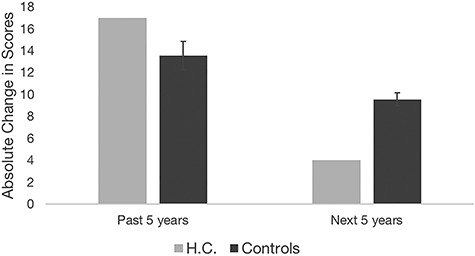
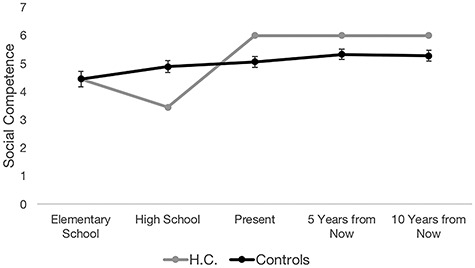
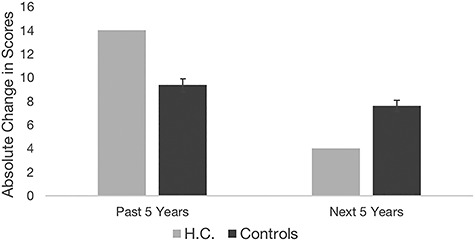
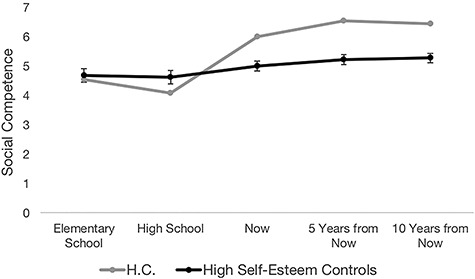
Does the tendency to adjust appraisals of ourselves in the past and future in order to maintain a favourable view of ourselves in the present require episodic memory? A developmental amnesic person with impaired episodic memory (HC) was compared with two groups of age-matched controls on tasks assessing the Big Five personality traits and social competence in relation to the past, present and future. Consistent with previous research, controls believed that their personality had changed more in the past 5 years than it will change in the next 5 years (i.e. the end-of-history illusion), and rated their present and future selves as more socially competent than their past selves (i.e. social improvement illusion), although this was moderated by self-esteem. Despite her lifelong episodic memory impairment, HC also showed these biases of temporal self-appraisal. Together, these findings do not support the theory that the temporal extension of the self-concept requires the ability to recollect richly detailed memories of the self in the past and future.
Keywords: case study; developmental amnesia; end-of-history illusion; episodic memory; self-appraisal; social improvement illusion.
© The Author(s) 2020. Published by Oxford University Press. All rights reserved. For Permissions, please email: journals.permissions@oup.com.
Figures
References
-
- Addis, D.R., Tippett, L.J. (2008). The contributions of autobiographical memory to the content and continuity of identity: a social-cognitive neuroscience approach. In: Sani, F., editor. Self continuity: individual and collective perspectives, New York, NY: Psychology Press, pp. 71–84Chapter xv, 273 Pages.
-
- Arnould, A., Rochat, L., Azouvi, P., van der Linden, M. (2018). Self-appraisals and episodic memory: different psychological factors related to patient versus informant reports of apathy in severe traumatic brain injury. Journal of Clinical and Experimental Neuropsychology, 40(7), 650–62. 10.1080/13803395.2017.1411468. - DOI - PubMed
-
- Bates, D., Maechler, M., Bolker, B. (2012). lme4: Linear mixed-effects models using S4 classes (R Package) http://cran.r-project.org/web/packages/lme4/index.html
-
- Blumenthal, A., Duke, D., Bowles, B., et al. (2017). Abnormal semantic knowledge in a case of developmental amnesia. Neuropsychologia, 102, 237–47. - PubMed
Publication types
MeSH terms
LinkOut - more resources
Full Text Sources
Miscellaneous
